Our drive south through New Mexico has been delightful. We have met many nice people from NM. The scenery is spectacular and the temperatures are increasingly warmer by the day.
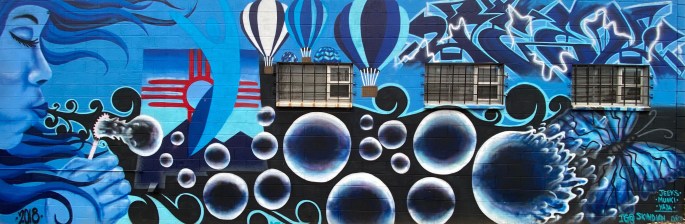
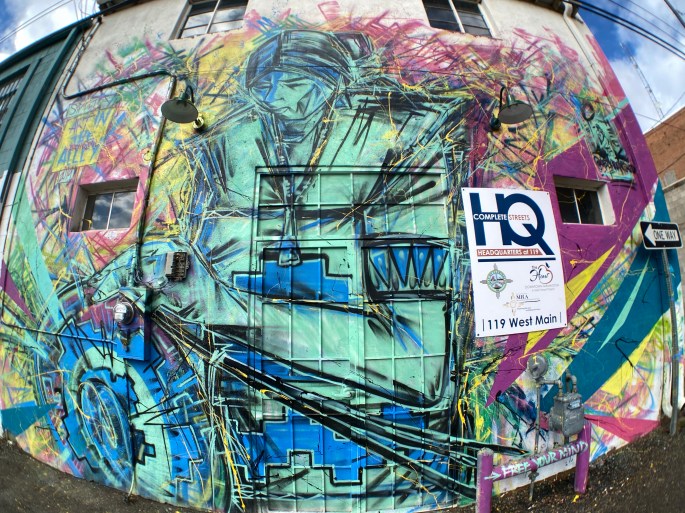
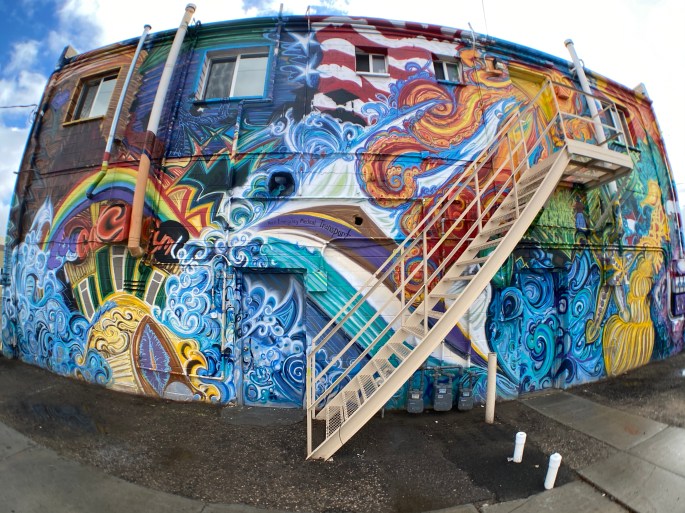
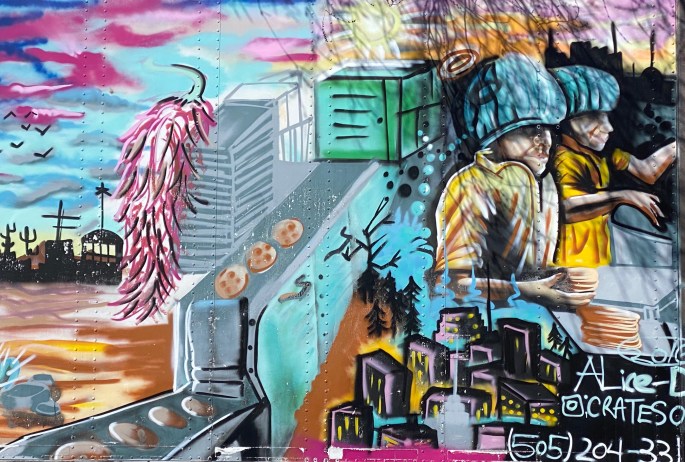
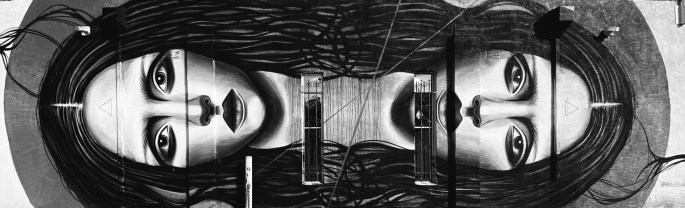
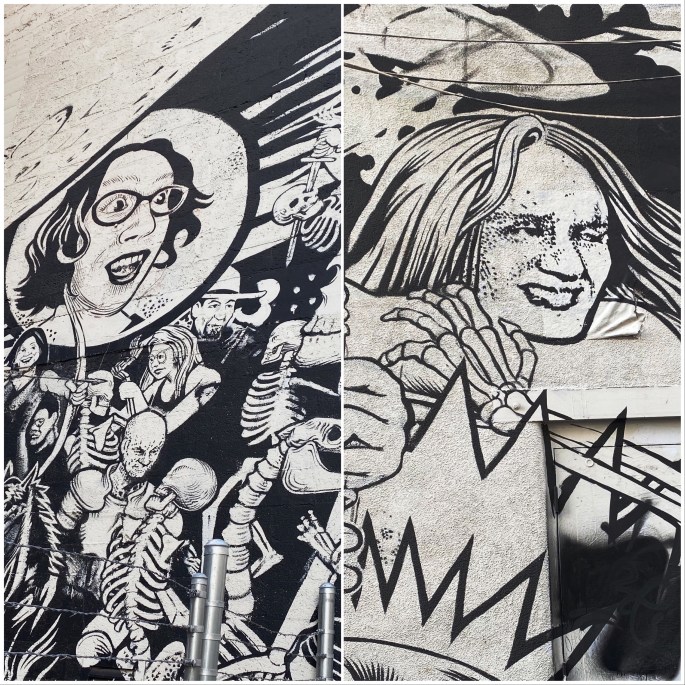
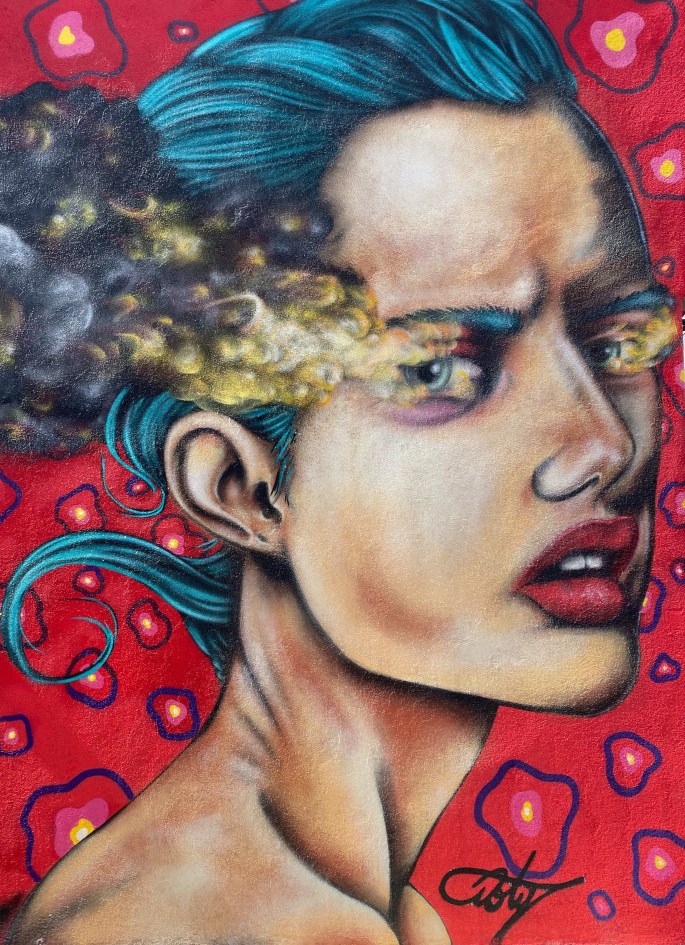
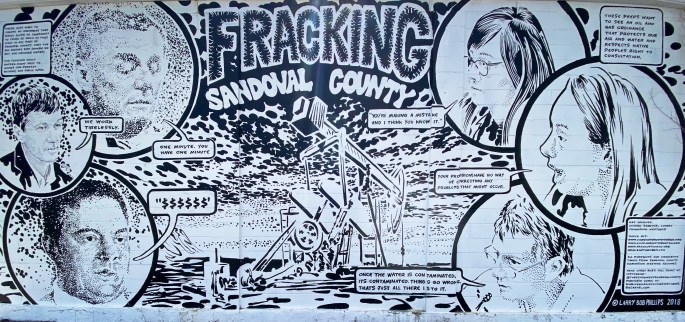
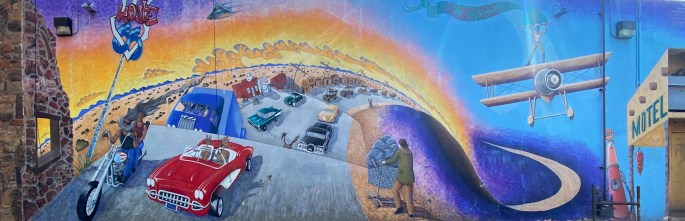
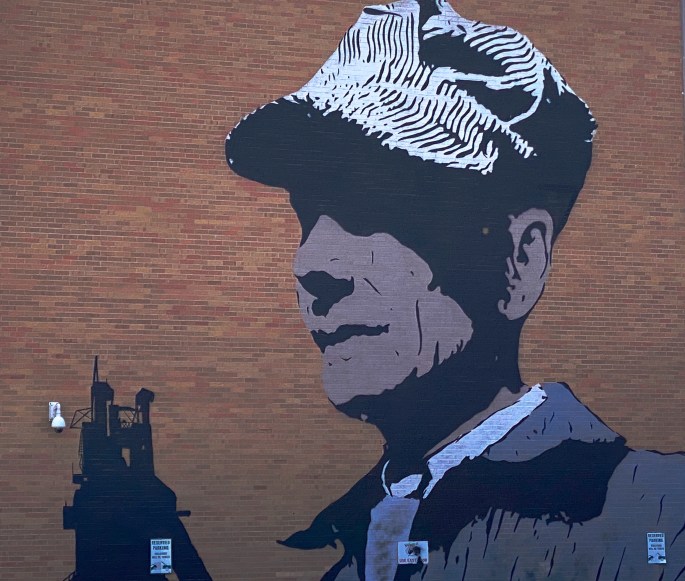
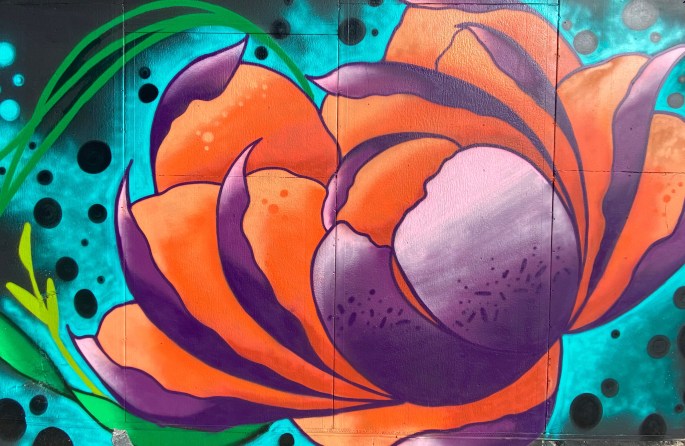
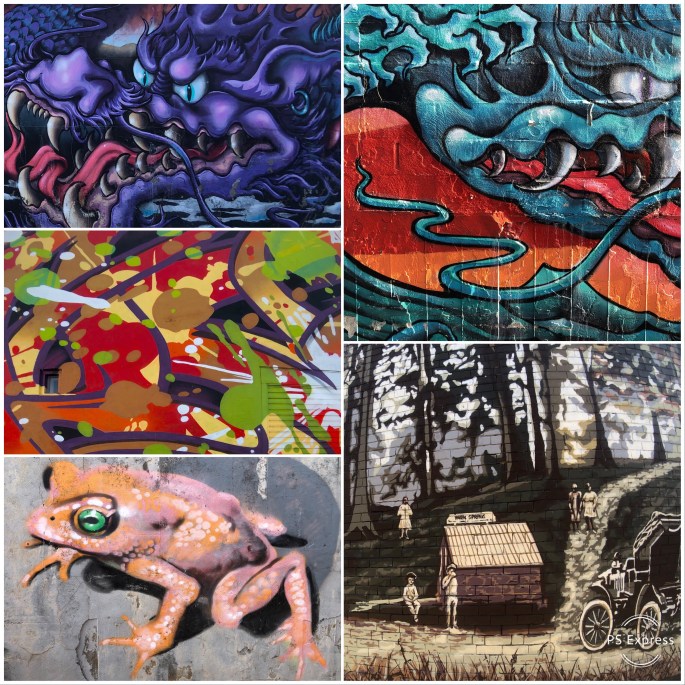
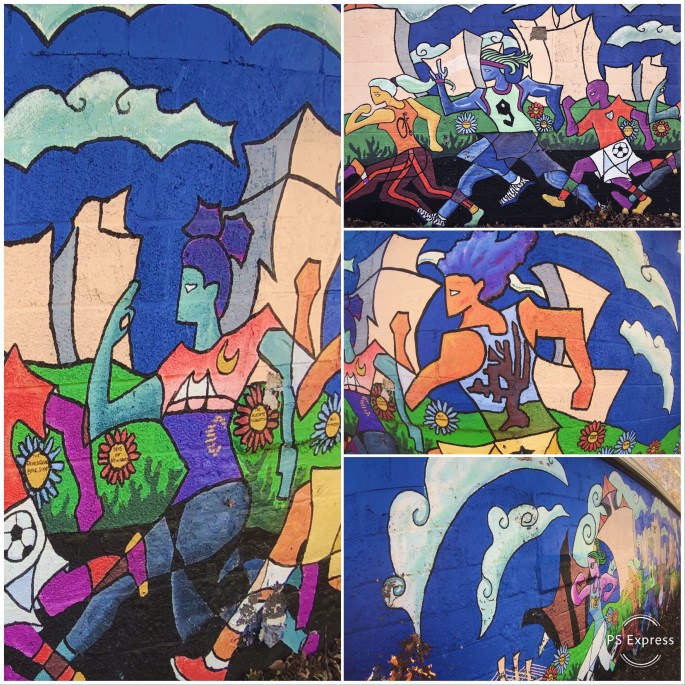
An added bounus on this trip to date has been the street mural scene. We have found excellent murals in every town (regardless of size) and a plethora of murals in the many distinct neighborhoods of ABQ. We could literally spend a month in ABQ and not find every one of the murals.
We have included a small sample of our favorites for your enjoyment. Wherever we have been able to identify the artist or organization we have noted that in the caption.
Be seeing you!
Farmington, NM
Heck Ironcloud
Skindian
Santa Fe, NM
Guernica
Albuquerque, NM
Echoes of the Future, Kevin Zuckerman, etal.
Untitled, Larry Bob PhilipsSilence, Compassion and Social Justice, Ernest DotyFracking, Larry Bob PhillipsUntitled, Kerry Bergen
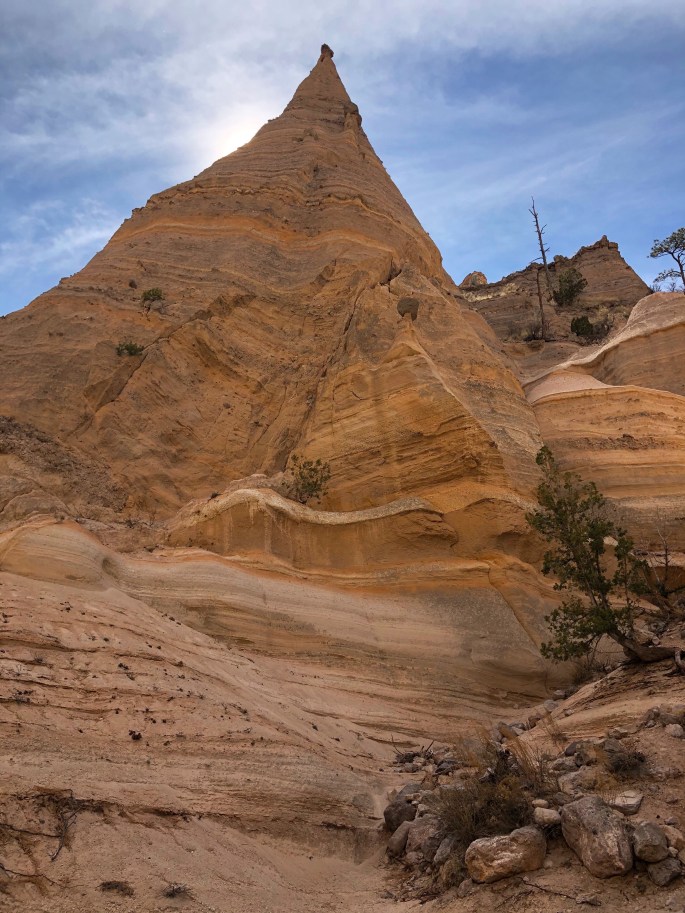
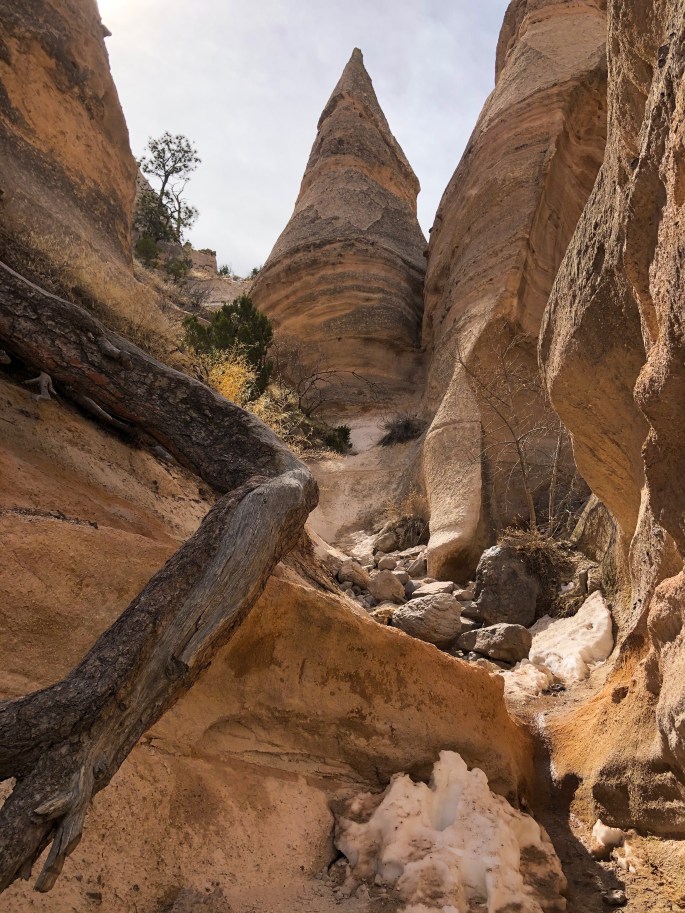
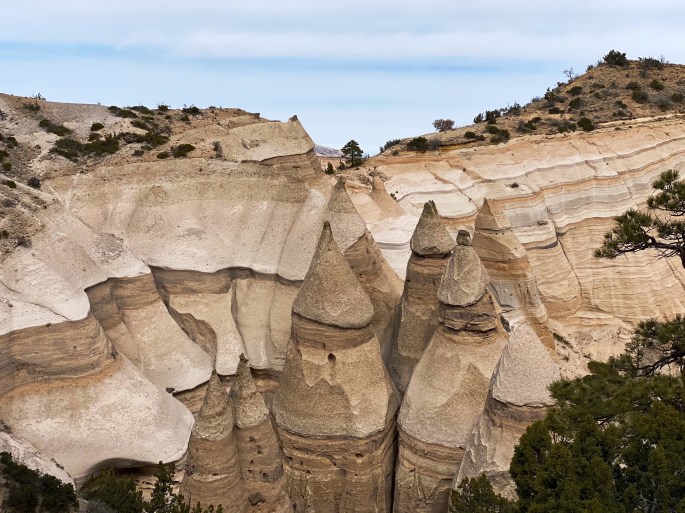
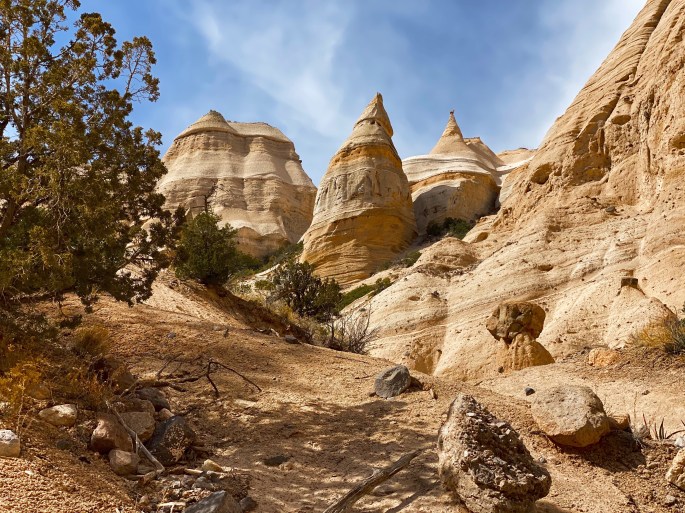
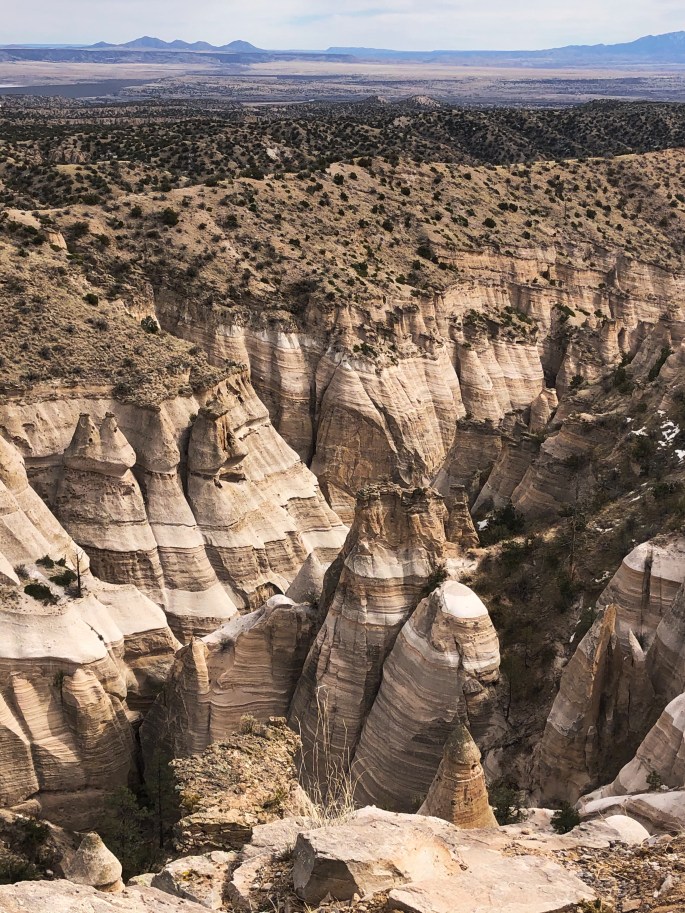
During our stay in Santa Fe we traveled south through the Cochiti Pueblo to hike at the KKTRNM. This monument is jointly managed by the Cochiti Pueblo and the Bureau of Land Management as the monument is only accessible by travel through the pueblo. The monument is a geologist’s delight as the Jemez volcanic eruptions left a thousand feet of tuff which has eroded into formations of caprock topped hoodos and tent rocks.
The hiking here features a short loop trail that provides fine views of a number of caprocks and several clusters of tent rocks. The real treat is the out and back slot canyon trail which winds its way up to a small table top at 6,760 feet elevation. The 360 view from the top is expansive and also provides a great birds eye view of several large formations of hoodos.
The Cochiti people are descendants of the Ancestral Puebloans (Anasazi). There are apx. 528 Cochiti remaining on the pueblo today. The total territory of the pueblo is just 1.2 square miles while the reservation manages about 54,000 acres of land.
The Cochiti were permanently displaced from their original lands by Spanish conquistadors in 1598. Subsequently, the Catholic Church followed the conquistadors and began to force the Cochiti to practice Catholicism. You know the rest of the story………
We definitely recommend spending time here if you are in either Santa Fe or Albuquerque. Our only caveat is that this monument is very crowded in the summer months due to very limnited parking at the trail heads. Also, this is a day area with no camping.
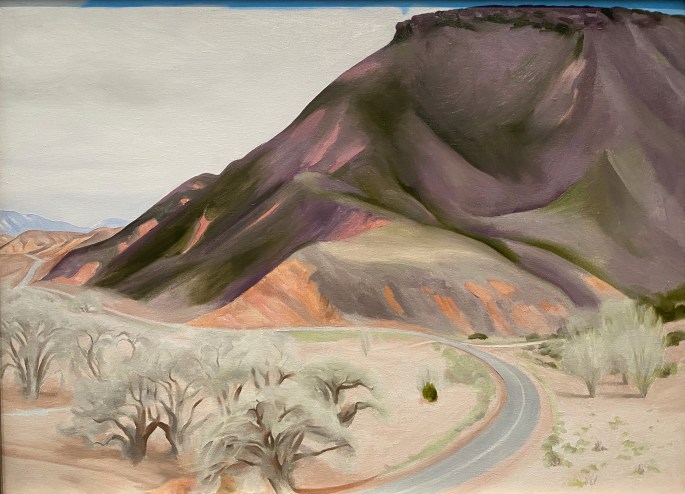
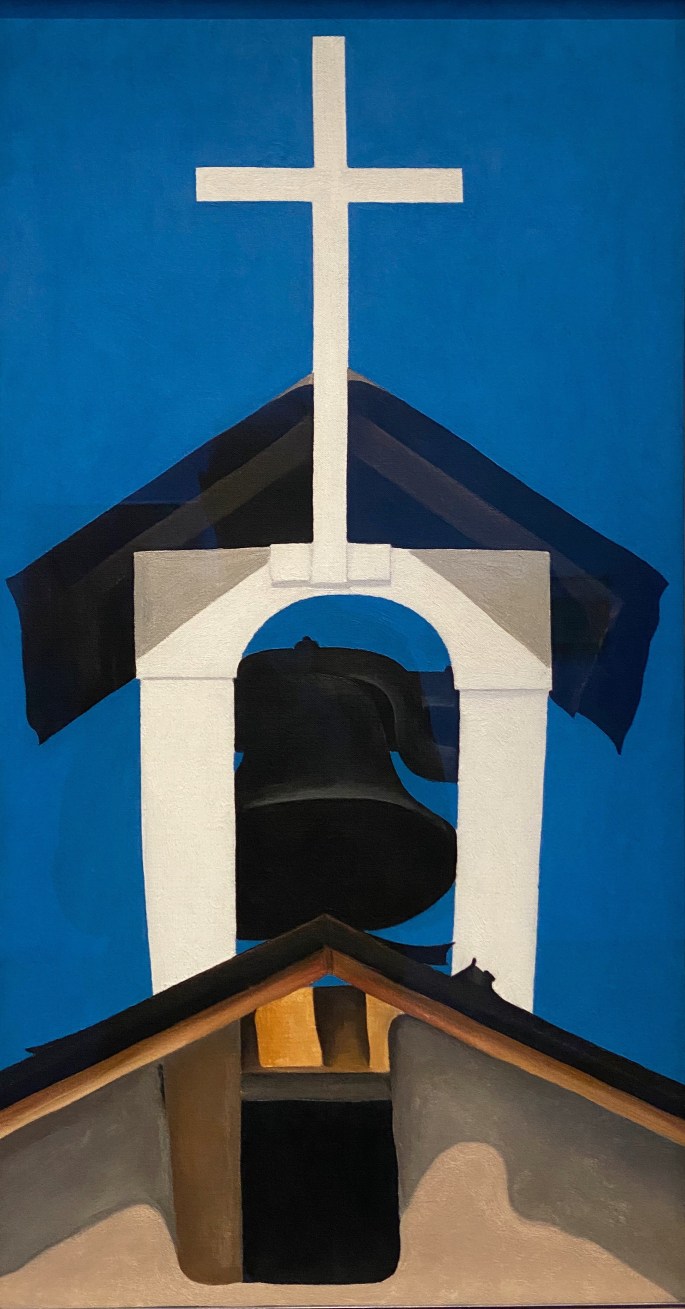
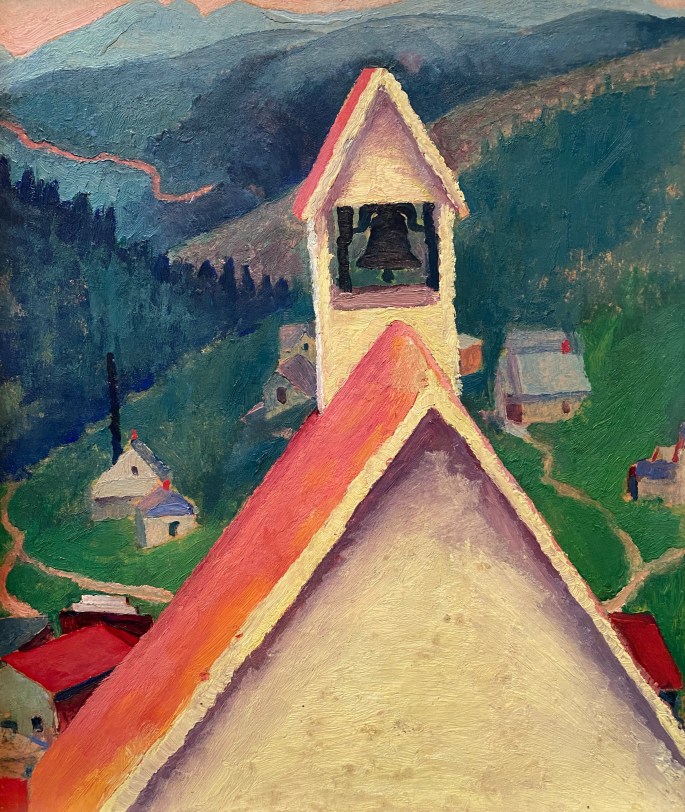
We are off the road for several days to explore Santa Fe, New Mexico. Our first stop (well second actually – fika at Iconik Roasters – we spent the afternoon basking in the brillance of the 300 or so works on display at the eponymous museum dedicated to her life and work.
Maria has long been an avid fan of her painting. Stephen on the other hand had not given her work serious attention – thinking her a painter of pastel colored flowers.
O’Keffee produced about 3000 works in her 60 year career. The museum owns 1100 of her works – phenomenally all but two were donated to the museum. The 300 paintings on display are grouped across eight galleries that relate to various phases of her life and creative focus.
O’Keffee split her time between New York and New Mexico for about thirty years. After her husband passed away she moved to New Mexico permanently although she traveled to South America and Japan several times.
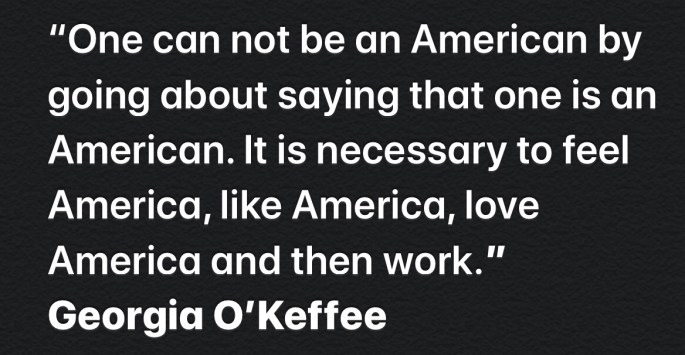
O’Keffee was initally critized by the male dominated artistic community for her use of bright colors. She loved color and refused to adopt the darker tones that the prominent artists of the time considered appropriate. Her strength as a woman and commitment to what and how she wanted to paint what she saw is evident through out the exhibits and the narrative of her life.
We have included a small sample of photographs of we took at the museum. The paintings featured below cover the period 1917-1958 and represent work from New Mexico and New York.
The Georgia O’Keffee is a must when you visit Santa Fe.
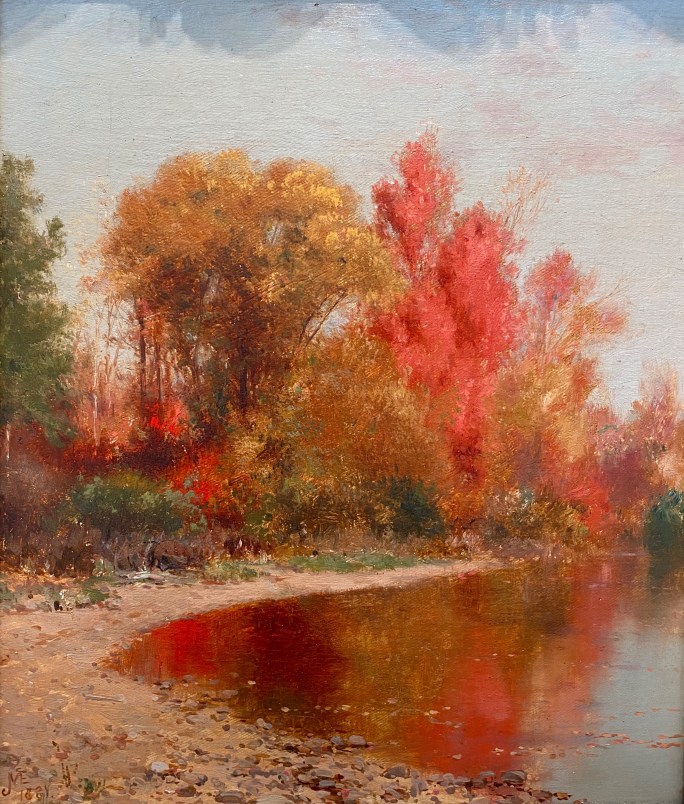
Mesa and Road East, 1952Ritz Tower, 1928Green and White, 1957-1958Church Steeple, 1930Autumn Trees – The Maple, 1924
As we mentioned in closing our last post we were planning on traveling south to spend two days exploring and camping at Chaco Culture National Historical Park near Nageezi, NM. Chaco Canyon was occupied as early as 900 B.C. and as an archaeological site is on par with the fantastic Mesa Verde cliff dwellings. Unfortunately, the storm that passed through northern New Mexico rendered the 25 mile dirt road into the park impassable.
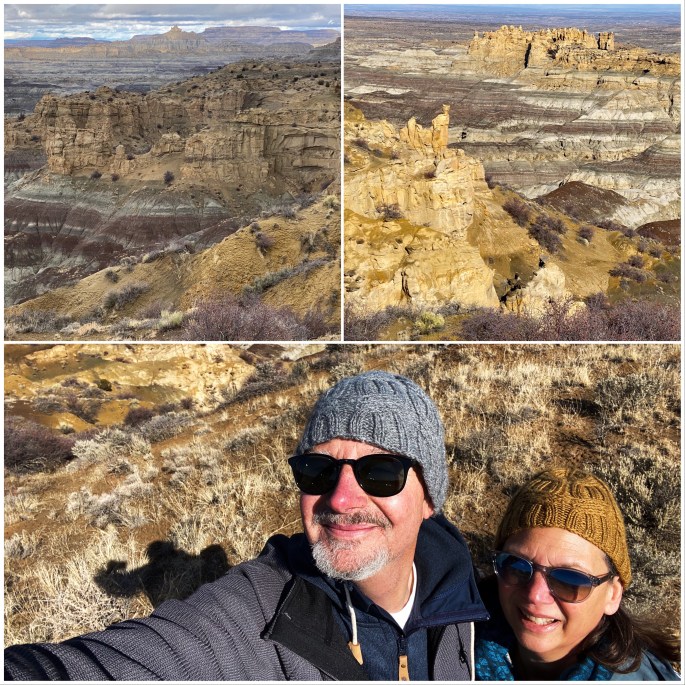
Not to worry! Northern New Mexico is rich with significant archaelogical sites. In fact, there are 19 ancestral locations which can be accessed in the Four Corners Region. So after a brief stopover in the badlands surrounding Angel Peak we set our sights on Bandelier National Monument.
The Angel Peak Recreation Area is managed by the BLM. It is a beautiful area of desolate badlands, occasionally marred by oil or fracking sites scattered through out the 10,000 acres. Angel Peak is still worth a visit.
We joined Route 96 to make the drive to Bandelier NP. Route 96 runs north then east skirting the northern boundary of the Santa Fe National Forest and parallels the Old Spanish National Historic Trail. This area is sparsely settled with only five settlements along the 60 miles -between Cuba and Abiquiu. The total population of all of the settlements is apx. 500 people.
Abiquiu is where artist Georgia O’Keefe did much of her painting while in New Mexico. We plan on visiting the Georgia O’Keefe Museum when we visit Santa Fe.
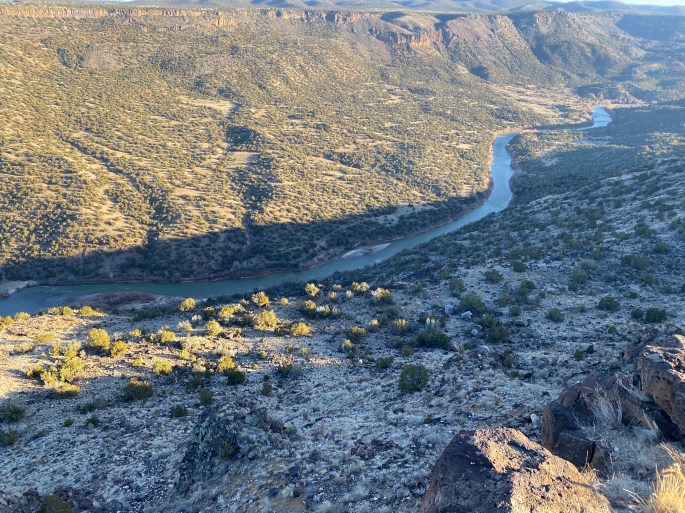
Badlands in Angel Peak Recreation AreaAngel Peak (elev. 6988 feet) Background Upper Left FrameSangre de Christo MountainsRio Chama from White Rock
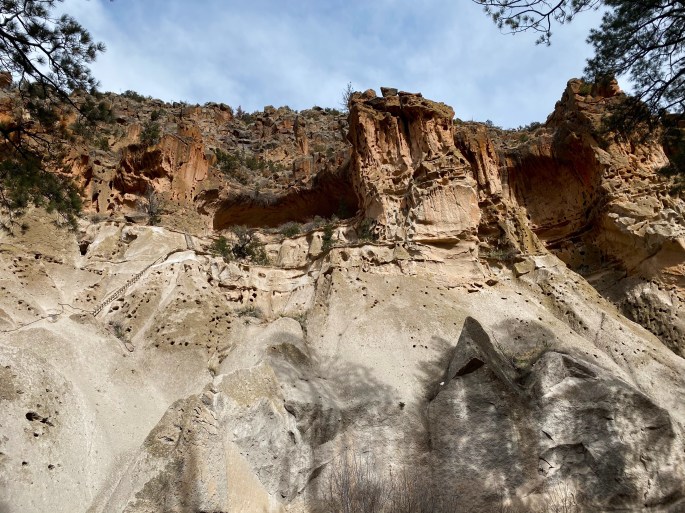
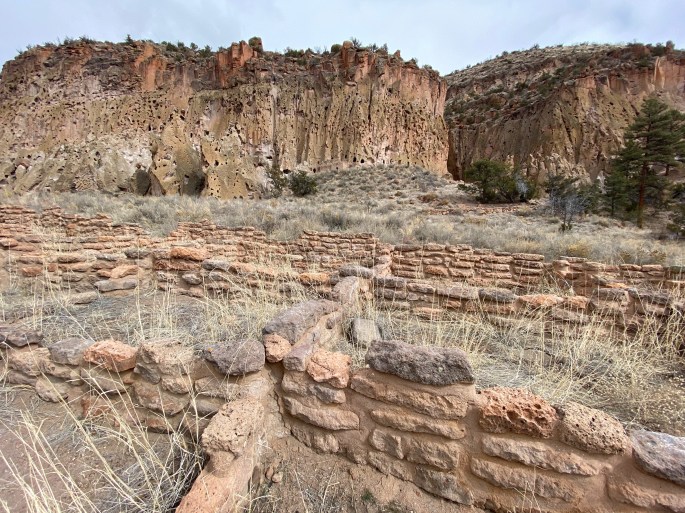
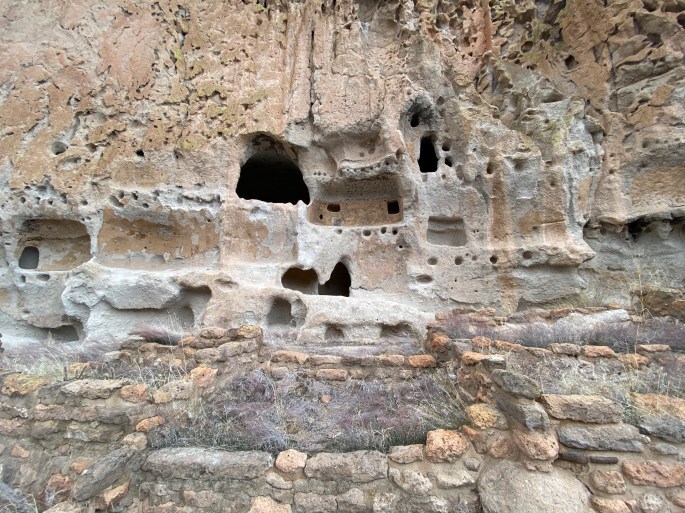
Bandelier National Monument is a relatively small (33,000 acres) monument but protects an area of mesas and canyons where humans lived as long as 11,000 years ago. This area features both cliff dwellings and multi-room dwellings on the canyon floor. Much of the material here is tuff (compacted volcanic ash) which allowed the Puebloans to carve into the cliffs.
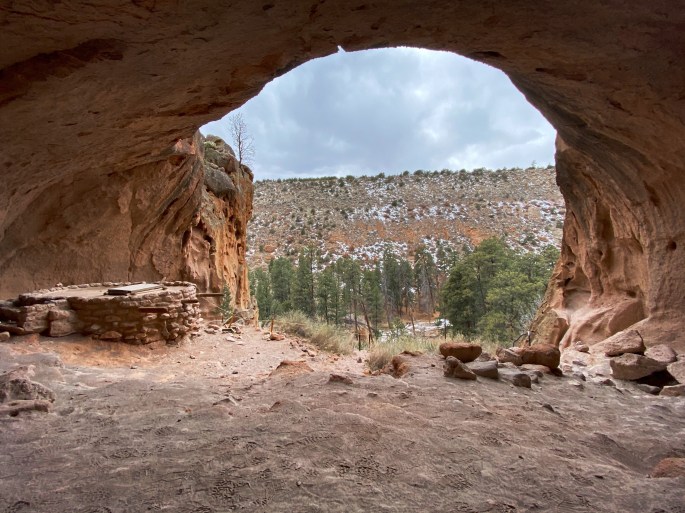
There are a number of dwellings where you can climb up into cliff dwellings using ladders modeled after the ladders the Puebloans used. The Alcove House pictured below provides the opportunity to climb up a series of ladders and provide the view of the canyon that the Ancesteral Puebloans had so long ago. Additionally, there are many petroglyphs on the cliff walls.
Alcove HouseMaria Climbing One of the Four Ladders required to Reach Alcove HouseView from Alcove House – 140 Feet Above Canyon Floor
Large Kiva on Frijoles Canyon Floor
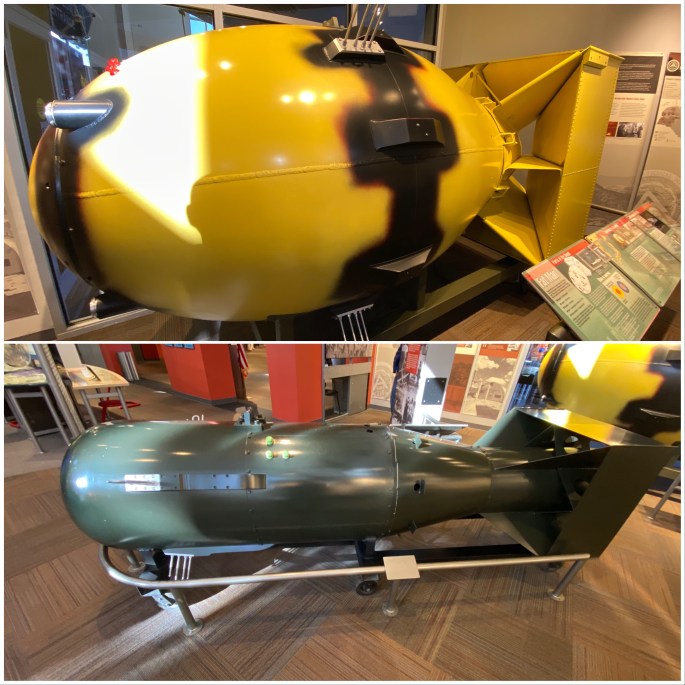
BNP was closed to the public during World War 2 as the buildings and lodging were appropriated for the Manhattan Project which was based in nearby Los Alamos. The Bradbury Science Museum in Los Alamos depicts the history of the Manhattan Project which produced the first atomic bombs which were dropped on Japan in an attempt to hasten the end of the war with Japan. Replicas of the “Fat Man” and “Little Boy” atomic bombs pictured below.
Bradbury Science Museum, Los Alamos
BNP is within easy driving distance of Santa Fe. The park offers primitive camping and there are hotels in nearby White Rock. We would recommend visiting in the off season as parking is limited and the crowds make for lines if you want to climb up into the dwellings (according to the park rangers). We recommend one to two days here in order to hike the Frey Trail, visit the Long House, the Alcove House and the Falls Trail.
Be seeing you!
P.S. The Revolt Coffee truck is parked on Route 4 in White Rock so you can grab a great coffee to go on your way into or out of the monument.
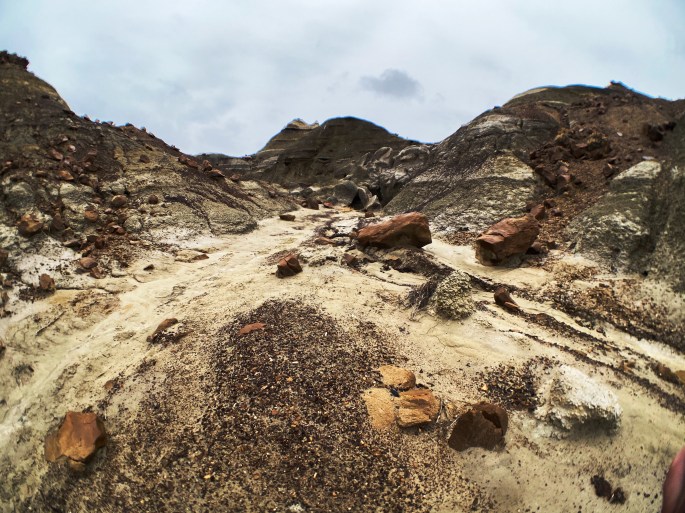
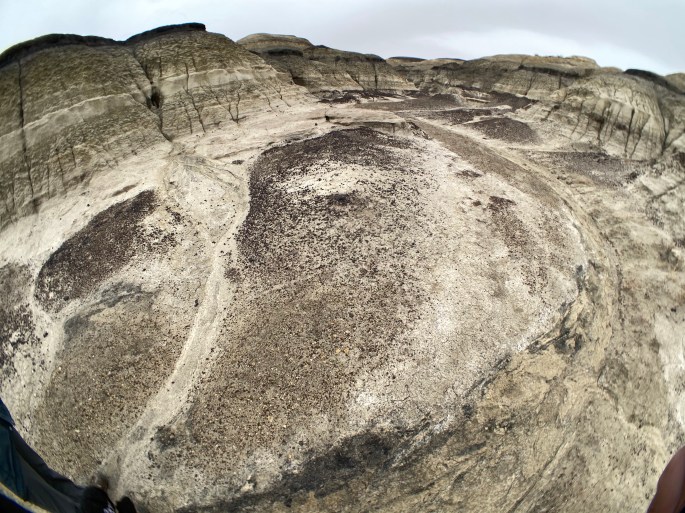
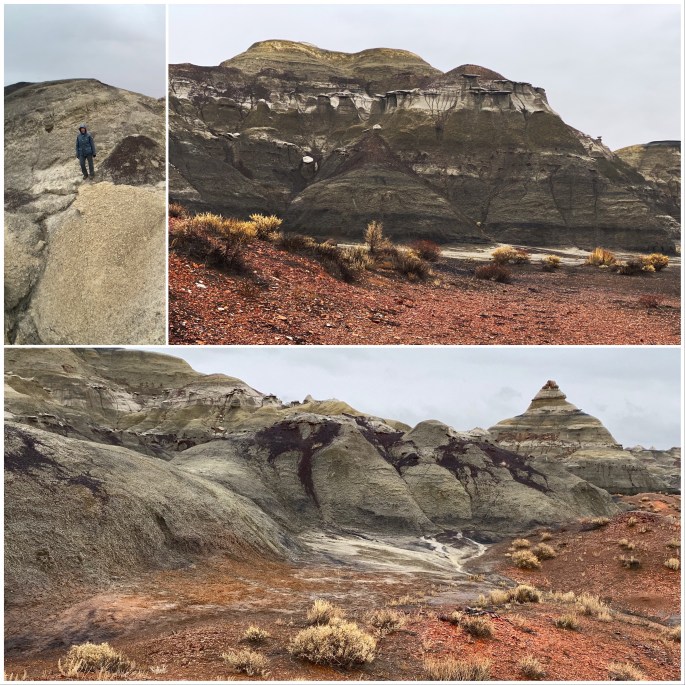
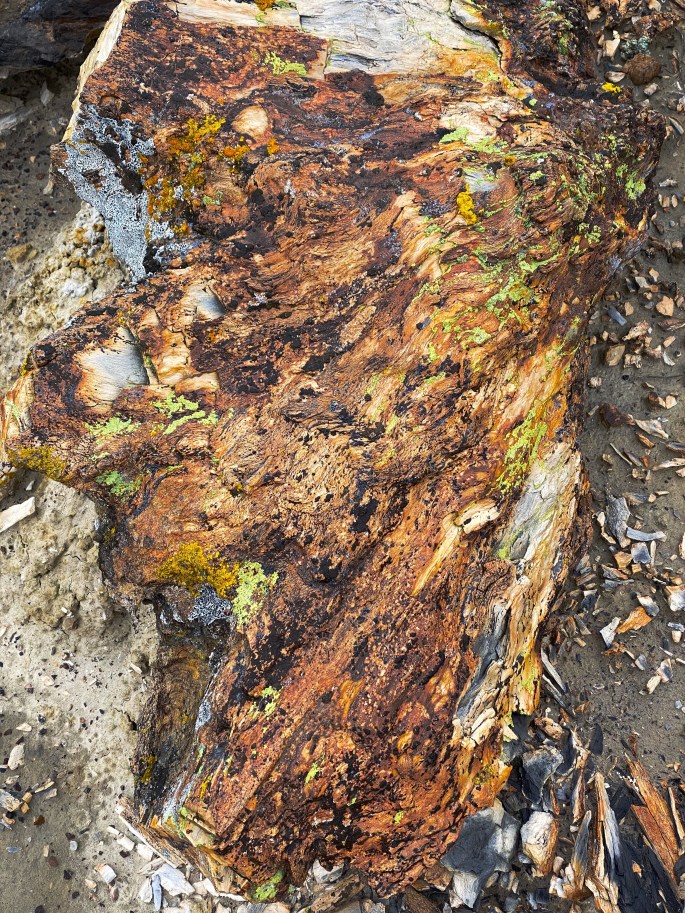
From Mesa Verde National Park we traveled south into New Mexico spending our first night in Farmington (fika @ Studio Bake Shoppe). From Farmington we journeyed due south on NM371 through the Navajo Nation to access the Bisti Badlands. As wilderness areas by defintion allow no motorized traffic the only access from the parking area is by foot. There are no trails or markers of any sort. So bring your compass and utilize your gps. Line of sight navigation is impossible as once you enter into the outcroppings you are in a maze of strange sandstone, shale, coal, mudstone and silt formations. There are a plethora of hoodoos and just strange looking features that evolve based on the ongoing wind and water erosion that takes place with these soft materials.
The closest lodging is in Farmington which is apx. 40 miles north. There is no developed camping within the vicinty of the access area. However, exploring here is an easy day trip from Farmington. We boondocked in the wilderness area.
Our next segment will be at the Chaco NHP to visit more ancesteral sites assuming the road is passable in the aftermath of the major storm the occurred overnight.
This trip will take us through New Mexico and deep into (the heart of) Texas before turning east along the Gulf Coast and eventually driving back to Connecticut. As usual we began our trip in Salt Lake City where we have been storing the Beast between trips.
After a day of travel to SLC and a day of preparing the Beast for this journey we departed for Moab, UT. We spent an overnight in Moab, UT (Moab Coffee Roasters) before traveling to southwestern Colorado to view some of the finest examples of Peubloan cliff and mesa communities in existence today.
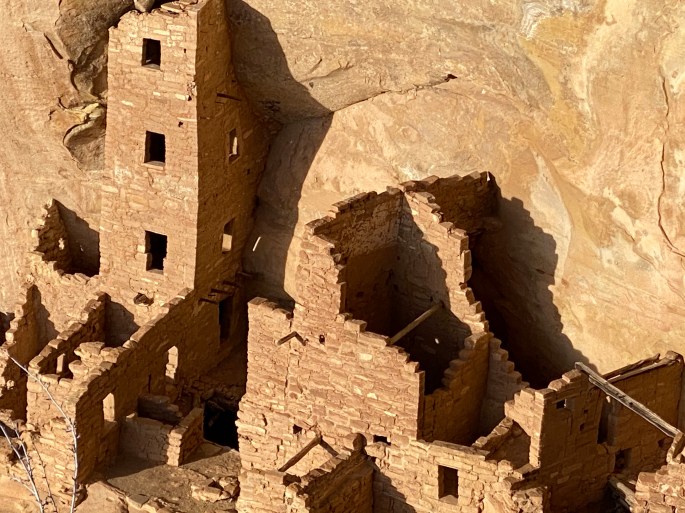
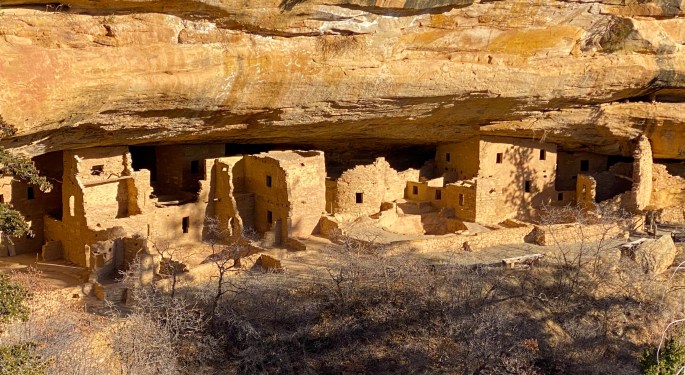
Mesa Verde National Park was created by President Theodore Roosevelt in 1906 for the explicit purpose of preserving the remarkable Ancesteral Peublo architecture. Mesa Verde was occupied by the Pueblo people for about 750 years beginning in 550 A.D.
MVNP is definitely a bit off the beaten path but we think more than worth the drive. The park is laid out with a loop drive that allows you to see many of the cliff villages from excellent view points. There are a number of kivas that have been excavated which are easily accessible by foot.
In the summer months you can also tour several of the cliff dwellings on ranger guided tours. The Far View Lodge offers acommodations with outstanding views of the mesa and canyons below. There is also a small musueum located in the park about twenty miles from the entrance.
There are a number of indigenous sites in the Four Corners area which could easily be combined with a visit to MVNP for an extended tour; Canyons of the Ancients and Chaco Culture National Historic Park are two major sites.
We made our final day trip of this home stay to Springfield, MA to check out the 3rd wave coffee scene, find the murals and visit the local art museums. We have been taking full advantage of the 17 daily trains that run from New Haven to Springfield frequently, utilizing the train for our trips into New Haven and Hartford. We extended our use of the CT Railroad by riding from the Meriden Station through to Union Station in downtown Springfield.
We have to admit that our only experience of Springfield derives mainly from passing through on I-91 on our way to Vermont and back. So this trip presented us with the opportunity to get to know more about the city and its history.
First to the coffee – no joy! Sorry to report that the downtown area is bereft of 3rd wave coffee establishments. There are a number of specialty coffee cafes and roasters just outside of Springfield – particularly west of the river.
The street art mural scene however provides great joy. Springfield, with the support of the Common Wealth Mural Collaborative, launched Fresh Paint Springfield in June of 2019. FPS is week long mural festival which also features many other cultural and food events throughout the week. A total of 22 murals were completed by 17 professional muralists with the help of local mural assistants. Fortunately, the mural festival was a big hit and will return for its second run in June 2020. We have included a sampling of photos of some of the moving, imaginative and colorful murals we saw on this trip.
Springfield boasts two fine art museums located in a quadrangle of distinctive buildings which also house a science museum, a museum of Springfield history and the Dr. Seuss Museum. Both of the art museums came about as the result of wealthy Springfield art collectors donating their personal collections to form the museums.
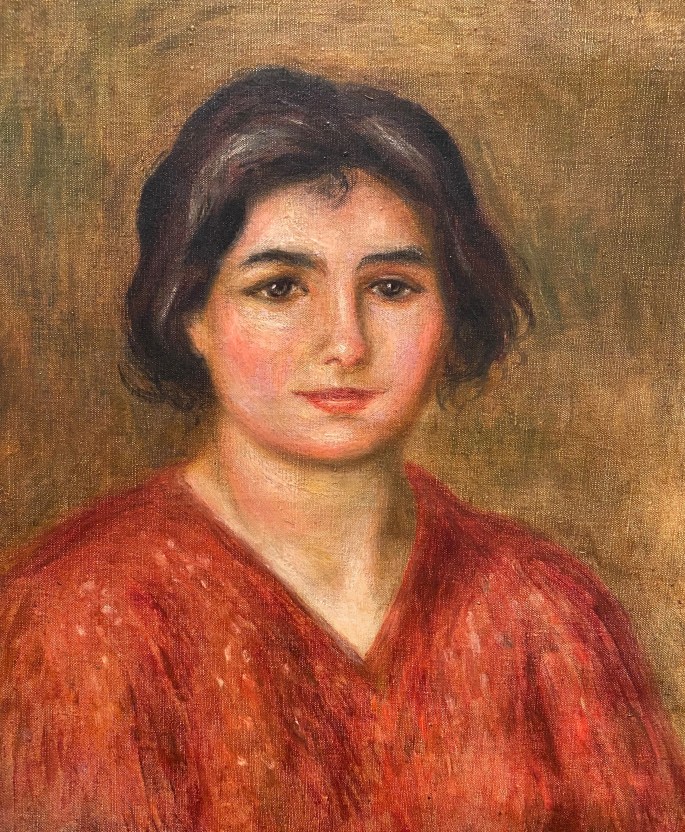
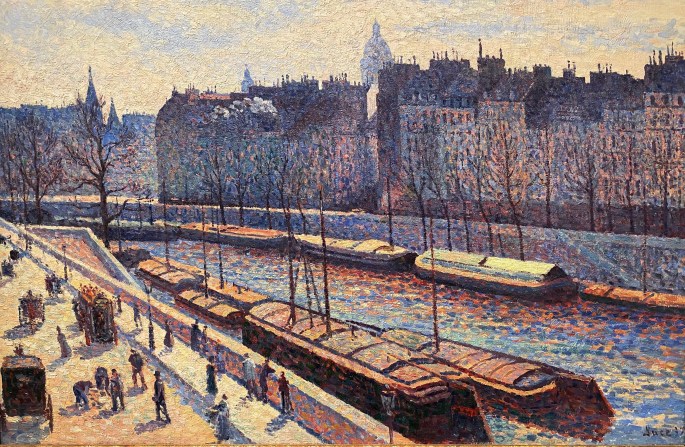
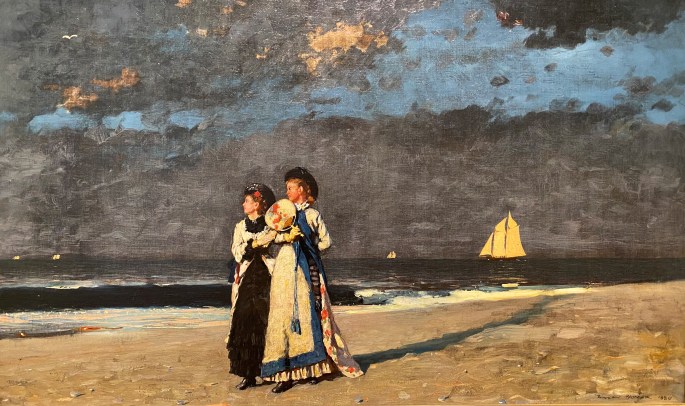
We spent most of our time at the D’Amour Museum of Fine Arts owing to our affinity for French Impressionism. The D’Amour has a small but impressive gallery of French Impressionist works along with galleries featuring 17th, 18th and 19th century Dutch, Flemish, French and Italian paintings.
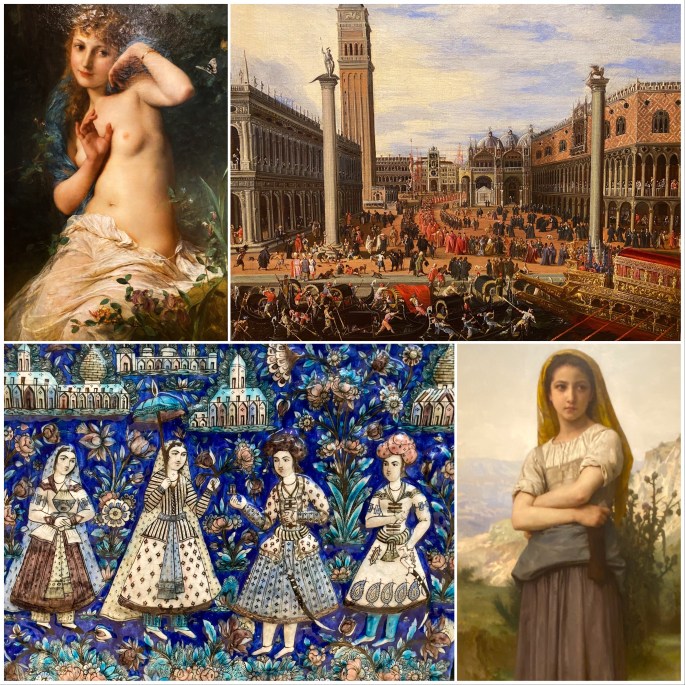
The other art museum is the George Walter Vincent Smith Art Museum. The GWVS collection consists mainly of Japanese and Chinese porcelains, bronzes, jade and arms and armor. There is also a smaller gallery dedicated to art of the Islamic world. The Japanese armor and arms were the high point along with the painted tiles in the Islamic gallery.
Springfield like many former manufacturing hubs in the northeast has seen better days. We noted a lot of work going on to renovate and utilize the many still standing factory buildings for retail, office and habitational space. The area proximate to the museum quadrangle is home to several beautiful cathedrals and several historic residential areas where 19th century row houses have been renovated.
Springfield by train was an excellent day trip albeit no specialty coffee!
Crossing Connecticut River on CT RailroadNo Coffee Zone!
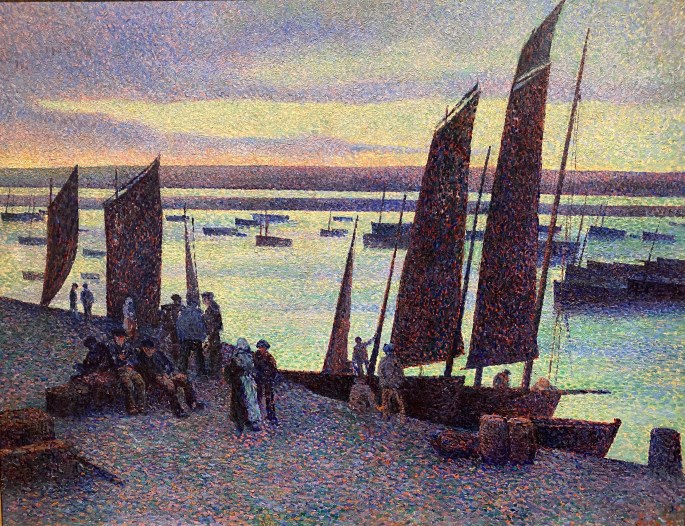
Quay at Camaret, 1894, Maximilien LucePortrait of Gabrielle in Red, 1899, Pierre-Auguste RenoirLa Seine, Undated, Maximilien LuceSeascape in Brittany, 1899, Paul GauguinFactory Near Pontoise, 1873, Camille Pissarro
Promenade on the Beach, 1880, Winslow Homer
July, 1955, John Rogers CoxHiking Socks by Kathryn LewisMattoon and Elliot Street Historic District
Our third CT Road Trip of this home stay found Maria and me traveling to eastern Connecticut to visit the William Benton Museum of Art. The Benton is located on the Storrs campus of UCONN. We followed Route 66 from Middletown to Willimantic which took us through a part of Connecticut that still retains a very rural feel with small towns and many historic homes, buildings and farms.
We made Willimantic our first stop to check out Grounded Coffee Co. http://groundedcoffeecompany.org/ and search out street murals in the otherwise depressed downtown area. Grounded Coffee sits right on Main Street in a historic structure built in 1831. The cafe occupies the ground floor. The owners did a nice job working around the central four-sided fireplace in creating a comfortable and pleasing space. In addition to a full menu of coffee and tea drinks GC offers a light food menu. GC is definitely the best choice for coffee in the Willimantic area in our opinion.
Willimantic has been very active over the last several years in sponsoring and promoting street murals. We found many interesting murals, a number of which are historical murals depicting the history of “Thread City” as a textile hub during the first half of the 20th century.
The Benton Museum https://benton.uconn.edu/# is a very small museum located in the heart of the Storrs UCONN campus. There is no admission charge and unfortunately very limited parking (four spaces) adjacent to the museum. We were fortunate to arrive to find one of the spaces available (get a pass at the front desk for your car window to avoid being ticketed or towed).
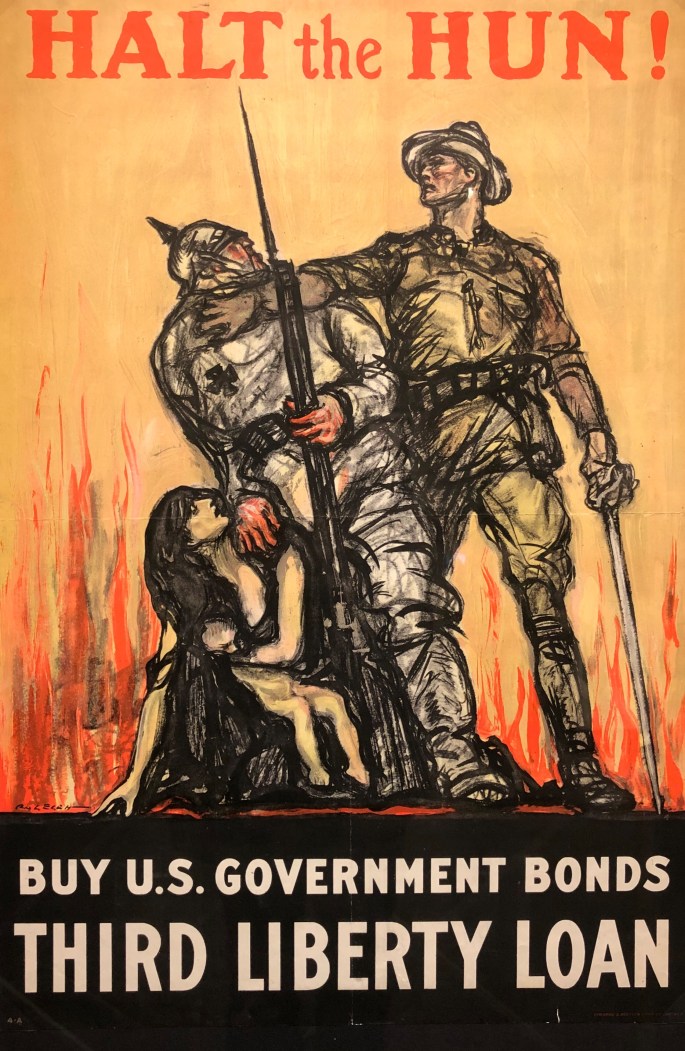
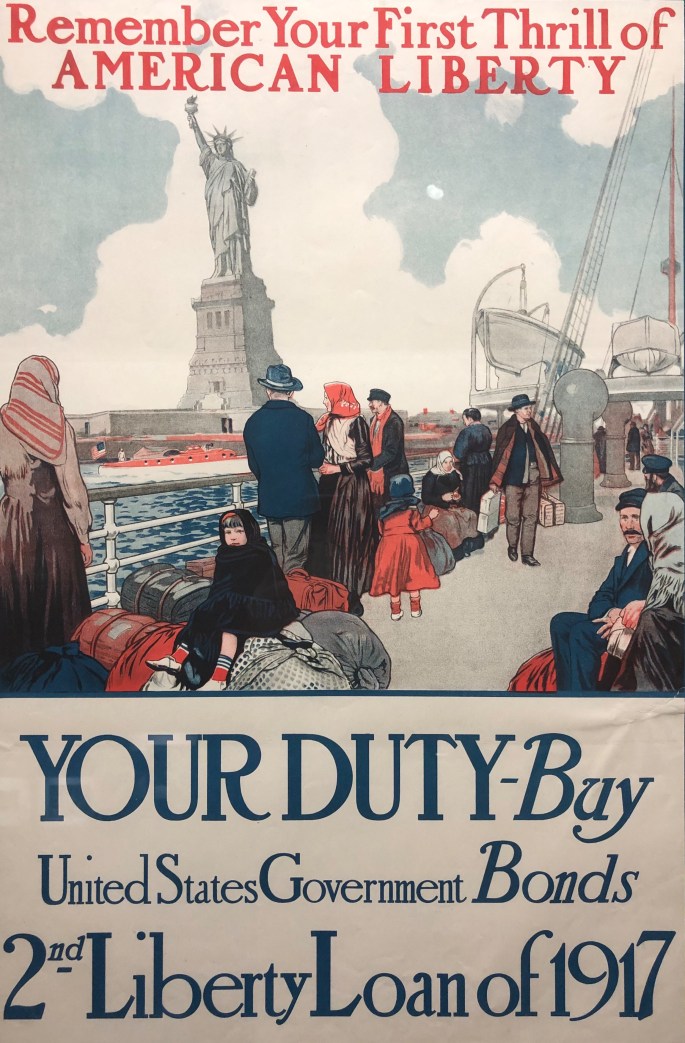
The museum has a permanent collection in the main gallery – From Old Masters to Revolutionaries: Five Centuries of the Benton’s Best and an additional two galleries featuring current exhibits. We were able to tour the entire museum in under two hours. We found two of the three current exhibitions to be worthwhile – Halt the Hun: Atrocity Propaganda in World War 1 and DEMOKRACJA GRAFIKA.
“Halt the Hun” featured posters created by artists to rally Americans to support the war effort by buying Liberty Bonds while “DEMOKRACJA” provides insight into life in Poland during the Cold War. UCONN has had an exchange program with the Academy of Fine Arts in Krakow since the 1980s which is where the majority of the prints on display were produced.
We recommend the museum with the caveat that you check out the current exhibitions before visiting as the permanent collection is small (but good).
For our next trip in January we are planning to cross state lines and venture north for more fika, street murals and fine art.
Be seeing you!
Thread City
Walt Kuhn, Study for Bareback Rider, 1926
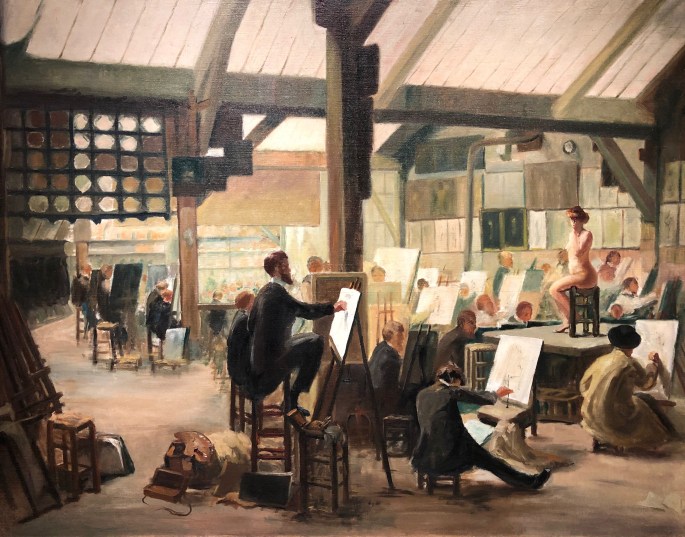
Caleb Arnold Slade, Atelier at the Academie Julian, 1905
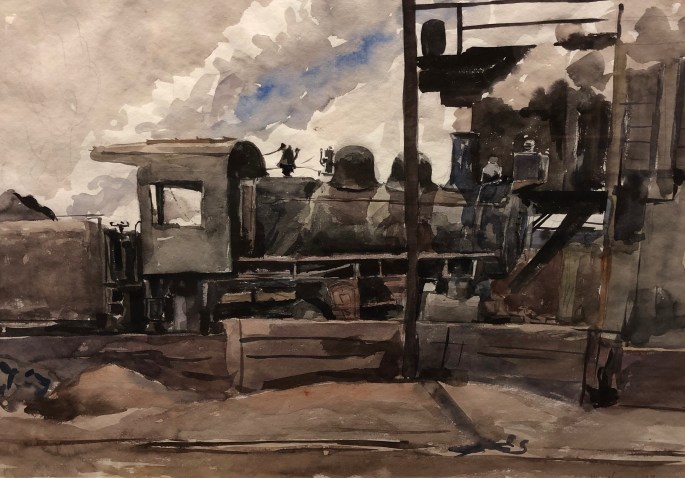
Reginald Marsh, Locomotive and Catwalk Structure, 1927
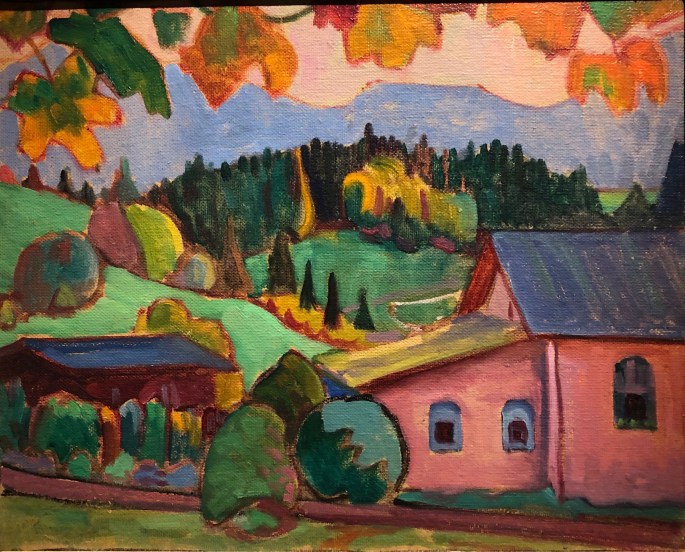
Gabriele Munter, Fabrik, 1908
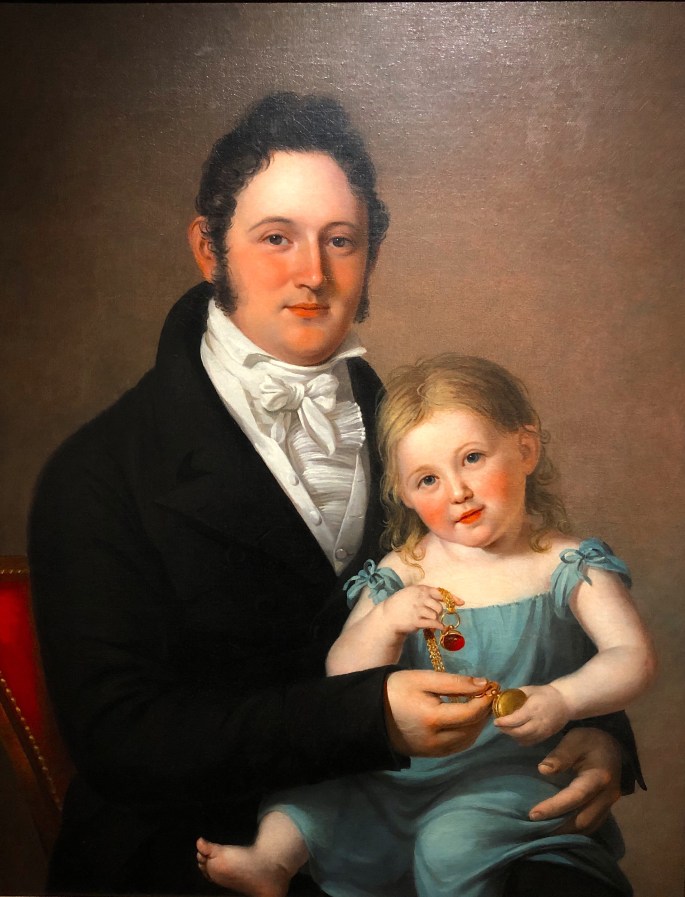
Rembrandt Peale, Captain Paul Ambrose and His Daughter, 1825
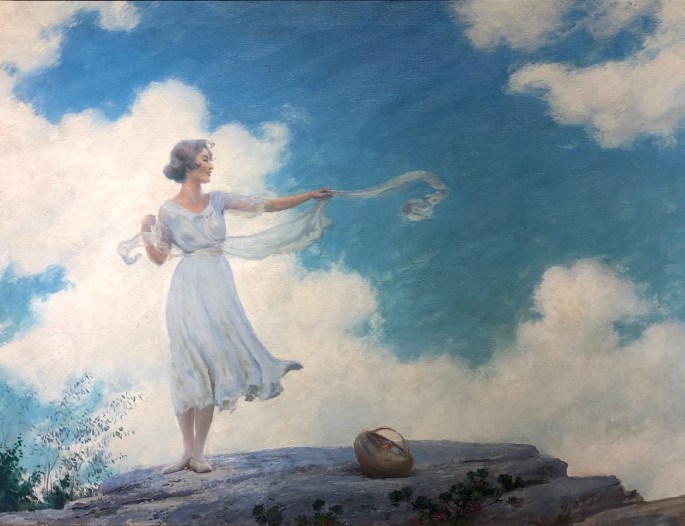
Charles Courtney Curran, Girl with Fluttering Scarf, 1924
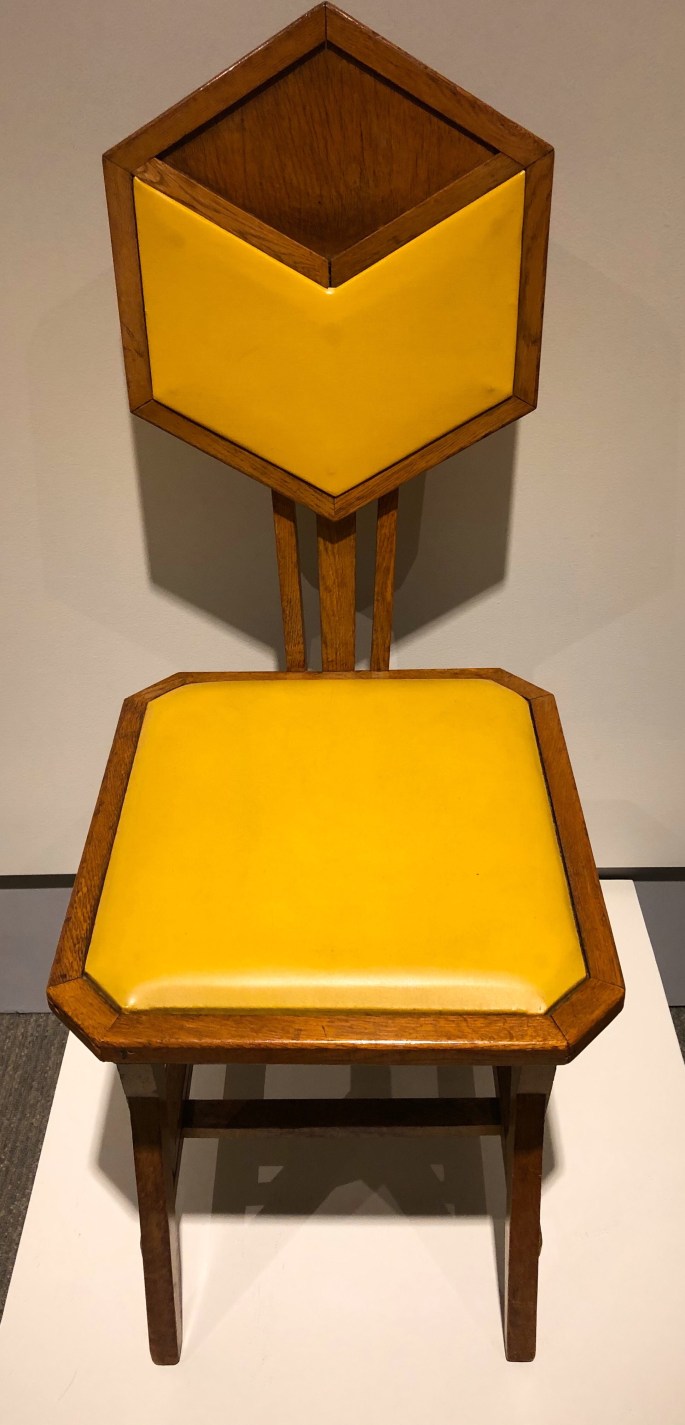
Frank Lloyd Wright, Peacock Chair from the Imperial Hotel, Tokyo, 1921
Our second road trip of this home stay found us in New Haven at the Yale University Art Gallery (http://www.artgallery.yale.edu). We were particularly interested in seeing the three exhibitions currently on display.
Of course all road trips require sustenance in the form of coffee pre-activity and a meal with wine post activity. We enjoyed fika at Fussy Coffee ( http://www.drinkfussycoffee.com) on Winchester Avenue. In addition to great coffee and light food, Fussy is strategically located next to the Farmington Canal Greenway which made for an easy and pleasant walk to Chapel Street for our museum visit. An added bonus of this location was the opportunity to view Kwadwo Adae’s mural “locomotion” which is on the FCG about three blocks north of Fussy Coffee (#streetartfromthe road).
After viewing the exhibitions, we made the short walk down Chapel Street for our repast at Atelier Florian (www.atelierflorian.net ). The focus here is on seafood. We tried the mussels, calamari and seafood tacos accompanied by white wine and found all to be delicious. A terrific spot for a mid-afternoon break.
P.S. As an added bonus we have included several paintings from prominent artists that we viewed on our way between the exhibitions.
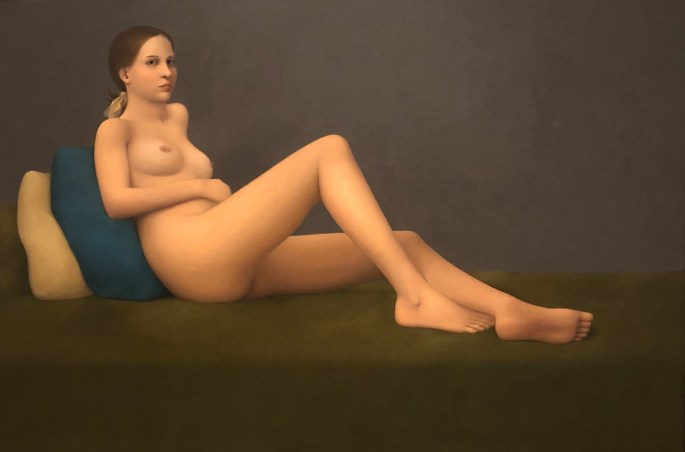
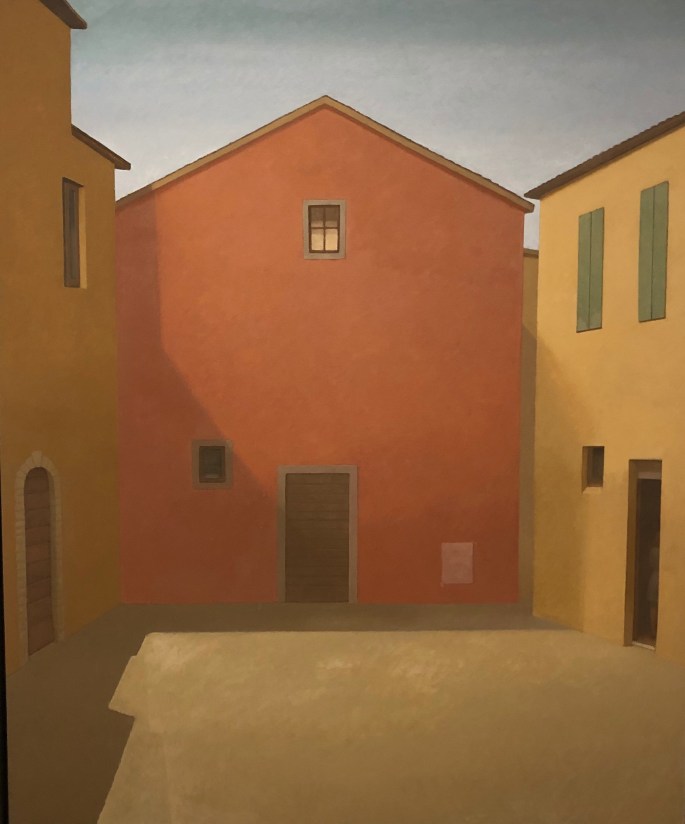
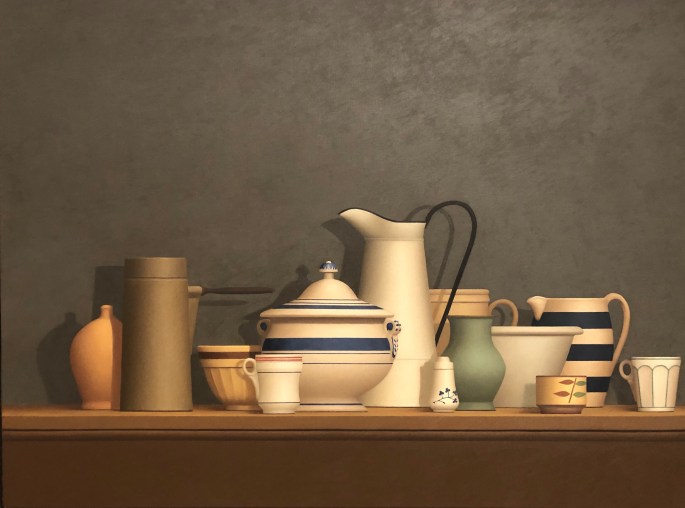
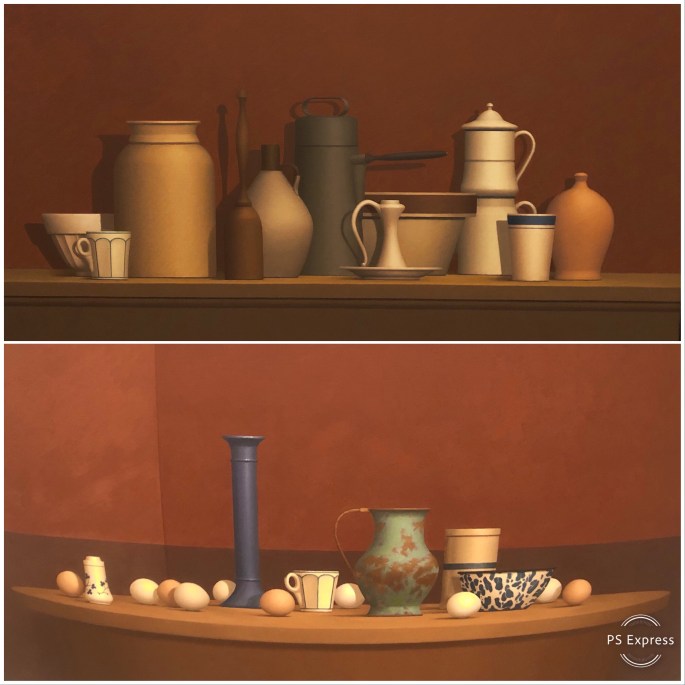
William Bailey: Looking Through Time
This exhibition consists of a number of oil paintings by long time Yale art professor William Bailey. Bailey focused on still-life paintings at a time when abstract painting was very much in vogue. The majority of the paintings on display are large still-life oil paintings. The colors are muted yet vibrant while stylistically relecting many different artists and periods. Photographs of eight of his paintings on display are included below. Many of these paintings were done during his visits to Italy.
Place, Nations, Generations, Beings: 200 Years of Indigenous North American Art
This exhibit includes paintings, wood carvings, textiles, pottery, photographs and drawings from the Yale collection as well as several other institutions. The exhibition includes pieces from a variety of first nations and tribes across the United States. The curators have been quite clear in the narrative to acknowledge that much if not all of this work was essentially stolen from the rightful owners as tribes were forced onto reservations. Yale has returned hundreds of artifacts to tribal nations over the last several years.
Ceremonial Dress from Southwest China: The Ann B. Goodman Collection
This exhibit provides 15 splendid examples of ceremonial clothing worn for special occasions such as birth, marriage, death and harvest. The clothing is incredibly intricate and detailed. All of this clothing was made by women who typically do everything from gathering the cotton, dyeing the material, sewing and embroidering the outfits. The groom’s wedding outfit in the exhibition was made by his bride to be! There is also a display of hats and jewelry that were worn at these ceremonies. This collection was recently gifted to Yale but is only on display through January 5, 2020.
Below Zero, Winslow Homer, 1894
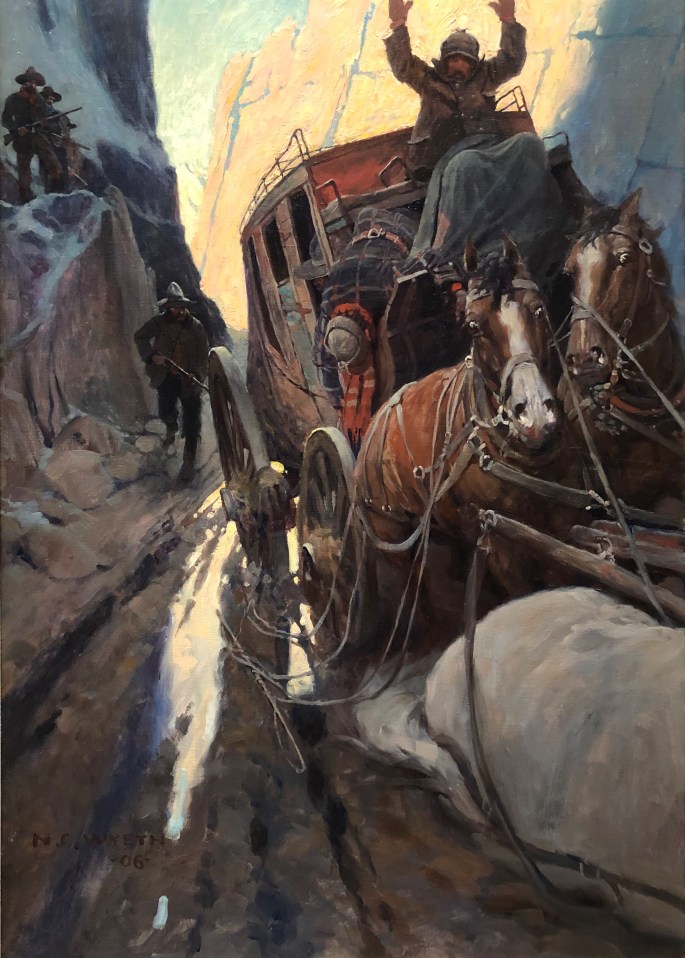
“Hands Up” (Holdup in the Canyon), N.C. Wyeth, 1906
Le cafe’ de nuit, Vincent Van Gogh, 1888
Femme assise (Seated Woman), Pablo Picasso, 1936
APB’s (Afro-Parisian Brothers), Barkley L. Hendricks, 1978










































 ON THE ROAD with Maria + Stephen