After our night in Bangor we set out for Calais (Cal-liss) and our first visit to Canada since the pandemic. This crossing experience was quite a bit different than our previous crossings. In the past we showed our passports, answered a few questions and we were on our way.
Calais—St.Stephen Border Station
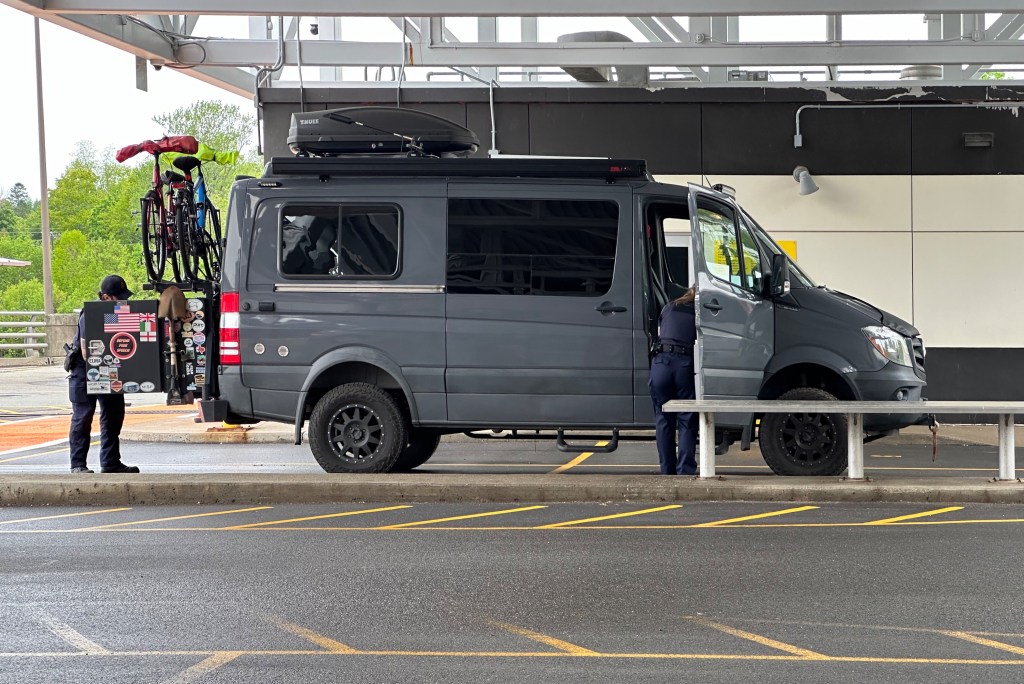
It was a very different experience this time. After showing our passports and answering a few questions we were asked to go inside the station and wait while two Canada Border Officers thoroughly searched the van. While we did not have any contraband on board it was still a bit unsettling having the van and all of our possessions searched. The frosting on the cake was our realization after driving away from the station that our passports had not been returned! One of the officers that had searched the van had our passports in his pocket — oh boy!
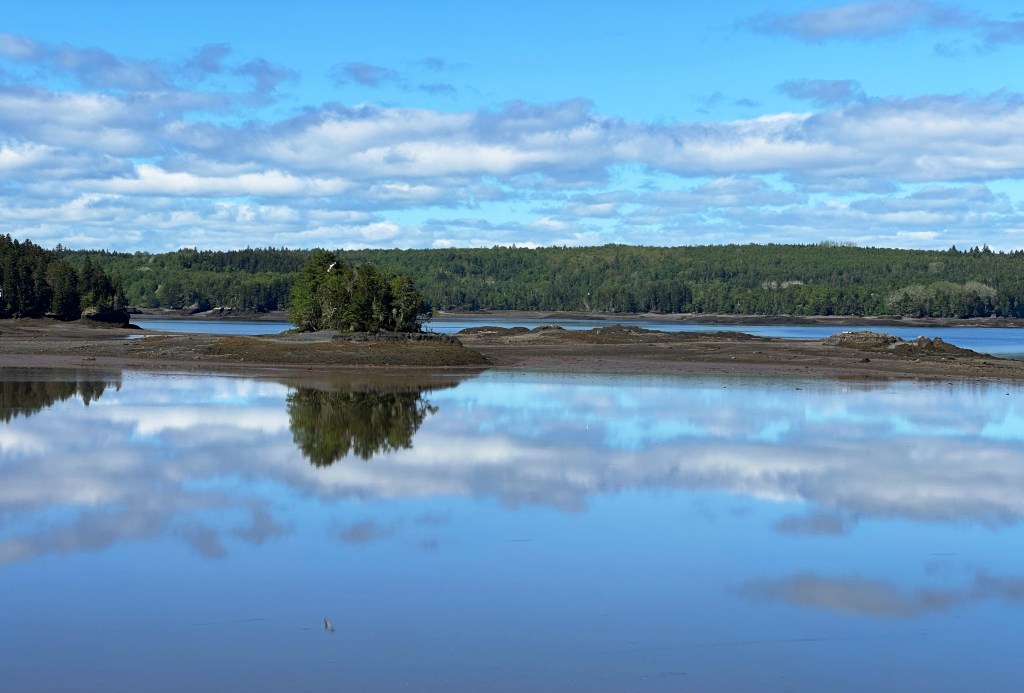
After retreiving our passports, we traveled east to camp at Mouth of the Magaguadavic. This is a privately owned tract of land that sits at the mouth of the river and the Passamaquoddy Bay. We were able to pull our van up to the edge of the bluff to have an unimpeded view of the gorgeous bay. Unfortunately, that evening a thick mist had settled over the bay and were not able to enjoy the full view. We sat by the campfire until the mist overwhelmed our fire and we retreated into the Beast.
In the morning we awoke to a much different view than the previous evening’s shroud of mist and fog. We enjoyed our breakfast as we sat outside transfixed by the pristine bay.
Passamaquoddy Bay
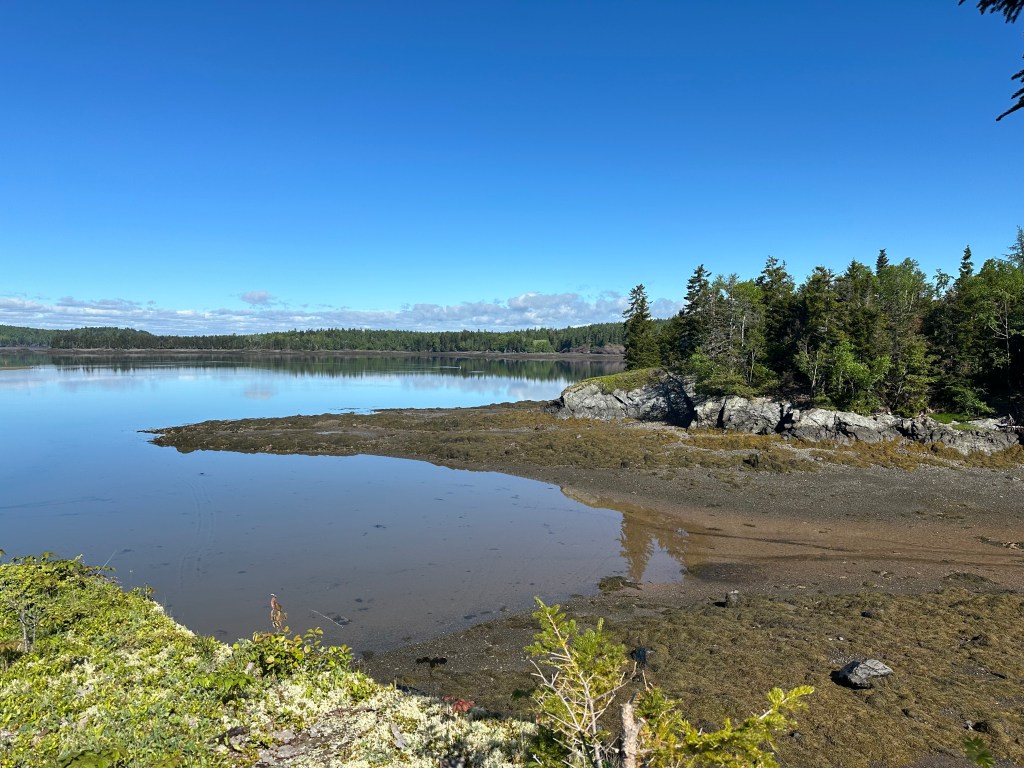
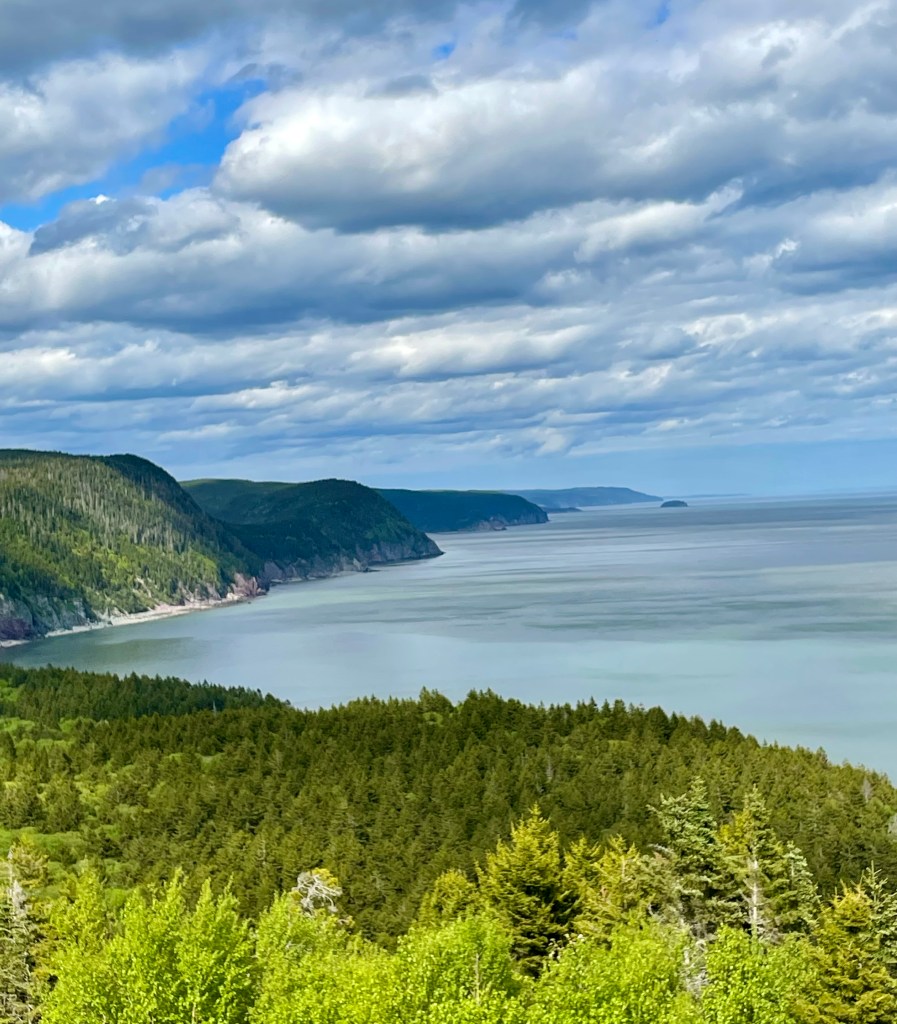
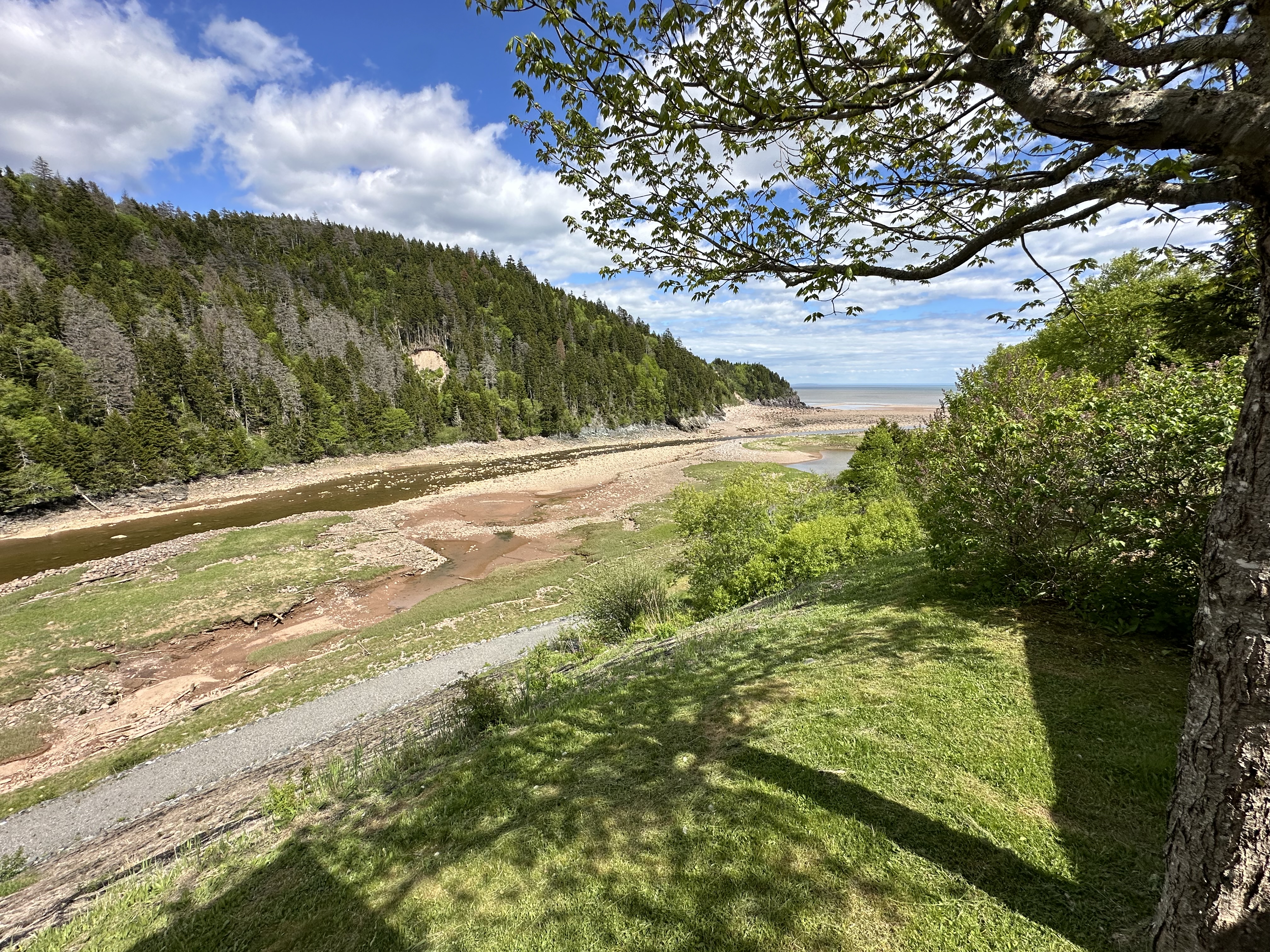
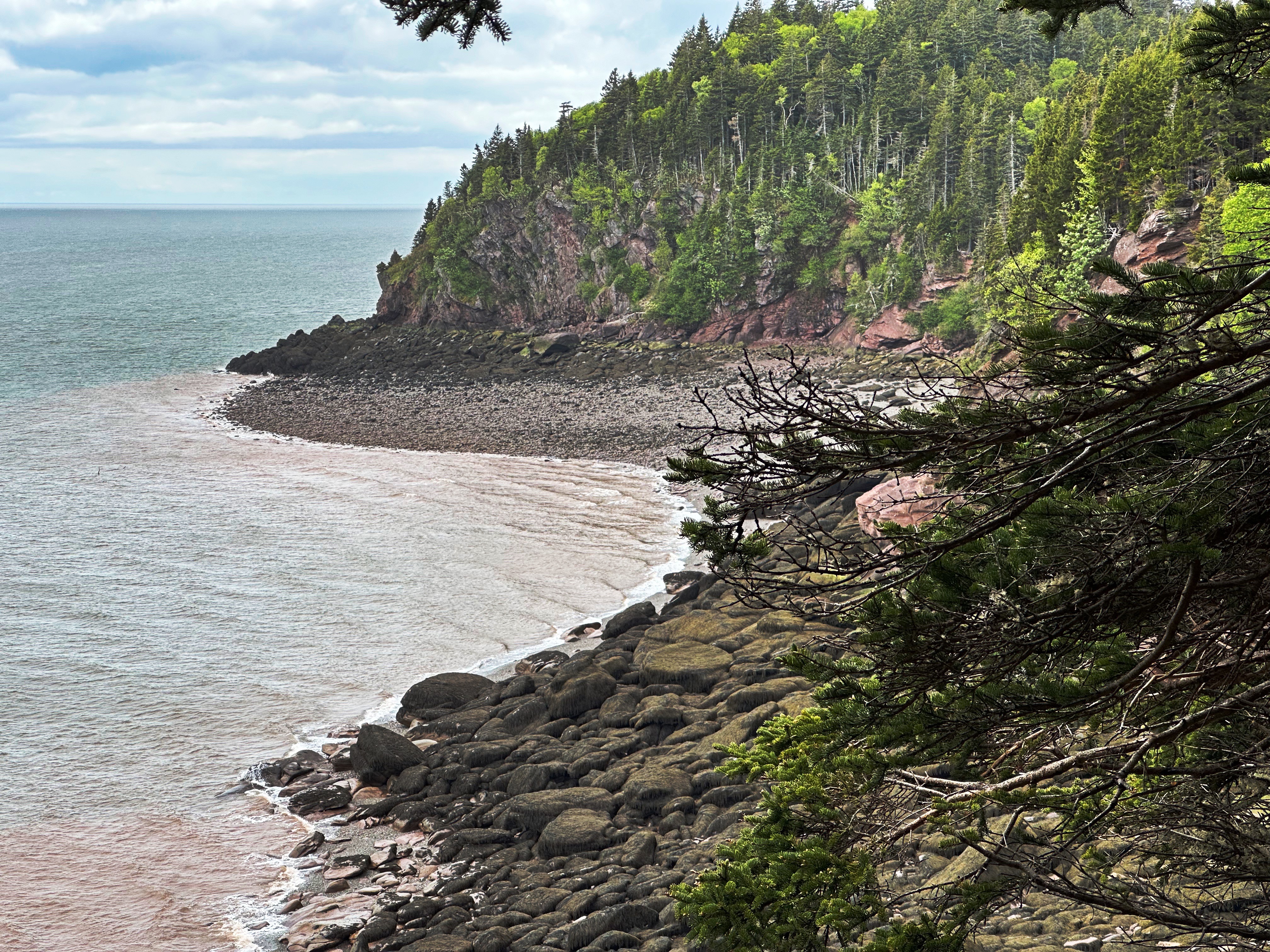
We pulled ourselves away from the view eventually and began our trek east along the coast and the Bay of Fundy. The Bay of Fundy has a beautiful and rugged coastline and an impressive 40 foot tide occuring twice daily.
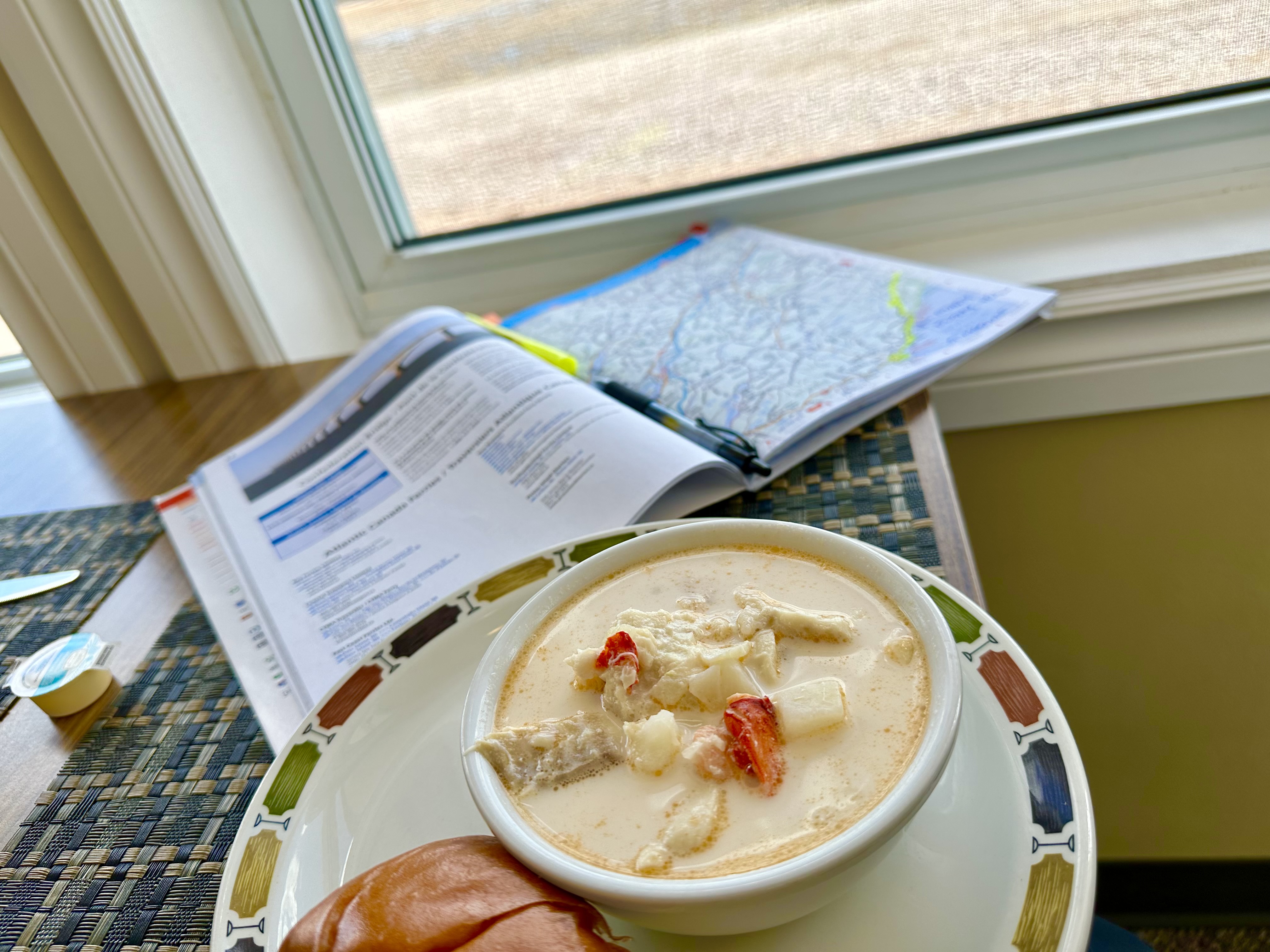
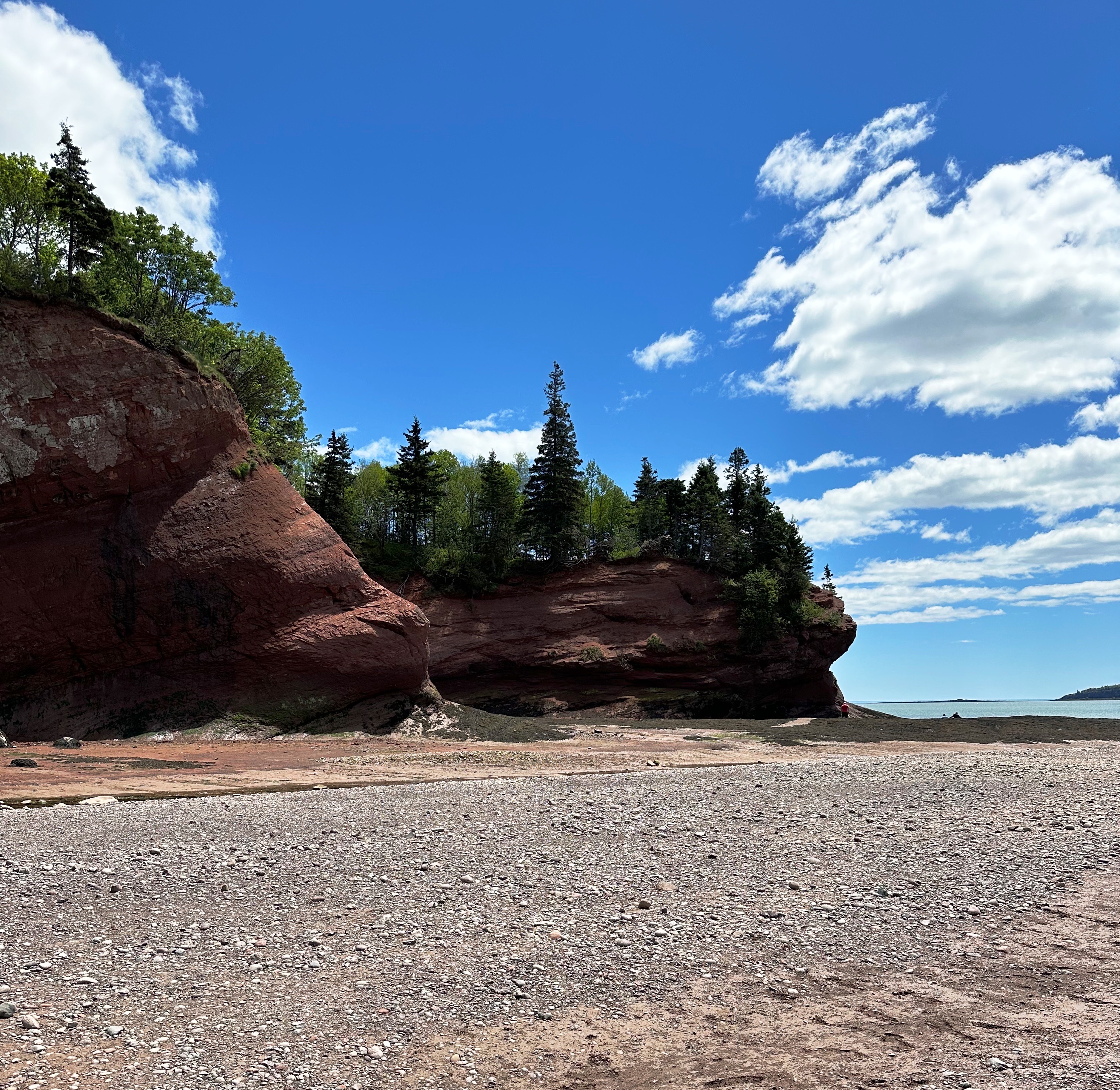
We stopped for lunch in the tiny fishing village of St.Martins. We walked out to caves which are accesible when the massive tide is out and then lunched at a seafood restaurant perched on the beach. To say the seafood is fresh and delicous is an understatement.
After our delicous lunch we continued along the coast to Fundy National Park where we would spend a couple of days hiking and exploring the area.
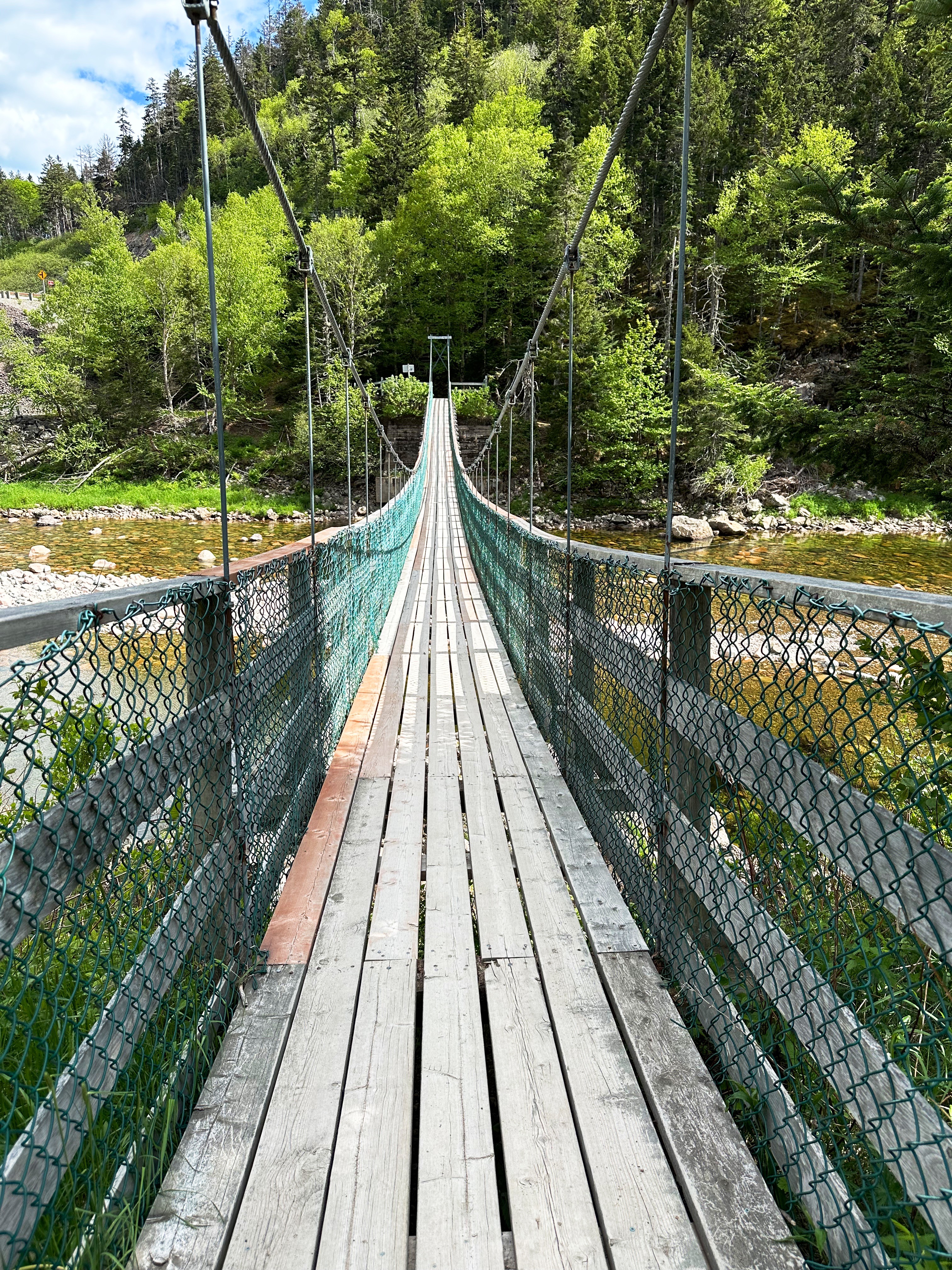
Big Salmon River, Fundy NP
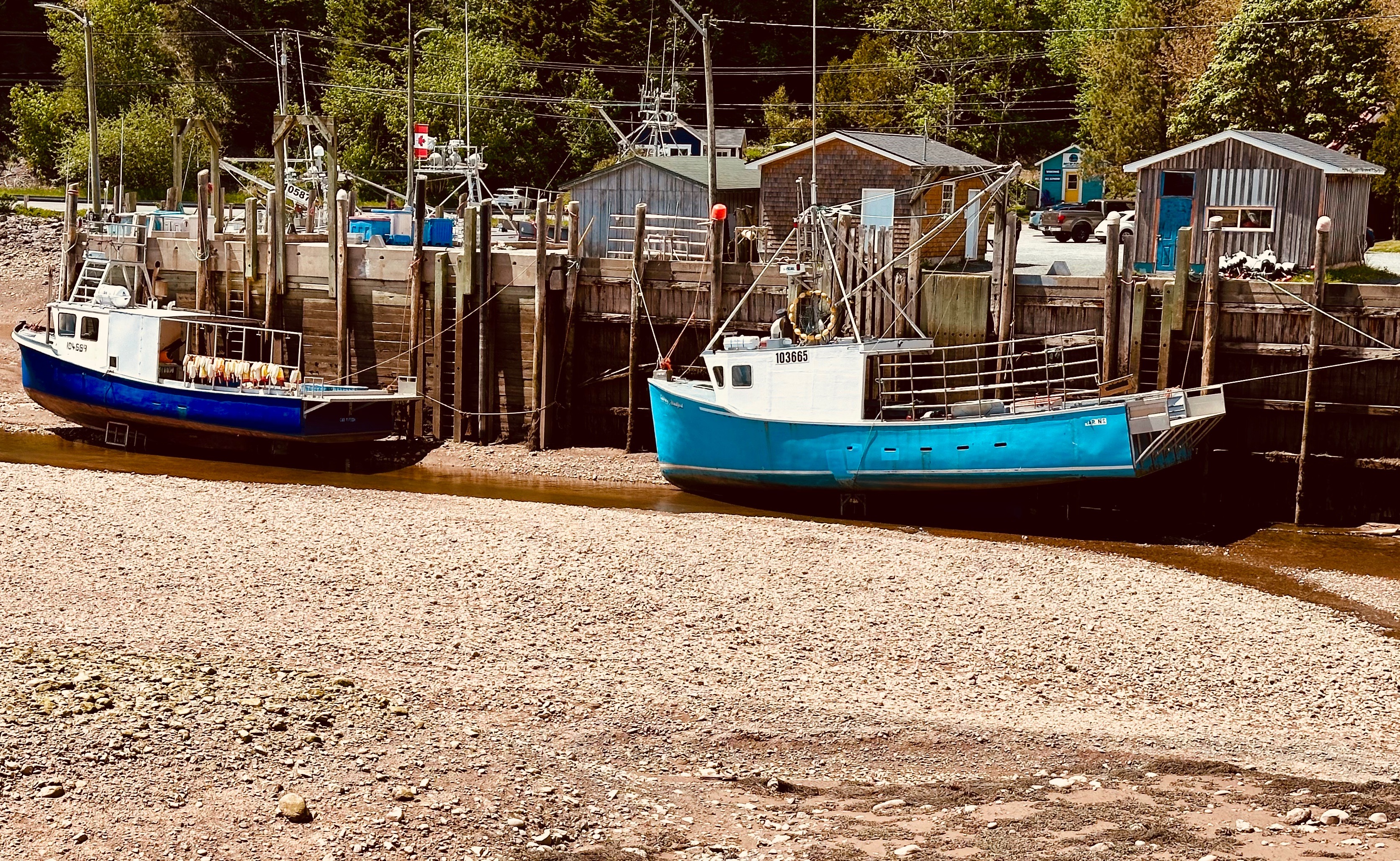
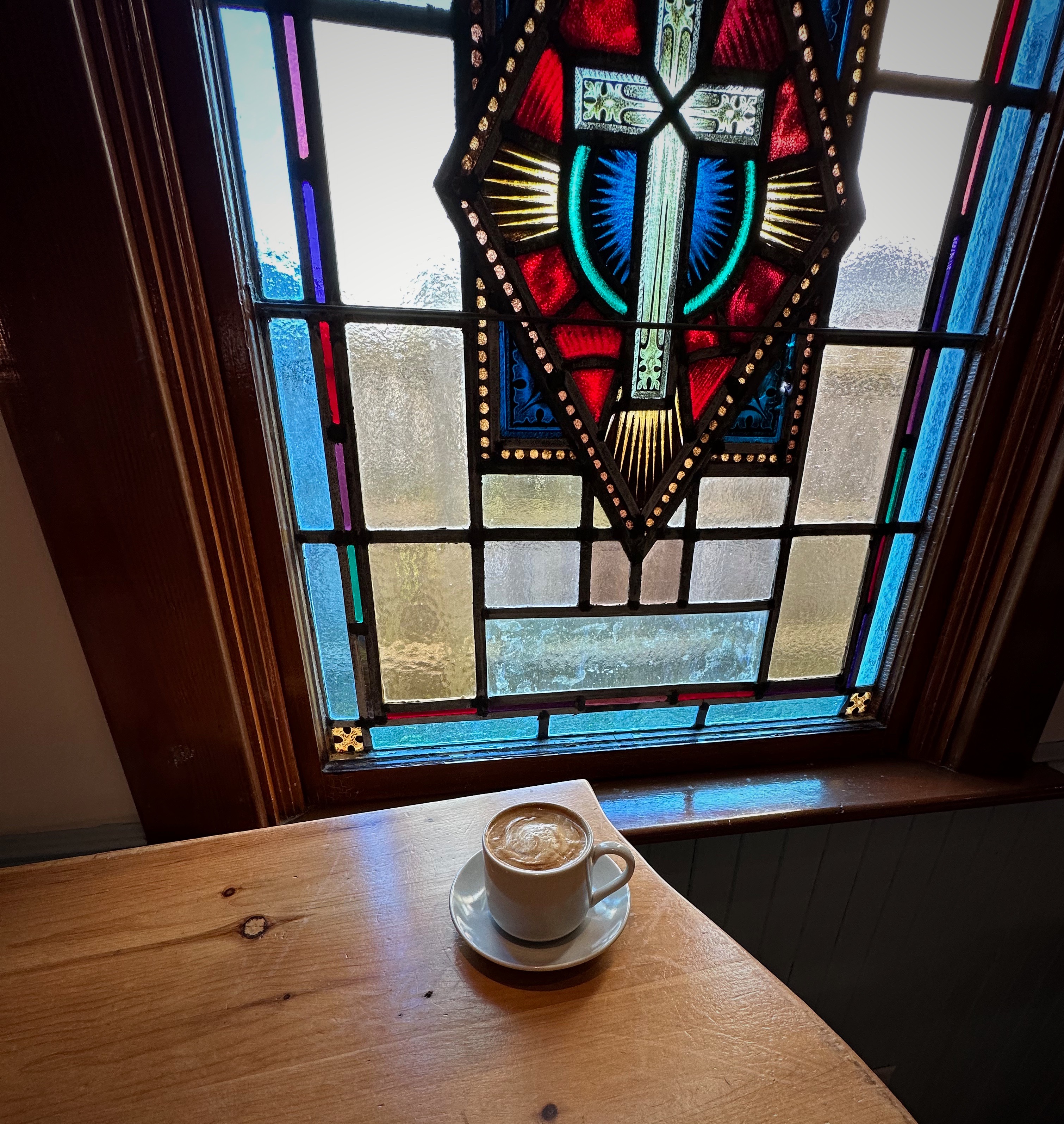
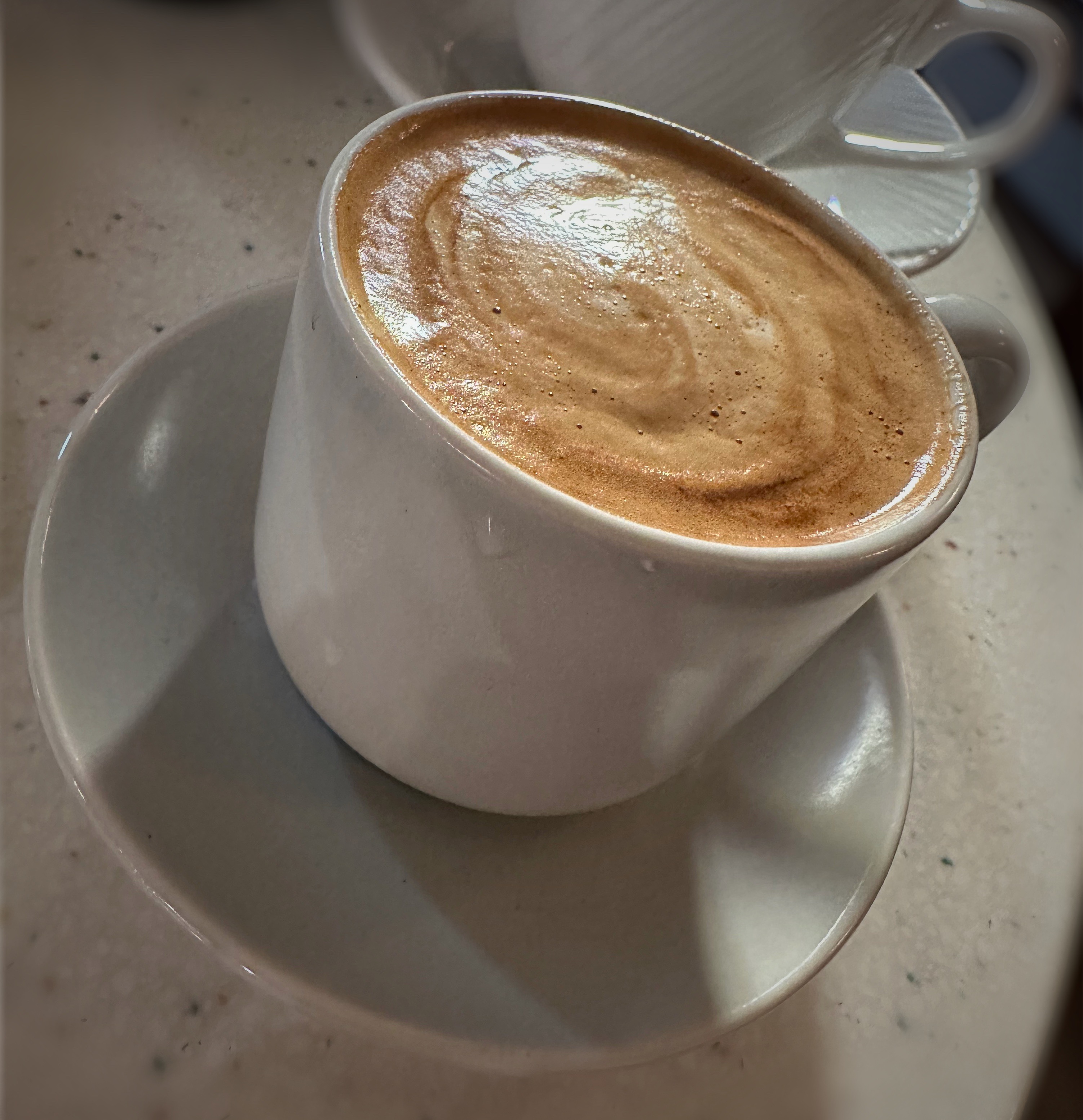
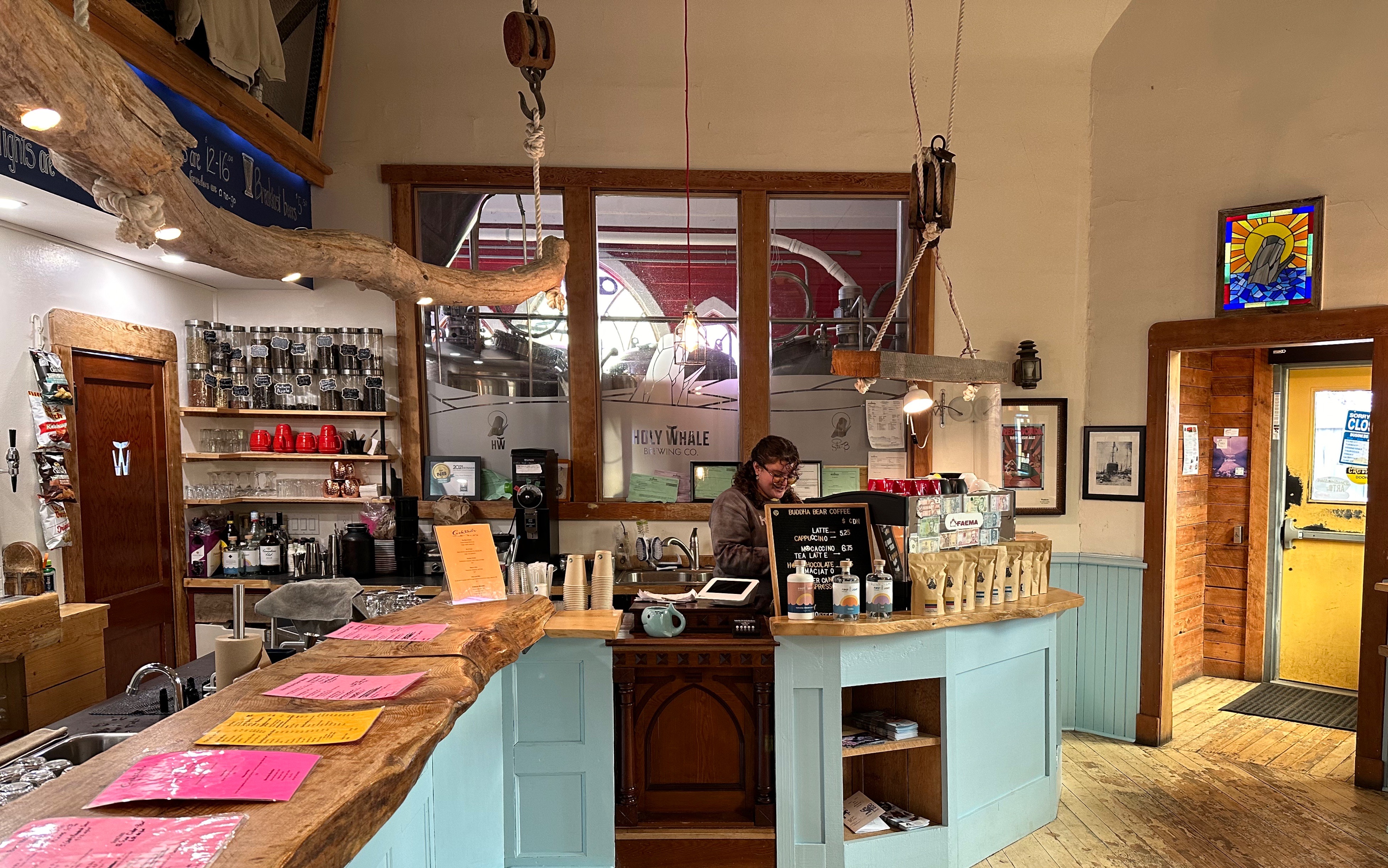
About ten miles southeast of our campsite at Fundy NP sits the village of Alma. The village is another quaint fishing town with great fresh seafood and quite impressively a specialty coffee shop — The Buddah Bear.
Alma at Low Tide
We enjoyed our stay at Fundy NP — beautiful scenery, moderate hiking and specialty coffee nearby (what could be better?). We are off to Prince Edward Island.
After departing the charm of Charlottetown we decided on a brief stay in Moncton, NB on our way through to Nova Scotia. We booked two nights at the hip Canvas Hotel a block off of Main Street in downtown. The hotel is a newer hybrid property with hotel rooms on the first five floors and residences on the five floors above. This is a great location which allows walking access to the river, restaurants, coffee shops and street art in downtown.
The city has a growing and diverse population with a current estimated census of 85,000. The Greater Moncton area boasts a population of approximately 152,000 and is the fastest growing region east of Ontario. The population growth has been bolstered by much needed foreign immigration to fill the shortfall of labor created by an aging population and a robust economy.
The economy here has been traditionally anchored to transportation and related industries and more recently the financial services sector and increased tourism to the area. Moncton also has a Major Junior Hockey League team — the Wildcats — the team plays in the Avenir Centre. The venue was opened in 2018 and seats 10,000 fans. The Centre also hosts major music artists for concerts (we just missed Billy Idol — dang!).
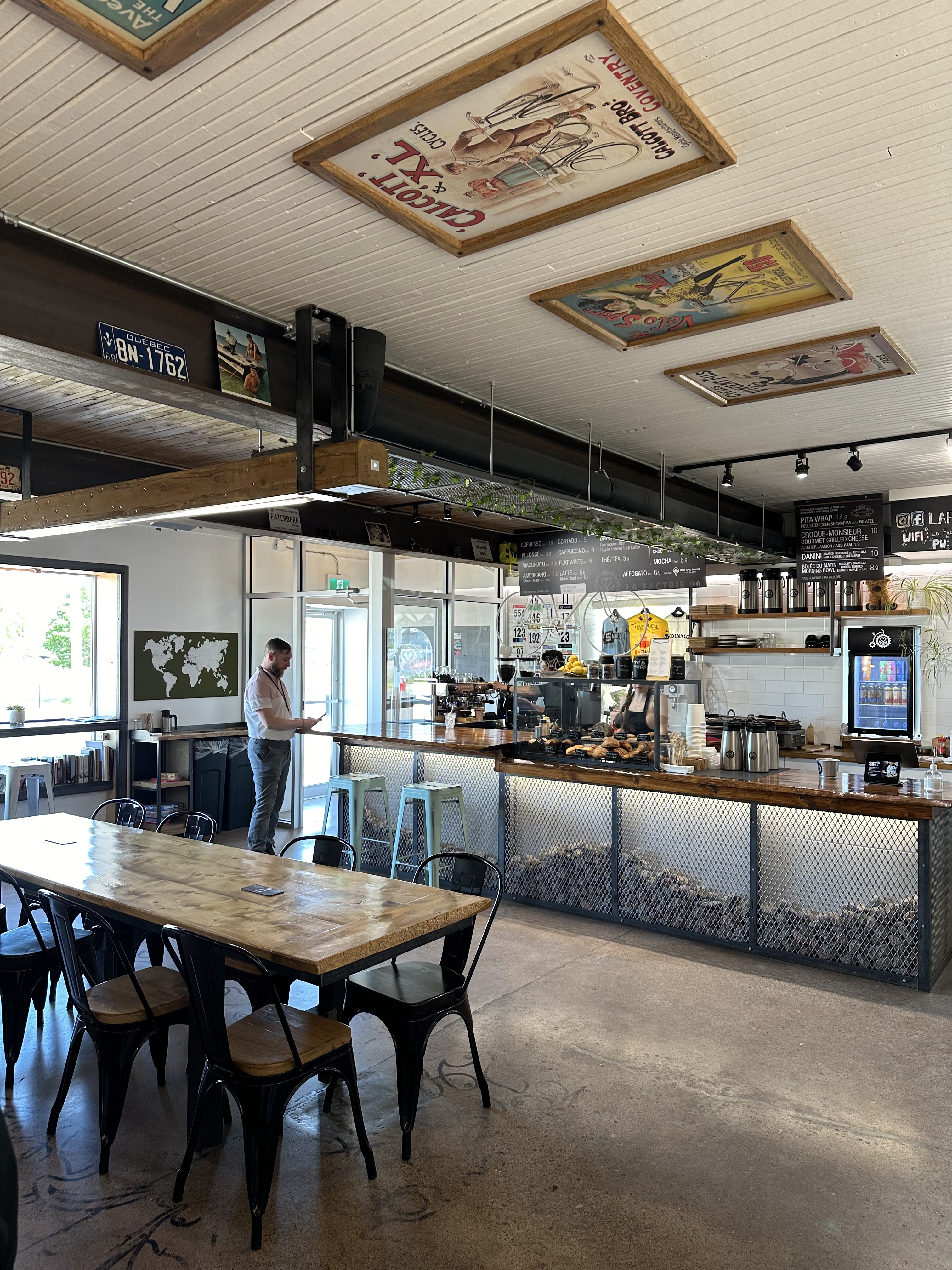
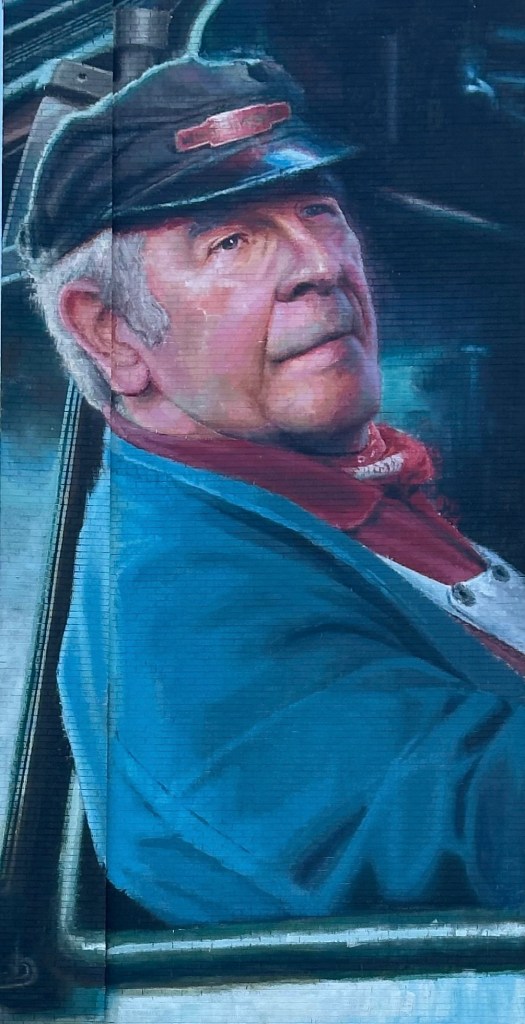
Most importantly from our perspective, the city is rife with remarkble restaurants, home to countless coffee cafes and a multitudinous mural scene (50+ murals and counting). We will let the photo collection below illustrate our 36 hours in Moncton.
Moncton, New Brunswick (Photo Getty Images)
Artist Eelco van den Berg
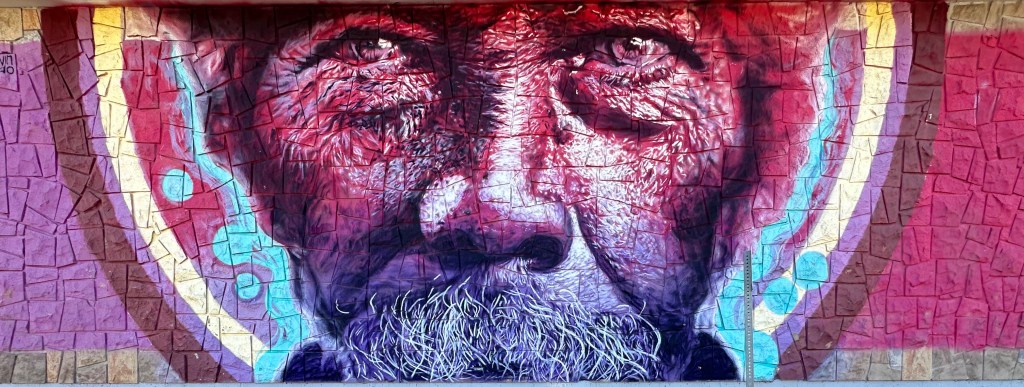
The Universe in his Eyes—Artist Kevin Ledo
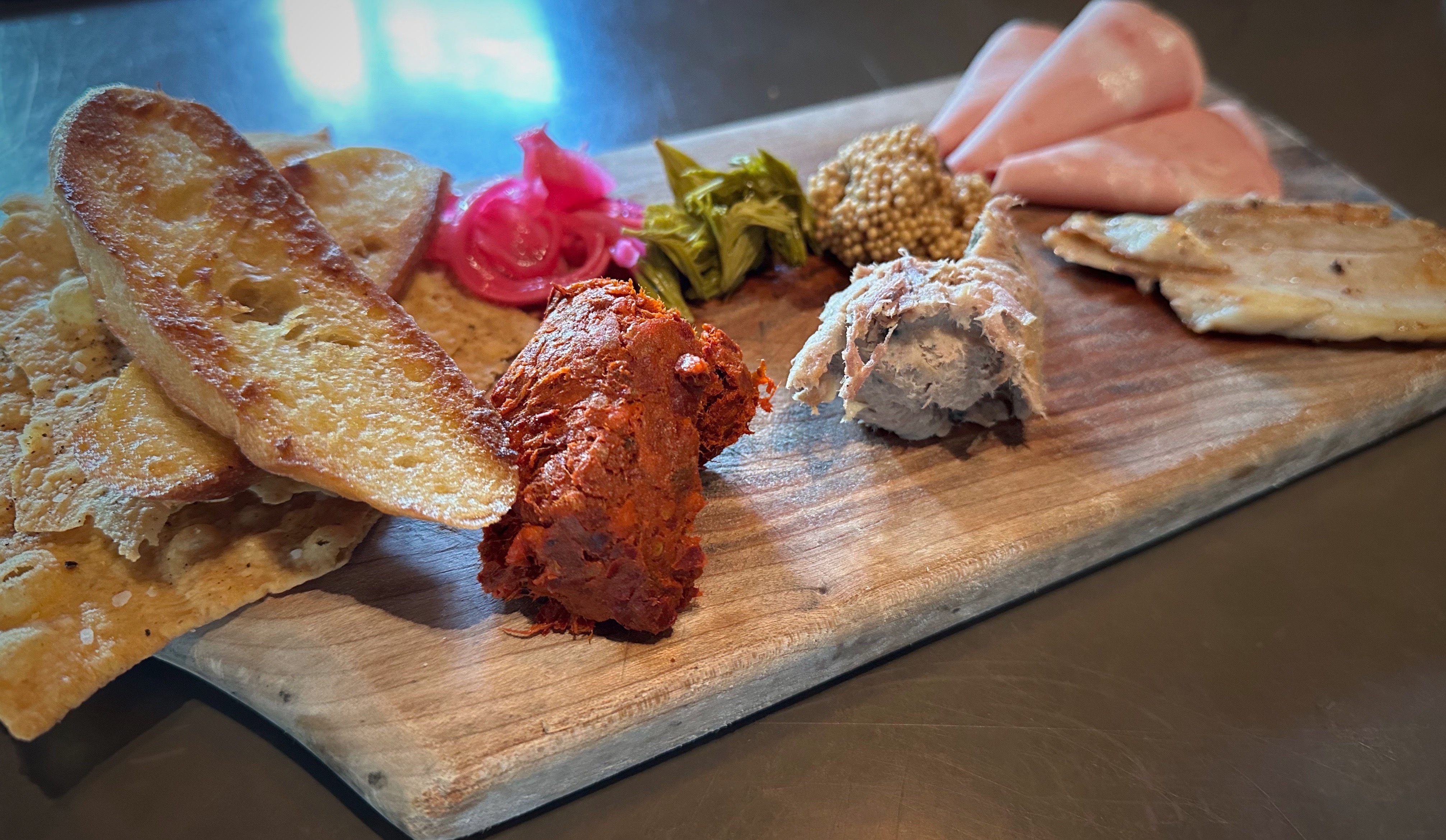
Croffle with maple butter at La Factrie, Moncton
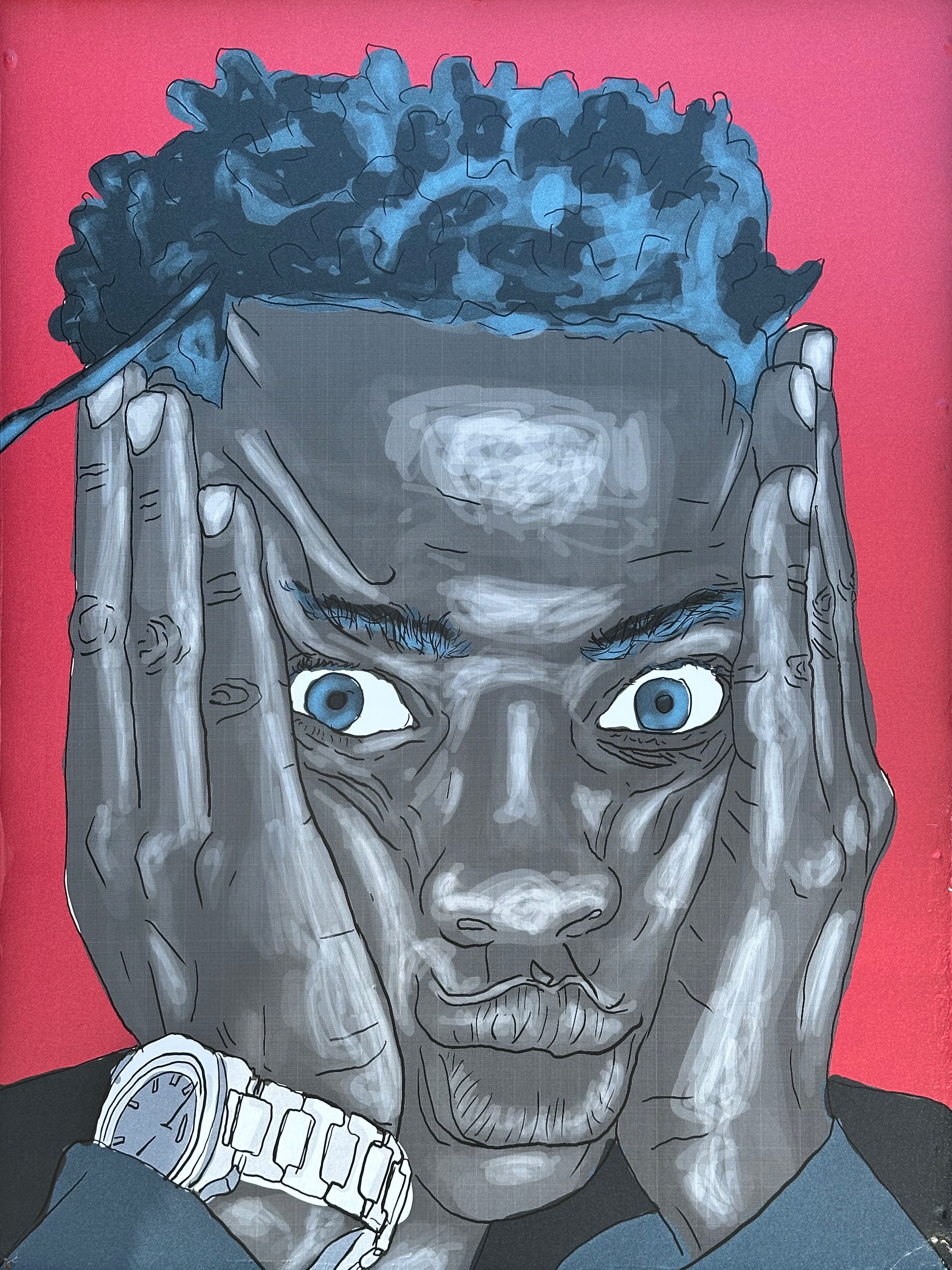
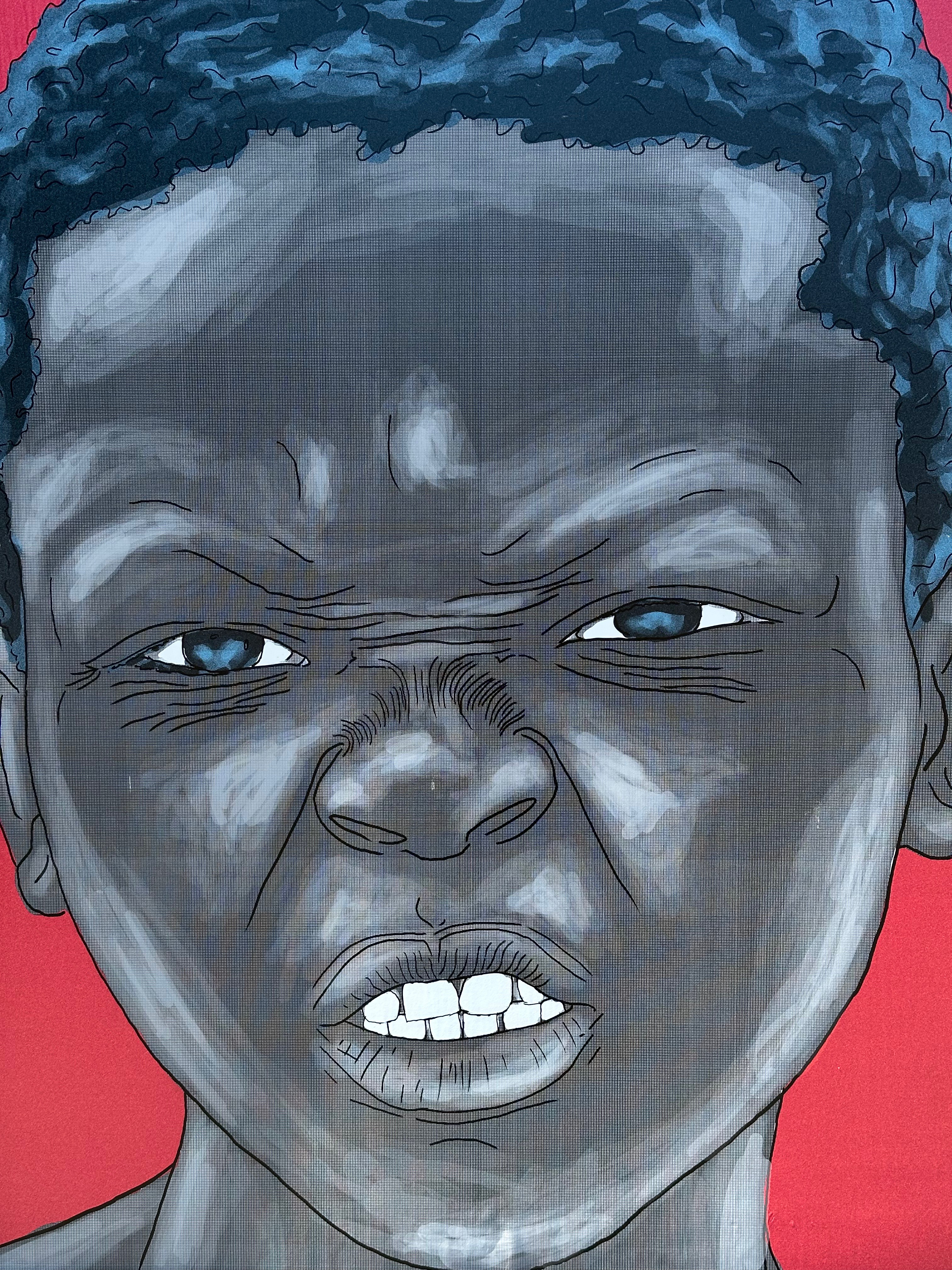
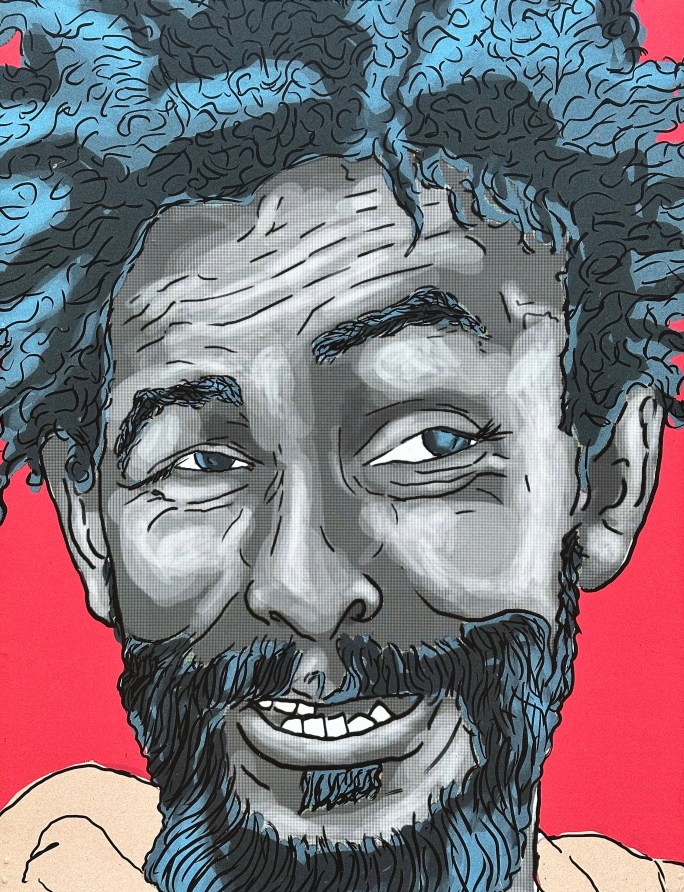
“If we can’t cry or get angry, let’s make a face to lessen our misfortune and look less ridiculous.”— Rotchild Choisy
Artist Rotchild Choisy
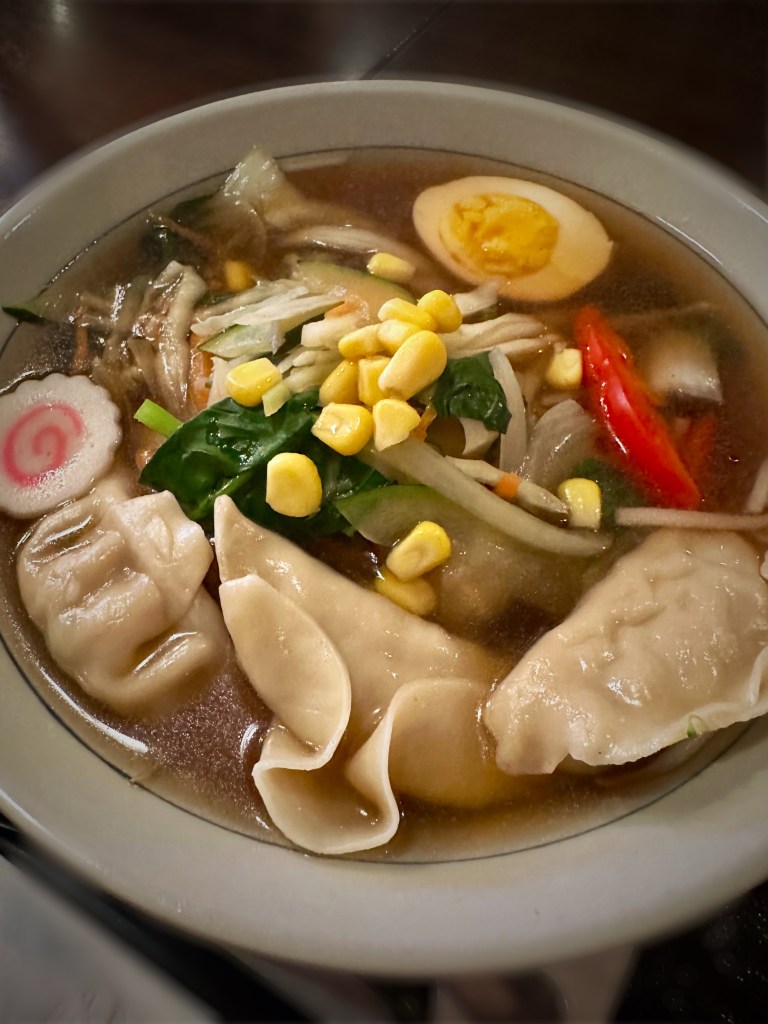
Tokai Ramen, Moncton
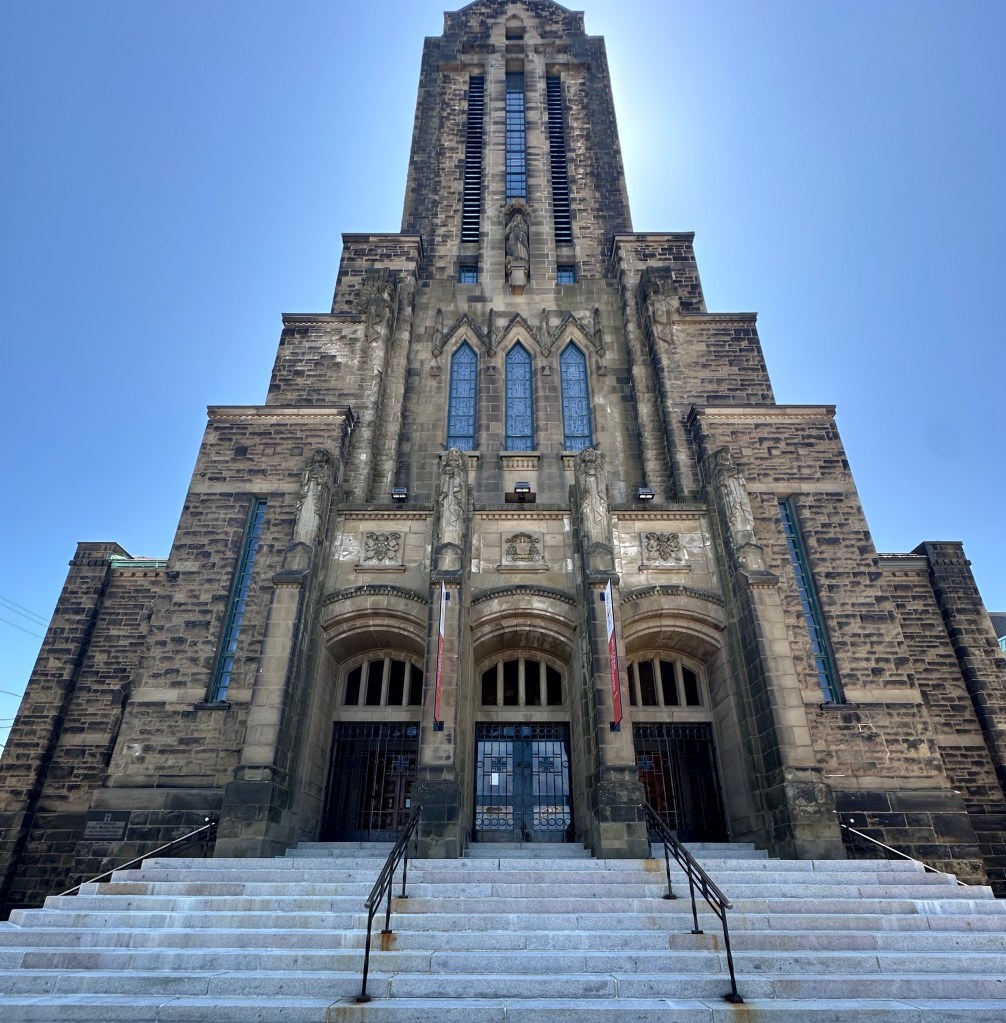
Built in 1939 and 1940, as the Monument of Remembrance, this cathedral is a symbol of the achievements and resilience of Acadians. It recounts their history in decorative elements, such as the tower sculpture of the Assumption of the Virgin Mary, patron saint of Acadie, capitals sculpted by Acadians, and stained glass windows depicting both secular and religious events in the history of Acadie.
Our Lady of the Assumption Cathedral
The exterior combines elements of Art Deco and Gothic Revival styles, while the interior is Romanesque. An affirmation of Acadian identity, the construction of this cathedral followed the creation of the Archdiocese of Moncton in 1936.
This cathedral is historically significant as a reminder of the Great Deportation (Grand Dérangement). When Acadians (French) living in what is now New Brunswick, Noca Scotia, Prince Edward Islands and Maine refused to sign an oath of loyalty to the British Crown they were deported en mass to the American colonies — most notably Louisianna where they became known as Cajuns. Their homes and farms were destroyed and the land was given to British loyalists.
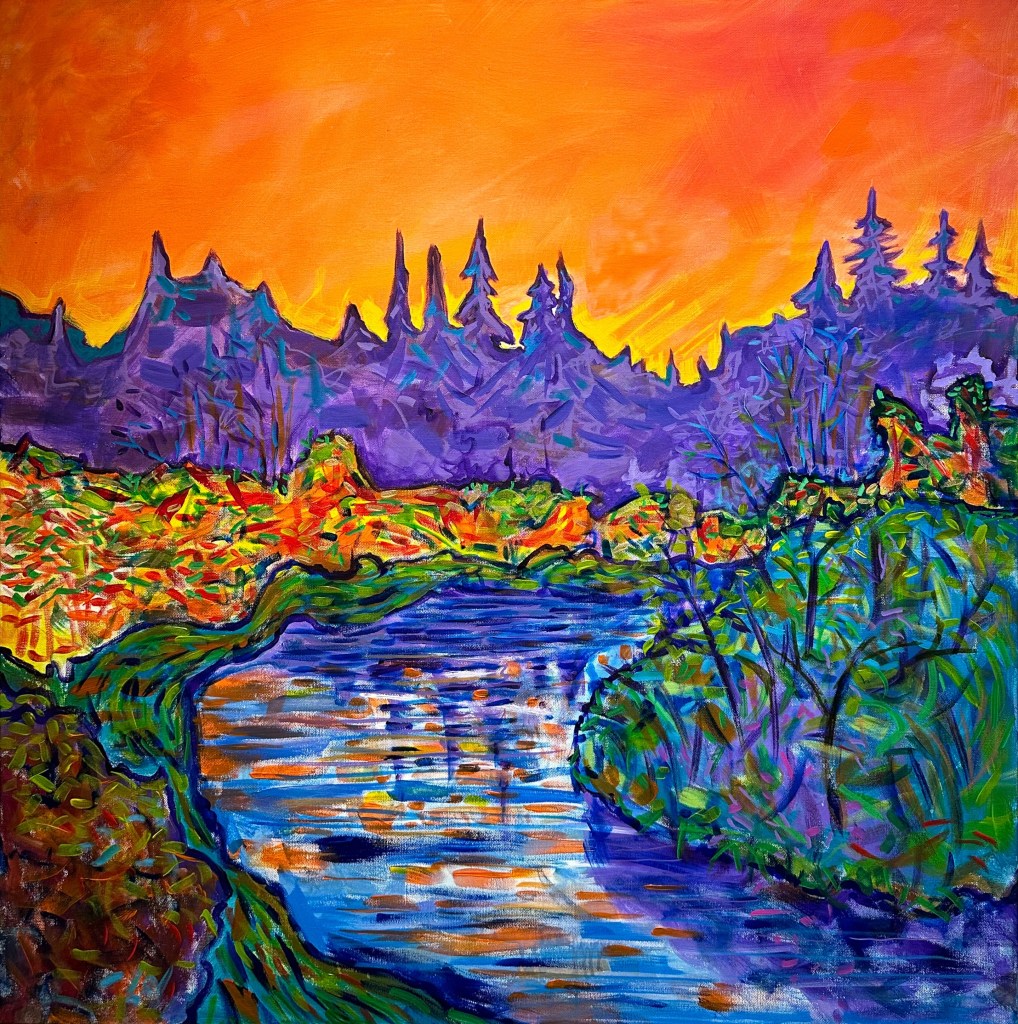
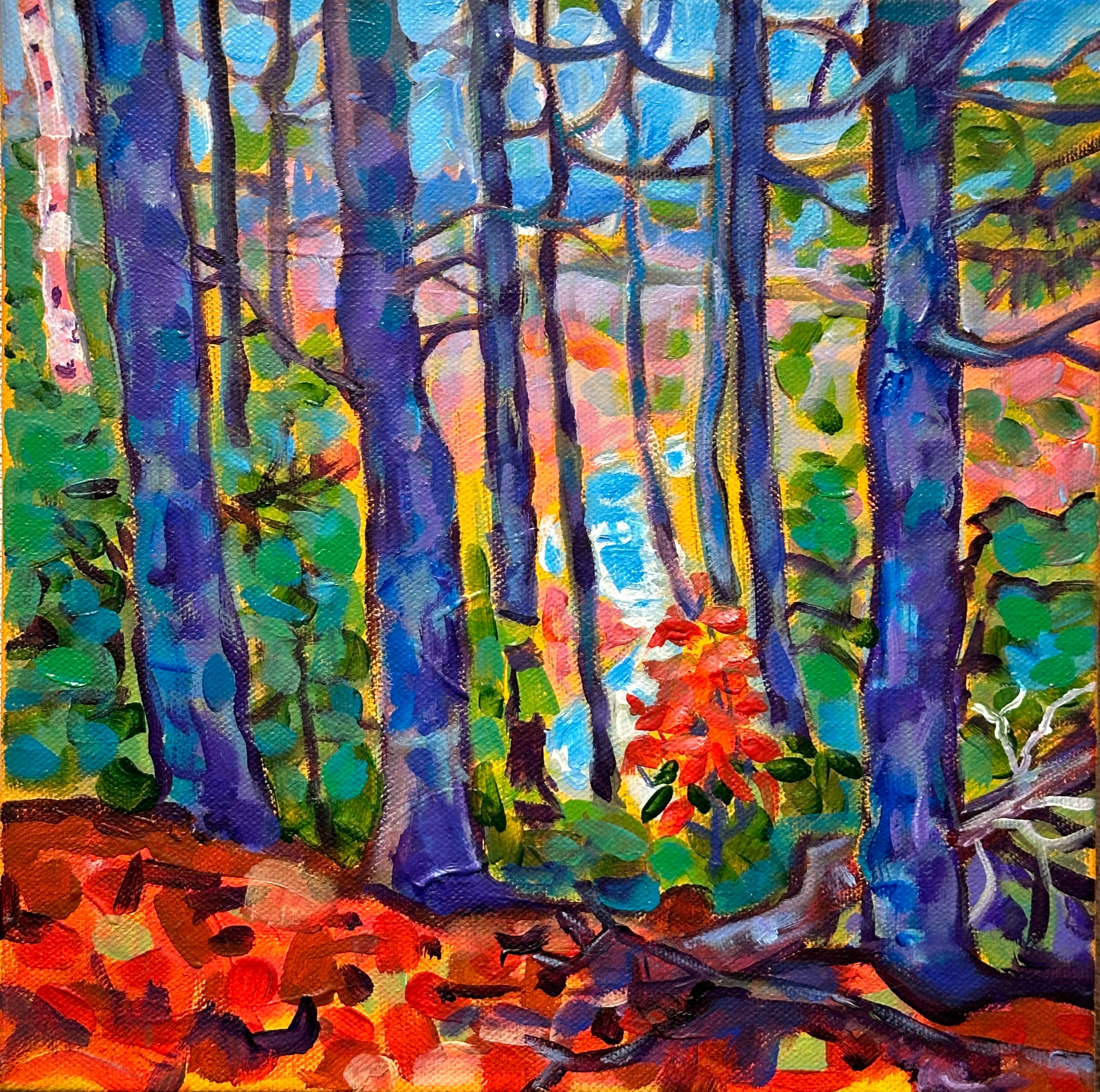
Artist Luc Joseph Damien Cormier
Moncton is also home to a number of fine art gallleries. We visited the Moncton Gallery housed inside the ground floor of City Hall. The small gallery currently has an exhibit of art by Luc Joseph Damien Cormier. We do not know much about the artist but we were really taken with the vibrant colors of the paintings featured in this exhibit.
If you are traveling in the Atlantic Provinces for the natural beauty of the breathtaking coastlines and quaint villages, don’t bypass Moncton. It is perfect for the classic 36 hour visit and can also be used as a base for many nearby attractions and outdoor activities. We will leave you with a couple more photos of our favorite street murals.
Artist Slim Safont
Our next post will cover our journey from the Canadian border to St. John.
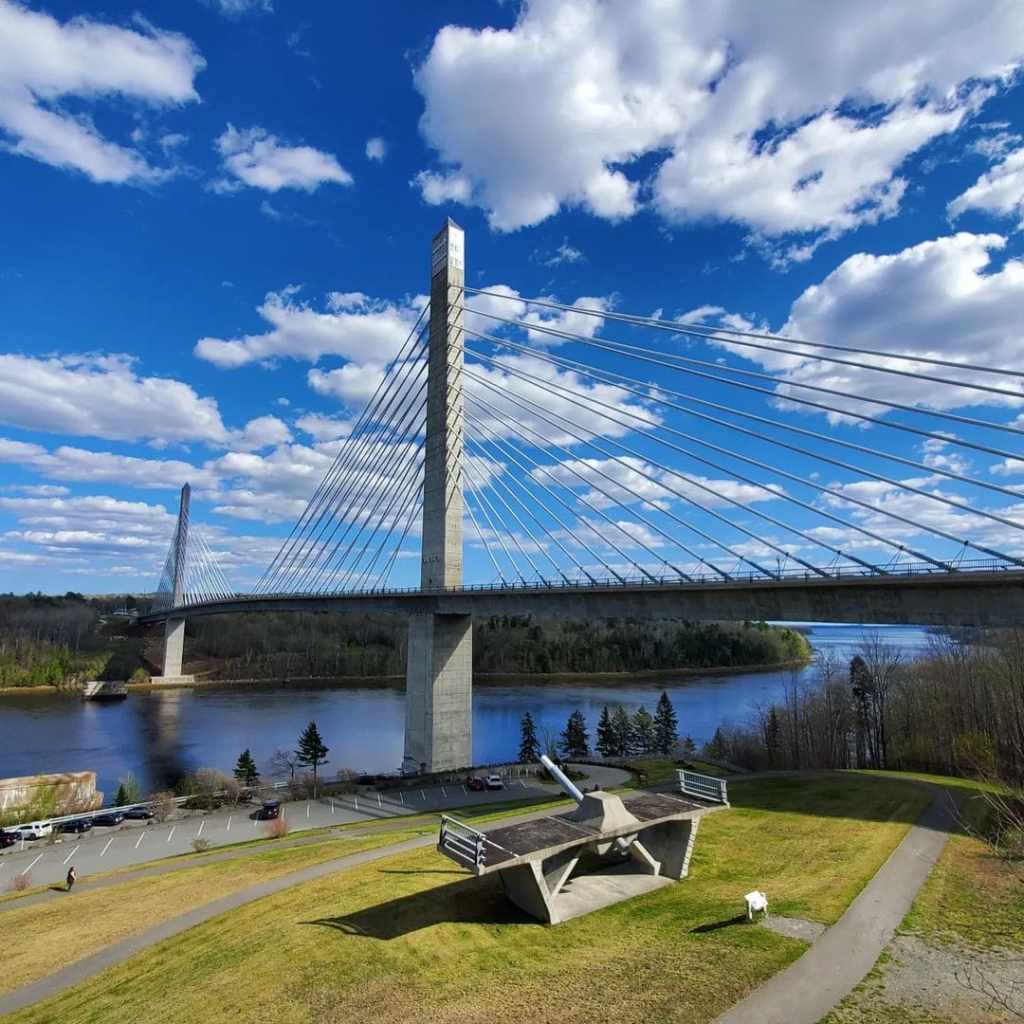
After departing the comfort of our hotel in PWM we followed the coast north for two nights of camping in Penobscot. A highlight of the drive to Penobscot and to Deer Isle is crossing the Penobscot Narrows Bridge and the Deer Isle Bridge.
Penobscot Narrows Bridge (Photo courtesy State of Maine)
The PNB pictured above and directly below is a 2120 foot long suspension bridge which opened in 2007 as a replacement for the Waldo-Hancock Bridge. The WHB was built in 1931 and was in very bad condition. The PNB was built as an emergency replacement using new untested techniques in order to accelerate the build.
Deer Isle – Sedgwick Bridge (Photo courtesy of the State. Of Maine)
The bridge pictured directly above is the Deer Isle – Sedgwick Bridge. The DISB is an almost 1100 foot suspension bridge connecting the mainland to Deer Isle. It is the only bridge connection to Deer Isle. This bridge was opened in 1939. The bridge, when opened, had wind stability problems similar to the Tacoma Narrows Bridge. The Tacoma Narrows Bridge collapsed immediately after opening. The DISB has had additional cables attached to prevent collapse from high winds! Driving over this bridge is an adventure – the bridge is steep and narrow and frankly a bit scary – particularly given the history of other similar bridges.
Through HipCamp we found a family that hosts just three campsites spread across 50 acres of blueberry fields. This location provided us with privacy and wonderful scenery as we relaxed by our campfire in the evenings.
We embarked on a short road trip from our campsite south over the bridge onto Little Deer Isle and from there crossed over to Deer Isle. Deer Isle has two towns-the eponymous Deer Isle and Stonington, which is nestled at the southern end of the Isle on the Gulf of Maine.
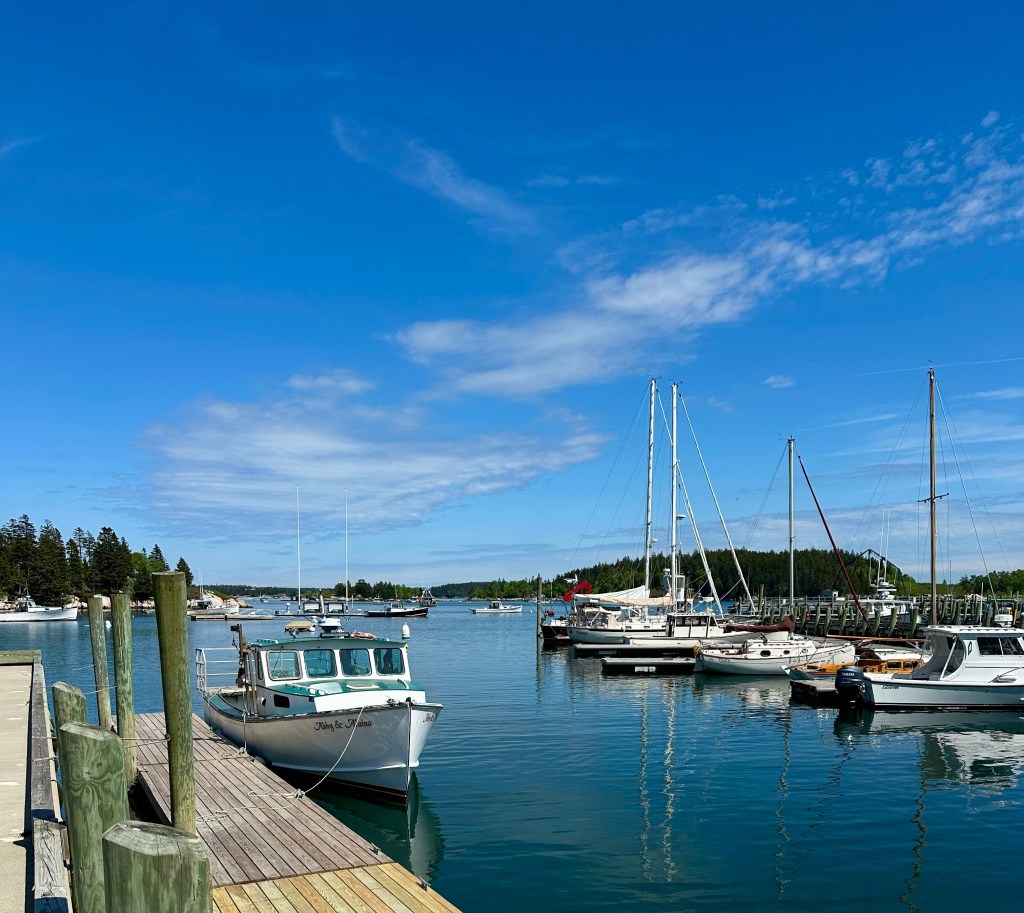
Stonington,Maine
Stonington has become somewhat of a tourist destination with Main Street predominately occupied by restaurants and retail establishments. The year round population of the Isle remains small at about 3000 residents. The mainstay of the local economy remains lobstering, although the granite industry has made a small comeback in recent years.
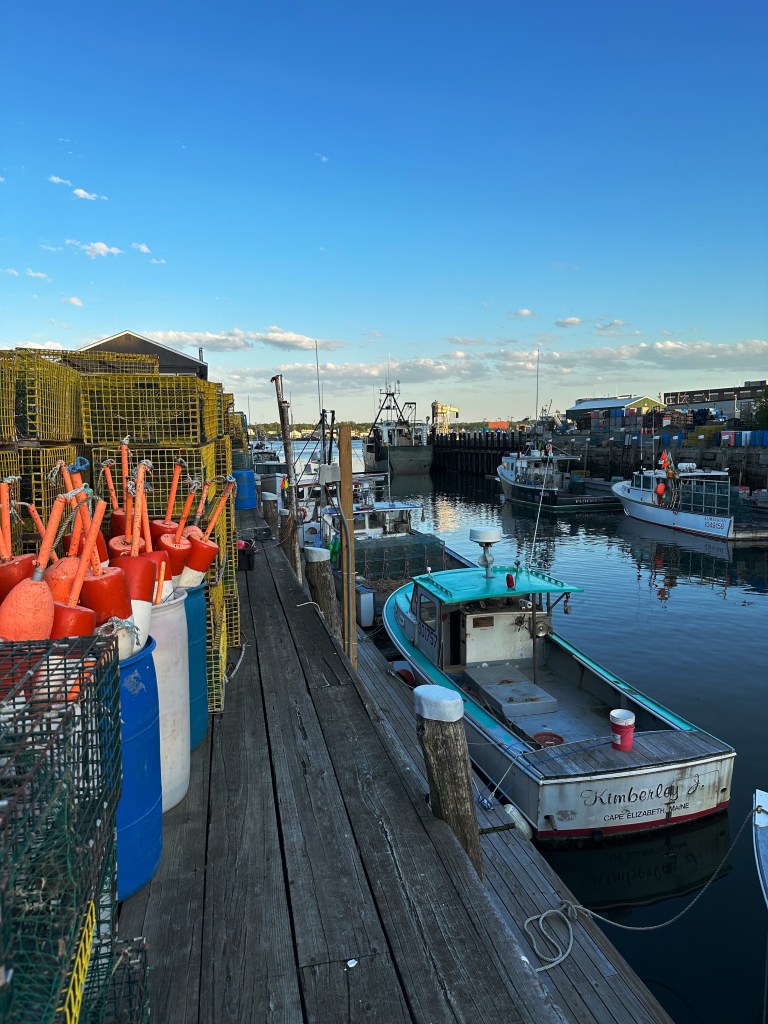
Lobstah!
At one time there were over 130 granite quarries operating along the coast of Maine. Many of the quarries are actually on the numerous small islands dotting the coastline. Today there is a quarry operation on Crotch Island (Yep!), a short distance offshore from the harbor at Stonington. Granite is extracted and moved to shore via barges.
Of course, for thousands of years before the arrival of Europeans settling in what is now Maine this area was home to the Penobscot.
The Penobscot (penawahpkekeyak) lived off of the bounty of the Penobscot River and Basin for thousands of years. After the arrival of settlers from Europe the Penobscot fought with the French against the British. When the British defeated the French the Penobscot signed a peace treaty with the British in order to avoid being deported to Canada.
With the advent of the Revolutionary War the Penobscot allied themselves with the American revolutionaries. Their support of the Americans was based on agreements that the Penobscot homeland would remain intact. None other than George Wasington agreed to this arrangement in a letter dated in 1777! Well, we all know how this story ends.
Today, the Penobscot are a federally recognized nation and a member of the Wabanaki Alliance of tribes. A portion of the Nation’s land was returned after a court case (The Maine Indian Claims Settlement Act – 1980) found in favor of the Penobscot and other tribes.
As a result of the legal settlement the Penobscot have 4000 acres of reservation land spread across 200 islands in the Penobscot River (their ancestral home as riverine people). Additionally, the Nation has 90,000 acres of land in trust which they manage. The trust land consists of nine locations in Maine.
There are currently 2400 people enrolled as members of the Penobscot Nation. The Nation has a fully independent system of government including it’s own judicial system. Two members of the Nation represent the Penobscot as non-voting members of the Maine State Legislature.
We departed Penobscot for a night in Bangor before heading to Calais to enter Canada. Staying the night in Bangor provided us with the opportunity to replenish supplies and more importantly make up for our specialty coffee and tea deficit. An added bonus was the chance to shoot several excellent murals.
Artist: Liam Reading
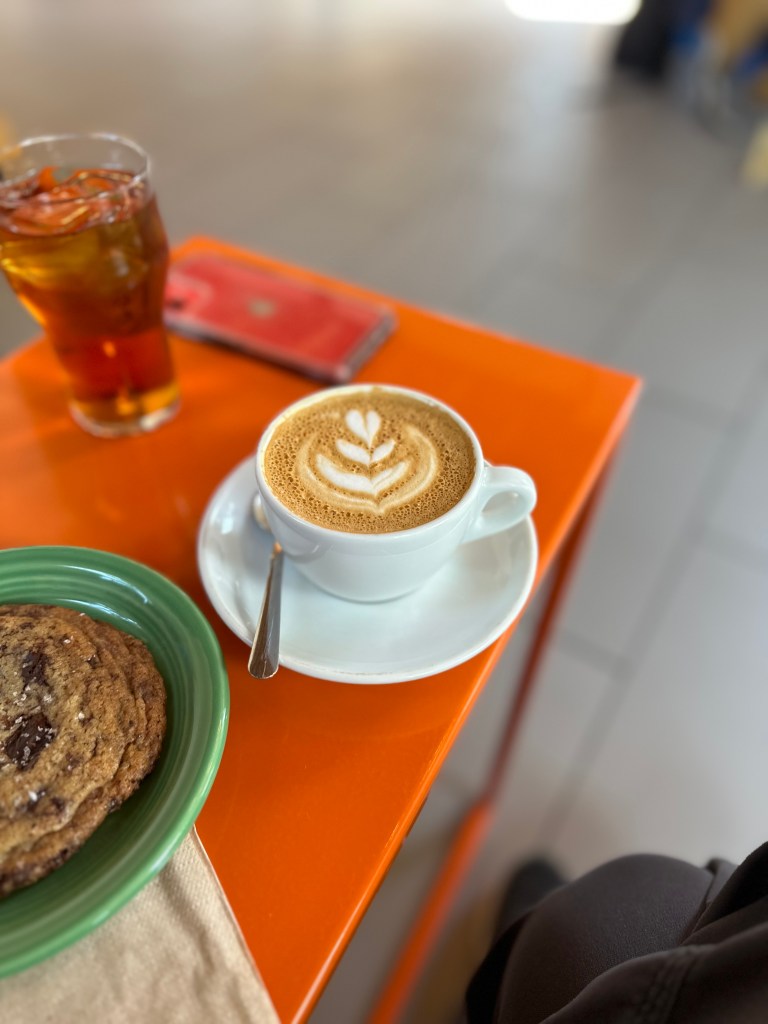
Chimera Coffee has been operating in Bangor for a couple of years. The owner had relocated from Dallas looking for a less crowded, hectic environment which offered cultural and oudoor activities. This worked out well for us as neither of the two specialty coffee shops in the Deer Isles had yet opened for the season. Thank you Chimera! P.S.Chimera serves Tandem Coffee!
Well that is pretty much a wrap for Maine. We will cover the enhanced security now in effect at the border and our travels along the beautiful coast of Fundy Bay in New Brunswick in our next post.
After a year off the road we have embarked on OTR 10.0! As we are headed north through Maine to the Atlantic maritime provinces of Canada we made Portland (PWM ) our first stop of the adventure.
PWM is a city of just over 68,000 but plays so much bigger! The food, coffee and art scene invariably provides something new and interesting to experience every time we visit.
Arriving in PWM mid-afternoon we made straight for Coffee By Design at their Diamond Street location in the East End. CBD is one of the oldest specialty roasters in the city dating back to 1994.
Coffee By Design
After our infusion of caffiene at CBD we worked our way up the hill for cocktails at Hardshore – a local distiller of gin and bourbon. Their gin is very reasonably priced and quite tasty! Our cocktails set us up perfectly to saunter across the street for dinner.
Izakaya Minato is located in the East End of PWM and is styled after traditional Japanese Izakaya. Izakaya (stay-drink-place) establishments are neighborhood bars that traditionally serve small plates and snacks to accompany alcoholic drinks and of course Sake.
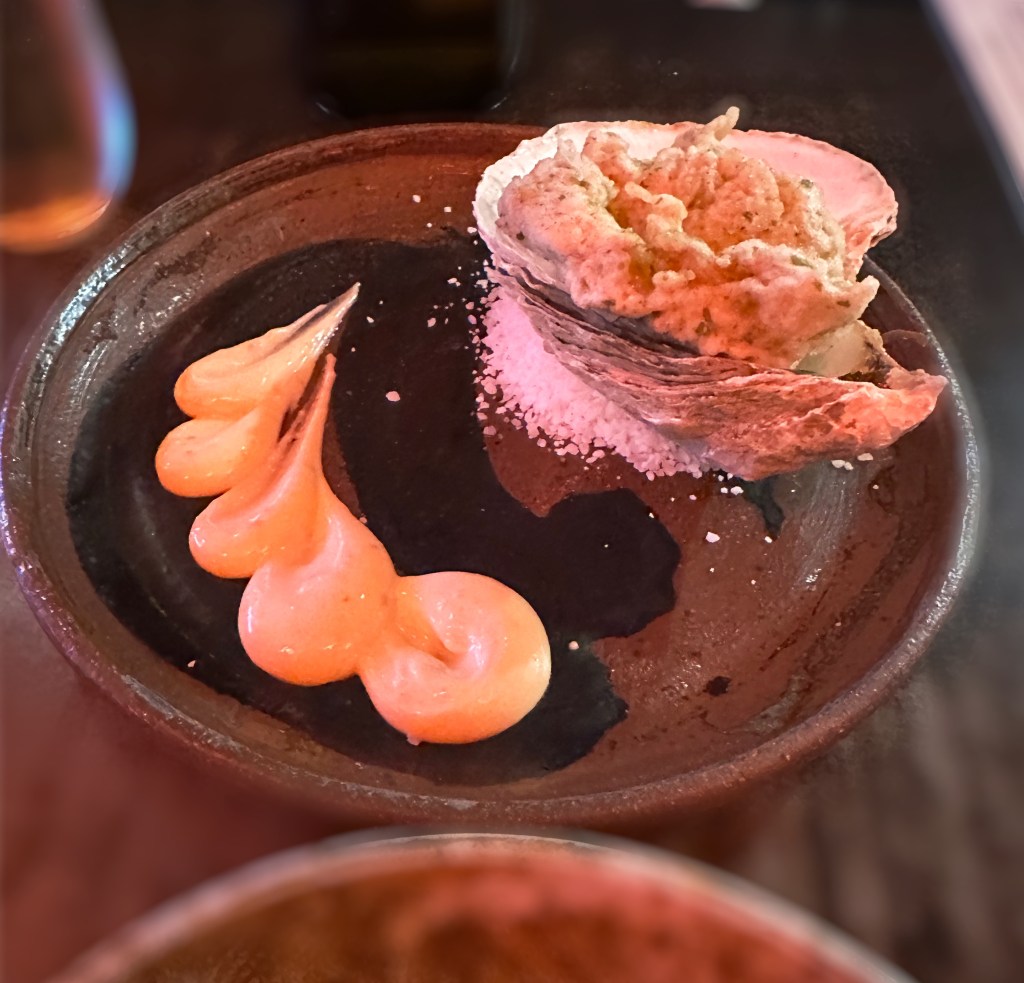
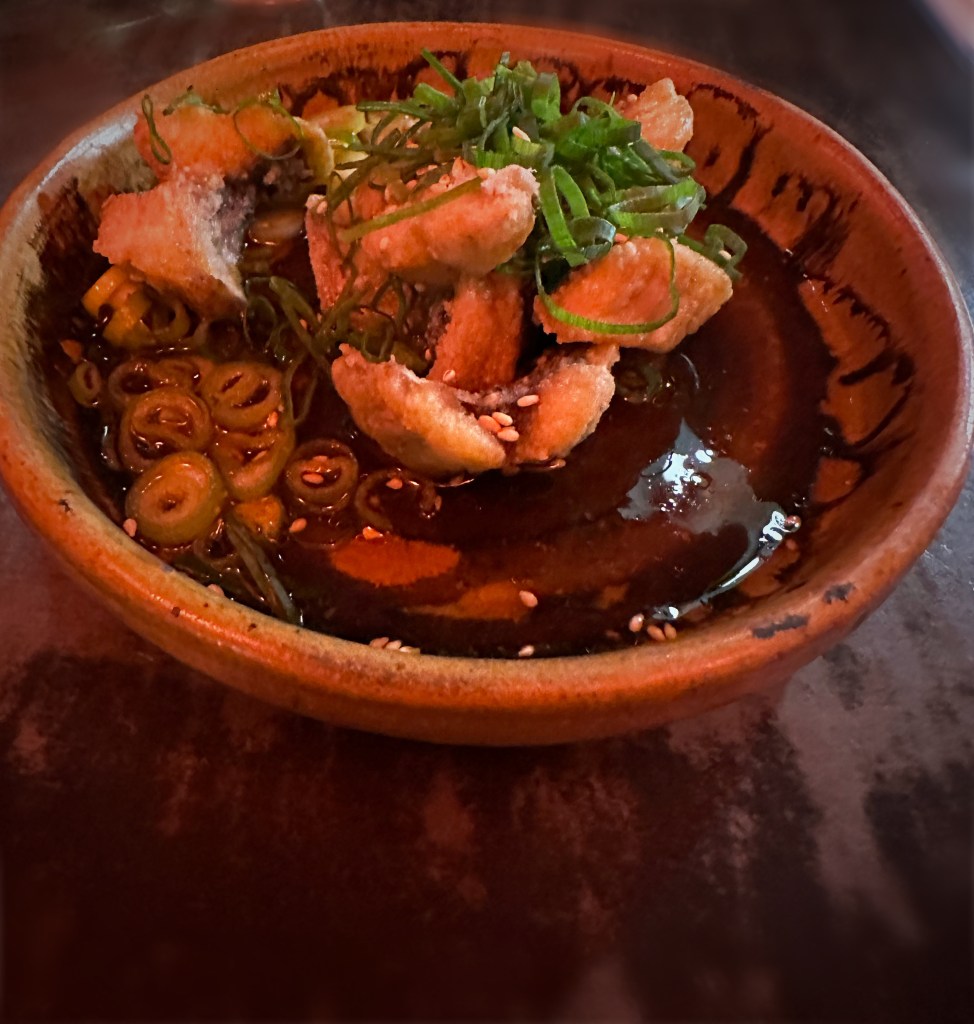
Our meal and drinks were excellent. We tried oyster tempura, fish and chicken dishes with rice and a fabulous spinach salad with the tastiest mushrooms ever. We highly recommend Minato!
Izakaya Minato
The next morning we ventured back to the East End for Fika but visited one of the other excellent coffee roasters and cafe operators in PWM – Tandem Coffee. Visitors tip — while the bakery is located at the East Congress Street location in the refurbished retro gas station location (very cool) it is always difficult to find parking and seating. The Anderson Street cafe located at the roastery is a low key neighborhood joint with super friendly folks and no problem finding parking or seating.
Hadlock Field
The Portland Sea Dogs Double A ball club was at home during our visit so we spent a lovely late afternoon at Hadlock Field. The home town club had their way with the visiting Hartford Yardgoats. Final score 7–4.
Portland has the three top prospects in the Red Sox system. Prospects SS Marcelo Mayer and CF Roman Anthony were in the line up but did not stand out during this contest. P.S. The Yardgoats are our home team in Connecticut and our record with them in person remains intact as we have never witnessed them winning a game!
After the ballgame we journeyed downtown for a stroll along the picturesque waterfront and a nightcap of gelato! Gorgeous Gelato is one of our favorite gelato spots in all of our travels. The husband and wife owners moved to Portland after graduating from the Gelato University in Milan. https://www.portlandoldport.com/listing/gorgeous-gelato/
Dark Chocolate Whiskey and Pistachio/Coconut Gelato
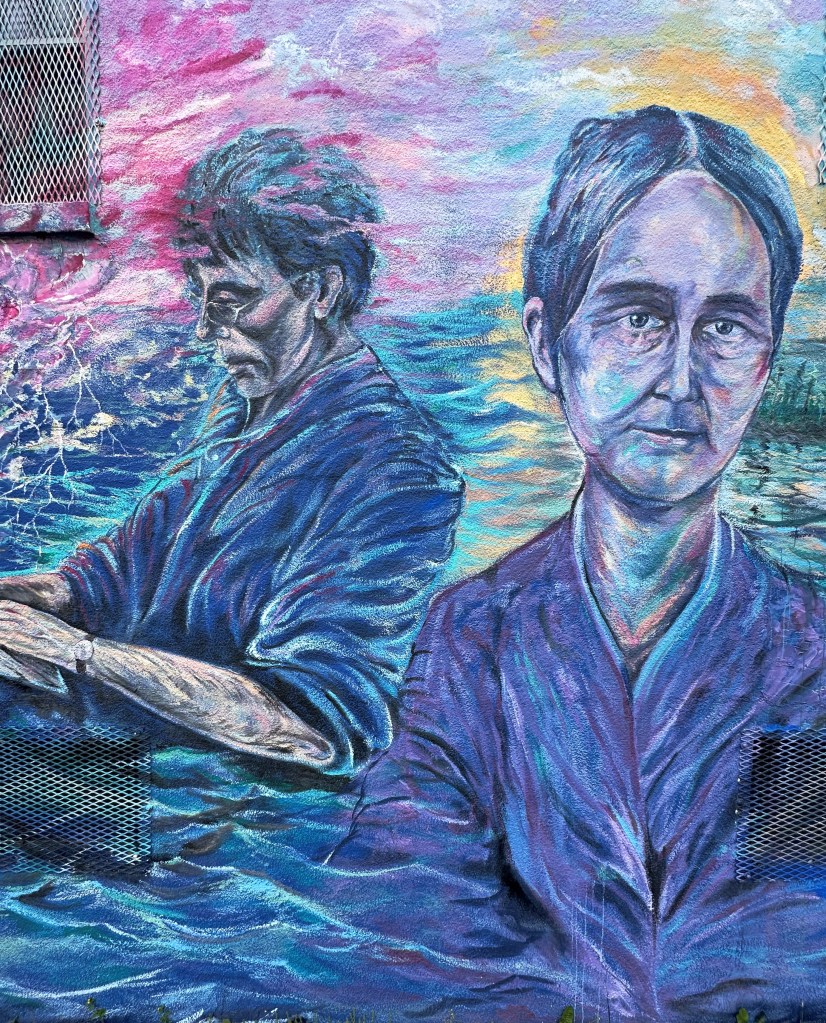
The street art scene in PWM remains as vibrant as ever. The three murals pictured below are new finds for us since our last visit. They are all located in the East End where we obviously spent a lot of our time during this brief stop in PWM.
“Nicole” Artists—Ryan Adams and Rachel Gloria Adams
“Moon” Artists—Ryan Adams and Rachel Gloria Adams
“Alain” Artists—Ryan Adams and Rachel Gloria Adams
Well, that is it for our first post in a year! Our next stop will be in Penobscott for several days of camping and touring the beautiful Deer Isles.
Fine Art Tourist:OTR 8.0: Mississippi Museum of Art: New Symphony of Time
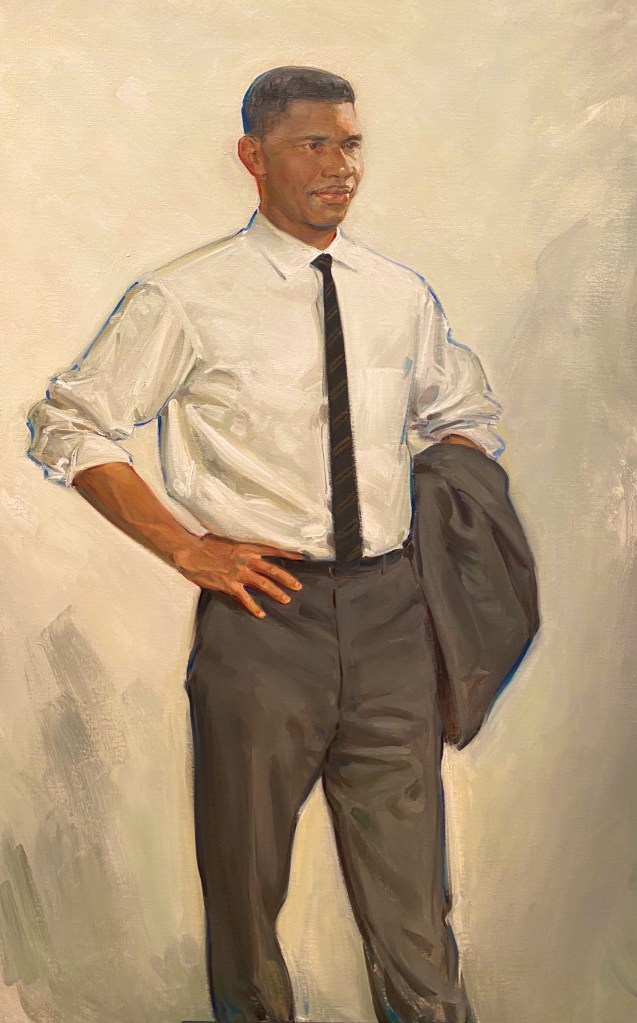
Jason Bouldin (1965) Portrait of Medgar Wiley Evers, 2013, Oil on canvas
Hystercine Rankin (1929-2010) Baptism in Crow Creek, 1996, quilted fabric, with appliqué and embroidery
After several days in Vicksburg, immersing ourselves in Civil War and Mississippi River history (see post – ctsprinterlife: OTR 8.0: Mississippi Part Three), we decidedto head east to visit Jackson, before continuing our journey south along the Mississippi River.
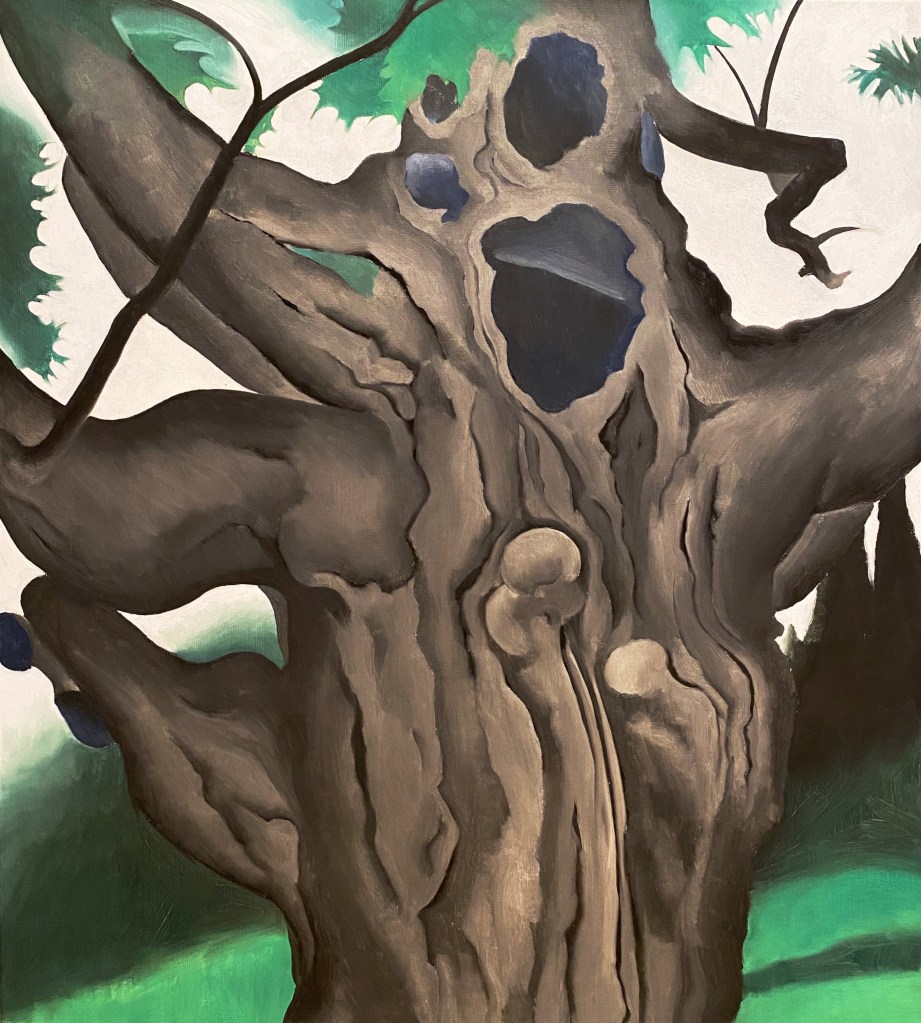
Our timing turned out to be impeccable asMMOA was just opening a new exhibit entitled New Symphony of Time. The exhibit is ongoing and part of the permanent collection of the MMOA. The exhibit consists of 170 works by noted artists such as Georgia O’Keeffe, Albert Bierstadt and Benny Andrews.Additionally, the exhibit includes many works by talented Mississippi artists.
msmuseumart.org
Albert Bierstadt (1830-1902) A Scene in the Rockies, Lake Silva Plans, not dated, Oil on canvas
New Symphony of Time expands and illuminates the boundaries of Mississippi’s narrative. Exploring the themes of ancestry and memory; migration, movement, and home; shared humanity; the natural environment; and liberty for all, the exhibition is inspired by Margaret Walker’s epic poem, “This is My Century: Black Synthesis of Time.” (Above paragraph is taken from the curator notes.) The poem is interspersed in the post below.
Throughout the exhibit certain ideas resonate: personal and collective memory, history and the connection to place, as well as the roles artists play in pursuit of civil rights and racial equality.
Helene Canizaro (1911-1997) Stafford Springs,1974, Oil on canvasGeorgia O’Keeffe (1887-1986) The old Maple Tree, Lake George, 1926, Oil on canvasMildred Nungester Wolfe (1912-2009) The Old Studio, 1957, Oil on canvas
This is My Century: Black Synthesisof Time by ---Margaret WalkerO Man, behold your destiny,
Look on this life
and know our future living
our former lives from these our present days
now melded into one.
Hale Woodruff (1900-1980) Mississippi Wilderness, c. 1944, Oil on canvas
Queens of the Nile,Gods of our Genesis,
Parade of Centuries
behold the rising sun.
The dying Western sky
with yawning gates of death,
from decadence and dissonance
destroying false and fair,
worlds of our galaxies,
our waning moons and suns
look on this living hell
and see the rising sun.
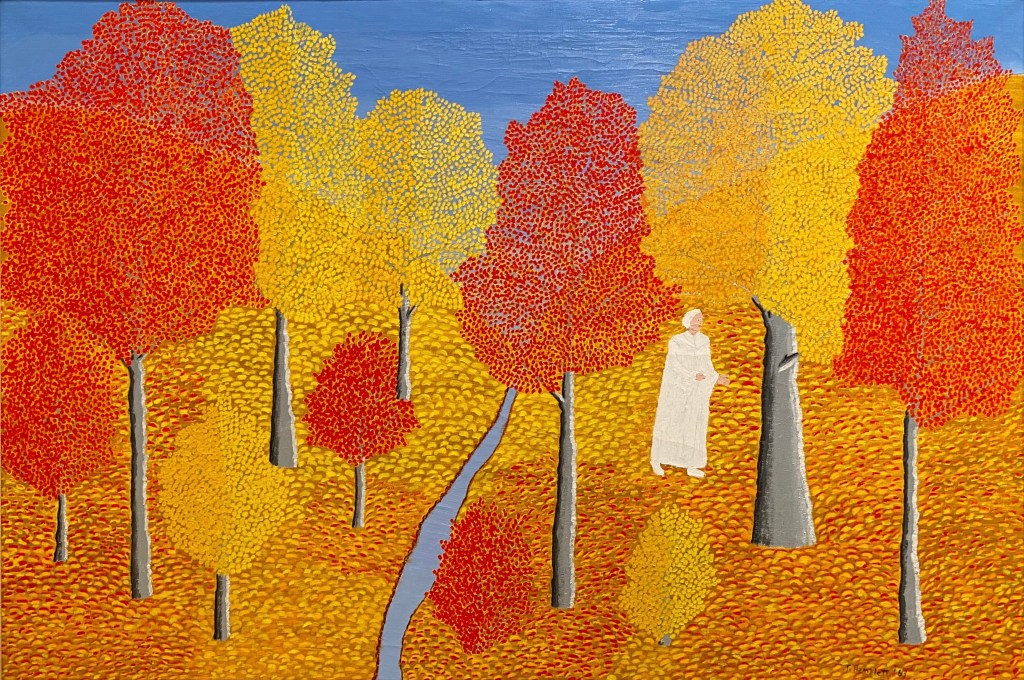
Theora Hamblett (1895-1977) Walking, Meditating in the Woods,1963, Oil on canvas
This my centuryI saw it grow
from darkness into dawn.
I watched the molten lava pour
from red volcanic skies;
Islands and Mountains heave
into the sea
Move Man into the spiraled axis turn
and saw six suns and sunsets rise and burn.
Karl Wolfe (1903-1984) Xanadu (View from Studio Window), c. 1960s, Oil on board
Osiris, Isis, black and beautiful gods,
When came your spectacle
of rythmed life and death?
You gods of love
on pyres of sacrifice
our human hearts become
old hearthstones of our tribal birth and flame:
the hammer and the forge,
the anvil and the fire,
the righteous sparks go wild
like rockets in the sky.
The fireworks overhead
flame red and blue and gold
against on darkened sky.
O living man behold
your destined hands control
the flowered earth ablaze,
alive, each golden flower unfold.
John McCrady (1911-1968) Rural Symposium, 1964, Acrylic on board
Now see our marching deadThe tyrants too, have fled.
The broken bones and blood
Have melted in the flood.
Clementine Hunter (1886-1988) Untitled, 1980, oil on canvas board
Cinque.O man magnificent.
The gods endowed you well.
Prince of our innocence
The stars move round your head.
You stride the earth to tell
your sons and daughters young
from island, sea, and land-
a continental span-
how men are made of gods
and born to rule the world.
In majesty with monumental hands
you bridge the Universe
and centuries of desert sands.
Bequeath to us your handsome dignity
and lordly noble trust.
George Morland (1763-1804) Execrable Human Traffick, 1789, Oil on canvas
Gods of compassion, rise
In mortal human form.
The splendor of your eyes
Streaks lightening through the storm.
Noah Saterstrom (1974) Road to Shubuta, 2016, Oil on canvas
This is my century-Black synthesis of Time:
The Freudian slip
The Marxian mind
Kierkaardian Leap of Faith
and Du Bois' prophecy: the color line.
These are the comrades of Einstein,
the dawning of another Age,
new symphony of Time.
New liberties arise;from Freedom's flag unfold;
the right to live and be
both stronger and more wise.
Each child, a prophet's eyes;
each place, a priestess stone.
This Beast no man denies
the godly-human throne.
Each generation cries
to touch divinity
and open up the sunlit splitting skies.
Ruth Miller (1949) The Evocation and Capture of Aphrodite, 2014, hand-embroidered wool
I have had a good time singingthe songs of my fathers
the melodies of my mothers
the plaintive minor notes of my grandmothers.
I heard the drums of Africa
and I made the music of Spain.
I gave rythym to the world
and called it syncopation.
All the Calypso brothers
have dance music in my head
and all my beautiful jazzy greats
like old Satchmo,
the Duke, the Count, the Duchess, the King
the Queen, Prince, and Princesses
they were the sons and daughters of royalty
in my dynasty.
I am a black shoeshine boy
made immortal by Barthe
and I am a black mother
running from slavery.
Ernest Crichlow (1914-2005) Underground III,1990, Oil on canvas
Look on my bronzed and black-red-mahogany face
and know me well.
For I am the seed of the earth,
the broken body of the Son of God,
and the Spirit of the Universe.
Drink wine in my memory
and pour water on stones
singing Libation songs.
I came out of the sunand I swam rivers of blood
to touch the moon.
I will not flinch before the holocaust
for I am a deathless soul,
immortal, black, and free.
The MMOA started as a state art association in 1911 and has grown in size and stature. Today the museum collection includes 5800 worksand contains works by notable artists including Andy Warhol, Robert Henri, Georgia O’Keeffe and George Bellows.
The museum and the community are clearly demonstrating a commitment to confronting the legacy of racism in Mississippi and to moving forward to help foster a better present and future. Our hats off to the organization and community.
We hope you enjoyed this edition of OTR with Maria and Stephen.
CAUGHT IN THE CIRCLE, 1903 —- Charles Marion Russell
The NCWHM was founded in 1955 as the National Cowboy Hall of Fame and Museum with a focus on honoring the cowboy. Today the museum is a smorgasbord of history, culture and fine art. The museum has over 200,000 square feet of display space with twelve galleries including a replica of a western frontier town and a significant collection of firearms in addition to cowboy and Native American art and artifacts. https://nationalcowboymuseum.org/all-galleries/
This post will focus on three painters whose works are in the museum collection, and are well known for their depiction of western life and Native Americans.
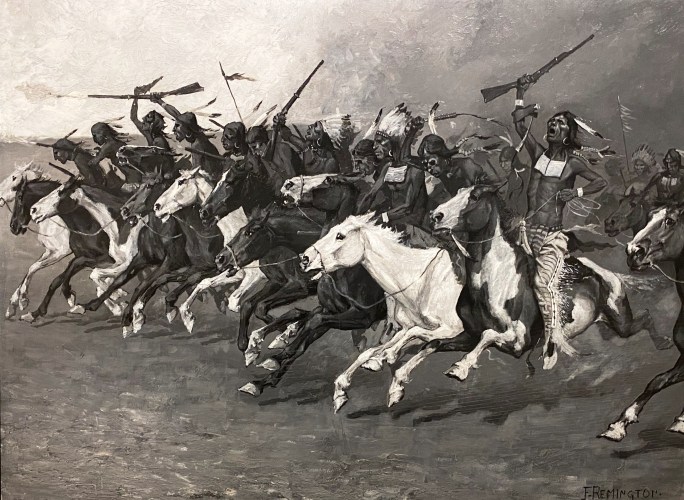
Federic Sackrider Remington (1861 – 1909) is undoubtedly one of the most widely recognized artists of the Old American West. As with many of his compatriots, Remington was an Easterner sent to the West to create illustrations for books and magazines which were focused on the romantized West of cowboys and indians.
PONIES PAWING IN THE SNOW, 1888 — Frederic Sackrider Remington
Unlike many of his fellow artists, he lived in the West for a period of time, owning a ranch and a saloon at different times (neither of which was successful). Remington’s start as a professional artist was actually the bartering of drawings to pay some of his debtors during the period of time he owned the saloon.
RAY’S TROOP, c. 1903 — Frederic Sackrider Remington
While he had very little formal art training, Remington became highly proficient at drawing cowboys, indians and cavalry officers (who paid him handsomely for portraits in uniform).He was quoted as saying “Cowboys are cash with me”.
THE HUNTERS’ SUPPER, 1909 — Frederic Sackrider Remington
Remington became quite successful financially, moving back East and taking up residence in a large mansion he had built for his family. Unfortunately for him, he adopted an oppulent life style and essentially ate and drank his way to an early death due to complications from his immense size.
THE CHARGE ON THE SUN- POLE, c. 1890 — Frederic Sackrider Remington
IN FROM THE NIGHT HERD, 1907 — Frederic Sackrider Remington
Charles Marion Russell (1864 – 1926) was born in Saint Louis, but from an early age was enamored of the West; by the age of 16 had left home to work as a ranch hand in Montana. He made Montana his home for the rest of his life, marrying Nancy Cooper and building a home in Great Falls.
WHEN TRAILS WERE DIM, 1919 — Charles Marion Russsell
Russell had no formal art training. He drew scenes from his life on the ranch as a way to record his experiences. “Between the pen and the brush there is little difference but I believe the man that makes word pictures is the greater.” —- Charles Marion Russell
WHEN MULES WEAR DIAMONDS, 1921 — Charles Marion Russell
Russell’s wife was influential in marketing his sketches, painting and drawings – as his work became popular he devoted himself full time to his artistic endeavors.By that time, he had spent eleven years ranching and had even lived for a time with a Native American tribe. His first hand knowledge of the West provided him with the ability to portray the West in a manner that other artists could not achieve. It is no wonder that Charlie (as he was known by his friends) is considered America’s true Cowboy Artist.
THE CALL OF THE LAW, 1911 — Charles Marion Russell
Russell is considered by many to be an early conservationist. ”A pioneer is a man who turned all the grass upside down, strung bob-wire over the dust that was left, poisoned the water, cut down the trees, killed the Indian who owned the land and called it progress.” —- Charles Marion Russell
As an acknowledgement of his recognition of the need to preserve the environment, a 1.1 million acre national wildlife refuge stretching along a remote portion of the Missouri River in Montana bears his name. We visited the Charles M. Russell National Wildlife Refuge during the summmer of 2021 as part of OTR 6.0 ( see post – Montana Prairie…Sun, Heat, Wind and Beauty). The land within the refuge is much the same as it was during Russell’s lifetime. See photographs below. https://www.fws.gov/refuge/Charles_M_Russell/about.html
Russell had great respect and admiration for the Native Americans of the Plains and their way of life. Of the 4000 works that he completed during his career, 1700 featured Native Americans as the subject of the work.
THE SIGNAL GLASS, 1916 — Charles Marion Russell
“The Red man was the true American. They have almost all gone, but will never be forgotten. The history of how they fought for their country is written in blood, a stain that time cannot grind out. Their God was the Sun, their church all out doors. Their only book was nature and they knew all the pages.” —- Charles M.Russell
BEFORE THE WHITE MAN CAME, 1897 — Charles Marion Russell
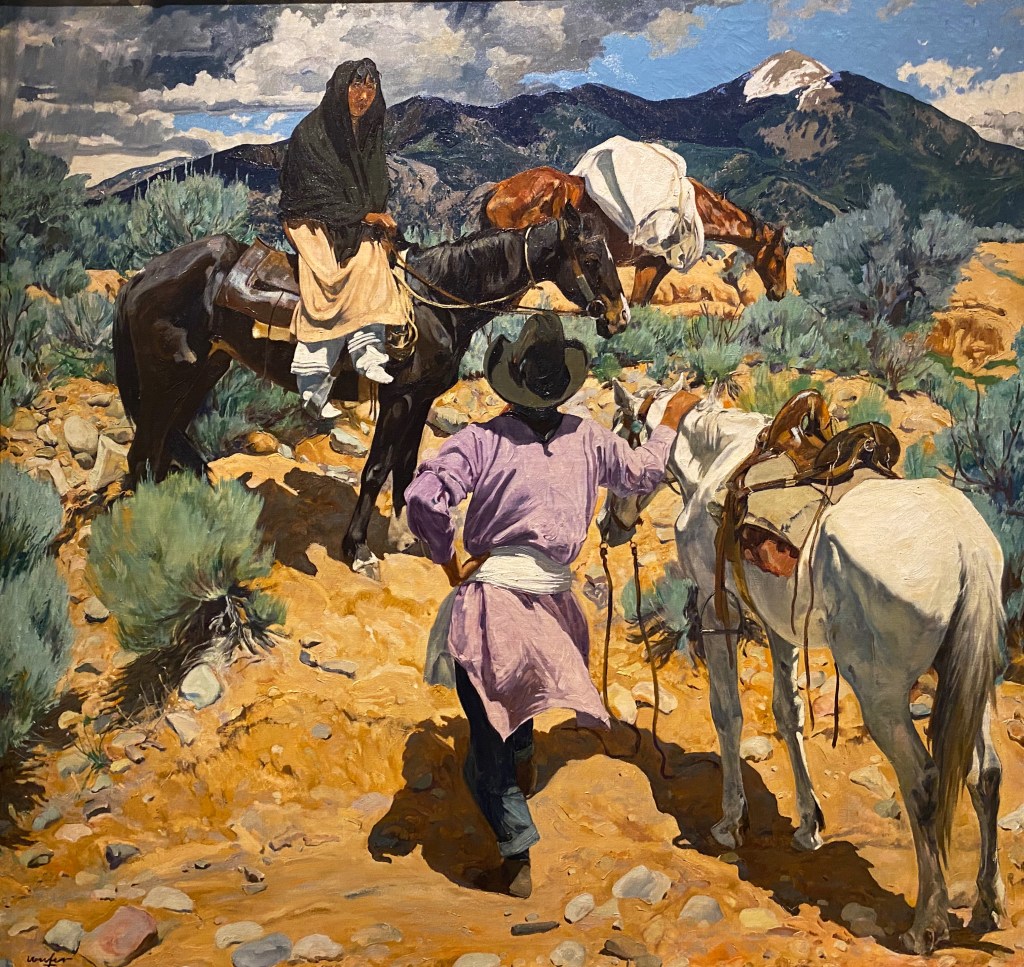
Walter Ufer (1876-1936) was born in Germany in 1876, although he spent most of his youth in Louisville, Kentucky where there was a sizable German immigrant population. Unlike Remington and Russell, Ufer was a trained painter, having returned to Germany to study at the Royal Academy in Dresden. He returned to the United States and began work as a Commercial Artist before returning again to Germany to study in Munich.
In 1914, the mayor of Chicago, Carter Harrison and his business partner, Oscar Meyer (yes, that Oscar Meyer), both admirers of Ufer’s work, helped finance a visit to Taos to provide Ufer with new environment to continue his development as an artist (and, of course, sell his paintings back in chicago).
JIM AND HIS DAUGHTER, c. 1925 — Walter Ufer
The brilliant light, landscapes and Native American culture of New Mexico captivated Ufer.Ufer very quickly abandoned working in the studio and began working outdoors in order to capture the brilliant light of the southwest and the daily activites of Native Americans and Hispanos.
AT REST, 1926 — Walter Ufer
Ufer’s depictions of the Taos Pueblo Indianswere rarely romanticized. He was a committed socialist and soon came to believe that the Euro-American settlers were largely responsible for the destruction of Native American culture and identitythat had occurred in America.
“The Indian has lost his race pride, he wants only to be an American. Our civilization has terrific power. We don’t feel it, but that man out there in the mountains feels it, and he cannot cope with such pressure.”—- Walter Ufer
SLEEP, 1923 — Walter Ufer
Ufer realized both critical and commercial success from his depictions of Native Americans and the southwestern landscape. The stock market crash of 1929 and the ensuing Great Depression were diasterous for Ufer. The public fascination with art depicting Indians and the West diminished significantly as the financial crisis deepened and endured.
Sadly, as the sale of his work evaporated and his financial burdens mounted he turned to alcohol. He died in 1936 at the age of 60 as the result of a ruptured appendix.
Frederic Remington, Charles Russell, Walter Ufer
At one time, the images of the West that were shared via the work of these three artists and others were viewed as illustrative of how the white man won the West and conquered the savagetribes of Indians. The winning of the West was considered a noble and necessary precursor to American greatness – our Manifest Destiny.
None other than Theodore Roosevelt said it is “our manifest destiny to swallow up the land of all adjoining nations who were too weak to withstand us.” Many of the Western artists were, as such, unwitting propagandists for the conquering of the West through their depiction of Native Americans as savages who murdered innocent white settlers. Today it is commonly acknowledged that Native Americans were in fact fighting to remain on their sacred lands and maintain their way of life.
This post is not about villifying the featured artists – they painted the West as they saw and experienced it. Both Russell and Ufer were sympathetic to the plight of the Native American and Hispano peoples.Neither is the post meant to be critical of the museum – the NCWHM is a wonderful museum and we highly recommend a visit when your travels take you to Oklahoma City.
This is the final post from OTR 7.0. We will back on the road in early March. Be seeing you!
h. d. bugbee, mountain men, (old bill williams and jim bridger), oil on canvasboard
A brief history of the PPHM
PPHM is located in Canyon, Texas, approximately 20 miles south of Amarillo. The museum opened to the public in 1933. It was the brainchild of Hattie Anderson, an educator who had moved to Canyon to teach history at the West Texas Normal School (now West Texas A&M University).
Hattie was fascinated by the history of the area and began to enlist the aid of individuals in the area to form a historical society to preserve the history and culture of the Panhandle-Plains. The historical society flourished for thirteen years; the growing collection of artifacts that created the need for more space. The historical society then funded the creation and operation of the museum.
Today the museum continues to prosper and is home to over three million artifacts within the 285,000 square foot complex. The museum provides insight into the past and the present of many facets of the people,culture, history and industry of the Panhandle-Plains. The collection includes galleries devoted to paleontology, archeology, geology, Native American culture, textiles, petroleum extraction and western art. we
We enjoyed the PPHM immensely and strongly recommend devoting at least a half day visit when you visit the Amarillo – Lubbock area of the Panhandle. In addition to the museum this area offers ample outdoor recreational opportunities (Palo Duro Canyon and Caprock Canyon – see post: CTSPRINTERLIFE: TOURING THE PANHANDLE). https://wordpress.com/post/ontheroadwithmariastephen.net/6946
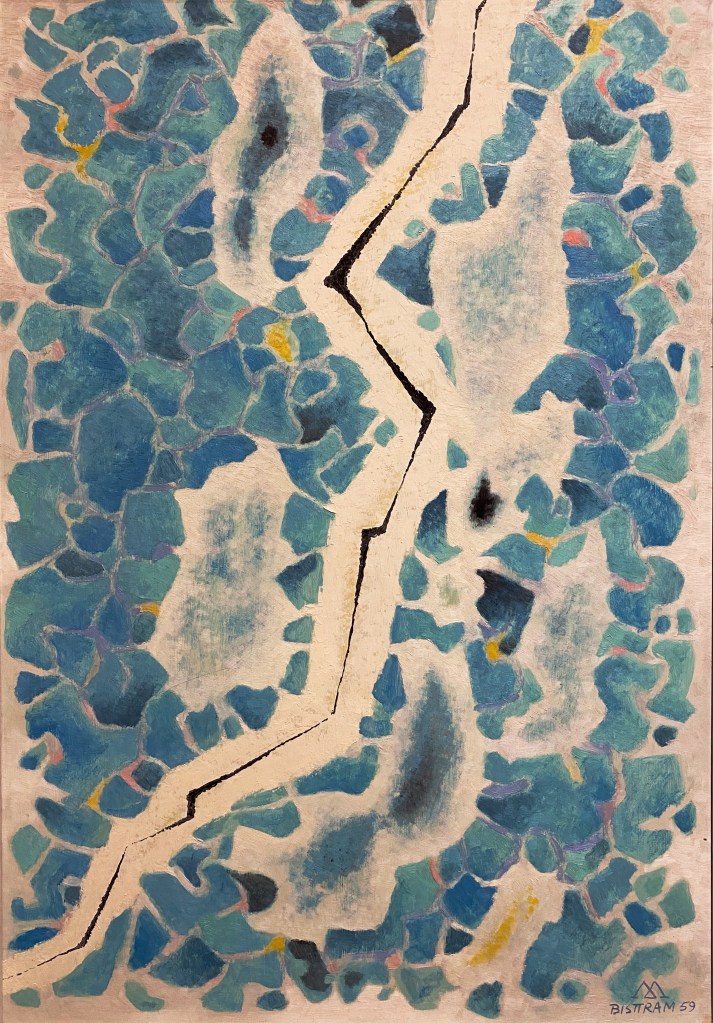
EmIL Bisttram
OTR had the great fortune to meet Deanna Lowe Craighead, Curator of Art at the PPHM, while visiting another museum in the panhandle. In addition to dialing us in about the Bisttram exhibition, Deanna also provided us with the recommendation to visit the Philbrook Museum in Tulsa ( see post FINE ART TOURIST PHILBROOK MUSEUM OF ART). https://wordpress.com/post/ontheroadwithmariastephen.net/7362 The balance of this post is dedicated to the Bisttram exhibit and a bit of his biography.
Emil Bisttram was born in Nagylak, Hungary (now Nadlac, Romania) in 1895. His family emigrated to New York City in 1906. Bisttram studied art at National Academy of Design, Cooper Union, the Art Students League, and the New York School of Fine and Applied Art. He also taught art while studying and was known through out his career as an excellent and sought after teacher.
emil bisttram, storm over taos, c. 1931, oil on canvas
Bisttram visited Taos, New Mexico in 1930. Initially he was overwhelmed by the size and scale of the New Mexico landscape and he struggled to capture the majesty of the environment. Despite that he returned to Taos in 1932 and it remained his home until his death in 1976.
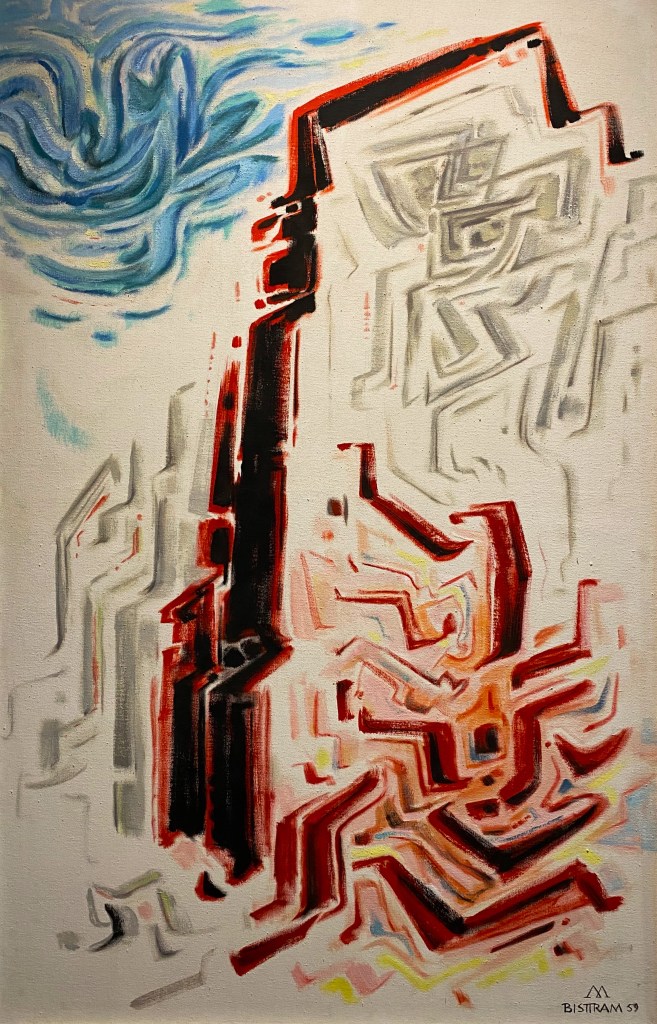
Bisttram evolved from painting New Mexico landscapes and native culture to a decidely abstractionist style. The painting above (Storm Over Taos, 1931) is representative of his early work in New Mexico. The photographs of his paintings below are from the PPHM exhibit (private collection on loan – Ladd Family) and show his progression into abstraction.
emil bisttram, waterfall, 1959, acrylic on canvas
emil bisttram, winter, 1959, enamel on masoniteemil bisttram, celestial structures, 1959, enamel on masoniteemil bisttram, ascension no. 2, 1959, enamel on masoniteemil bisttram, midsummer night’s dream, 1960, enamel on masonite
festivity, 1960, enamel on masonite
Transcendental painting group (TPG)
Bisttram, along with Raymond Jonson, formed the TPG. The TPG was part of the Non-Objective Abstractionist wave of Modernism – which in part emanated from the influx of artists fleeing the increased political disruption ocurring during the 1930s in Europe.
emil bisttram, left: cosmic stream, 1959 – right: composition #77, 1960emil bisttram, the fiery world, 1963,emil bisttram, symphony in blue, 1963, oil on masonite
“The Transcendental Painting Group is composed of artists who are concerned with the development and presentation of various types of non-representational painting; painting that finds its source in the creative imagination and does not depend upon the objective approach.” —- TPG Manifesto
emil bisttram, windsong, 1964, oil on masonite
While we do not enjoy the work of some popular avant garde abstract artists, in our very humble opinion we think the paintings of the TPG artists and in particular Bisttram are in a different category. The work is clearly non-objective in may regards but relatable and created with a clear design in mind. We would love to know what you think.
Be seeing you!
P.S. Added bonus of visiting the PPHM – the excellent Palace Coffee is a five minute walk from the museum.
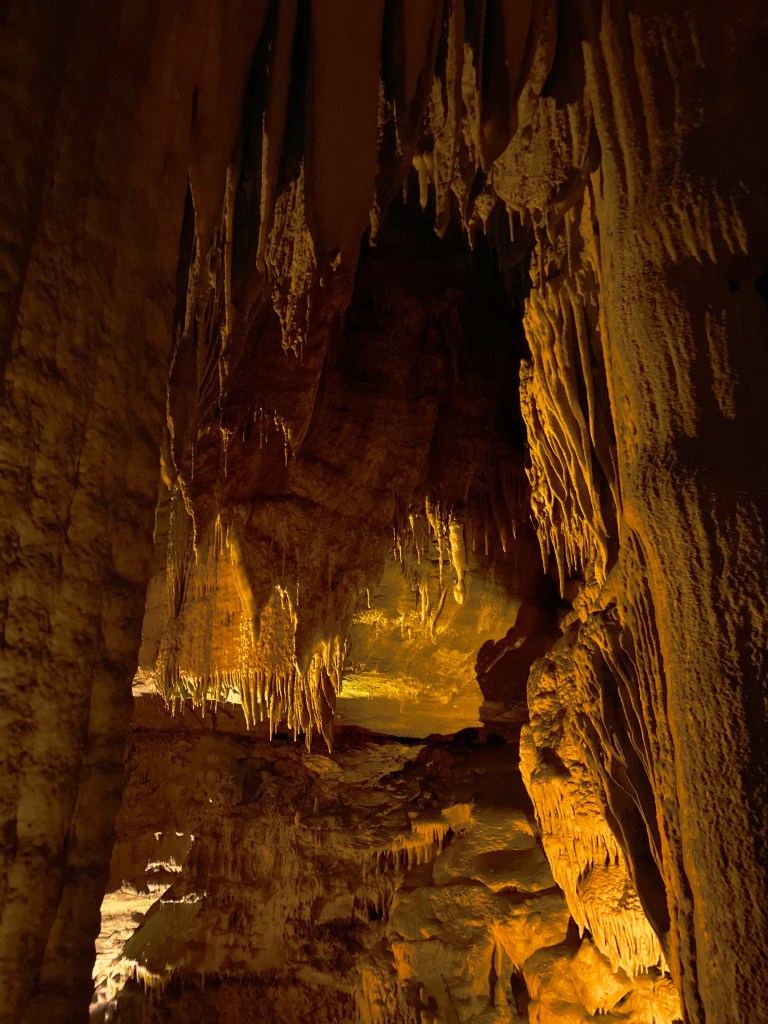
Mammoth Cave, located in southwestern Kentucky, was officially designated as a national park in 1941. The park is approximately 53,000 acres (small by national park standards); its main focus is the cave system which lies under the surface.
Mam Cave, as it is called locally, is the longest cave known to exist in the world at just under 400 miles. The 400 miles of cavern are not linear, but exist on six levels which crisscross and extend out in multiple directions, fitting inside a seven square mile area under the park.
We took a ranger led tour during our visit, venturing down 250 feet below the surface and then through a series of rooms as we gradually climbed back towards the surface to exit the mine.
The park offers a wide range of tours differing in time and the level of physical activity required to complete the tour. We took the Domes and Drips Tour where you are brought through some of the largest domes in the cave system and also to a wetter area where stalactites and stalagmites are still forming.
The lower two levels of the cave are underground rivers – with water draining down from the Green River and the numerous sinkholes in and around the park. In the past visitors could tour the lower cavern by boat but the practice was stopped to protect the environment.
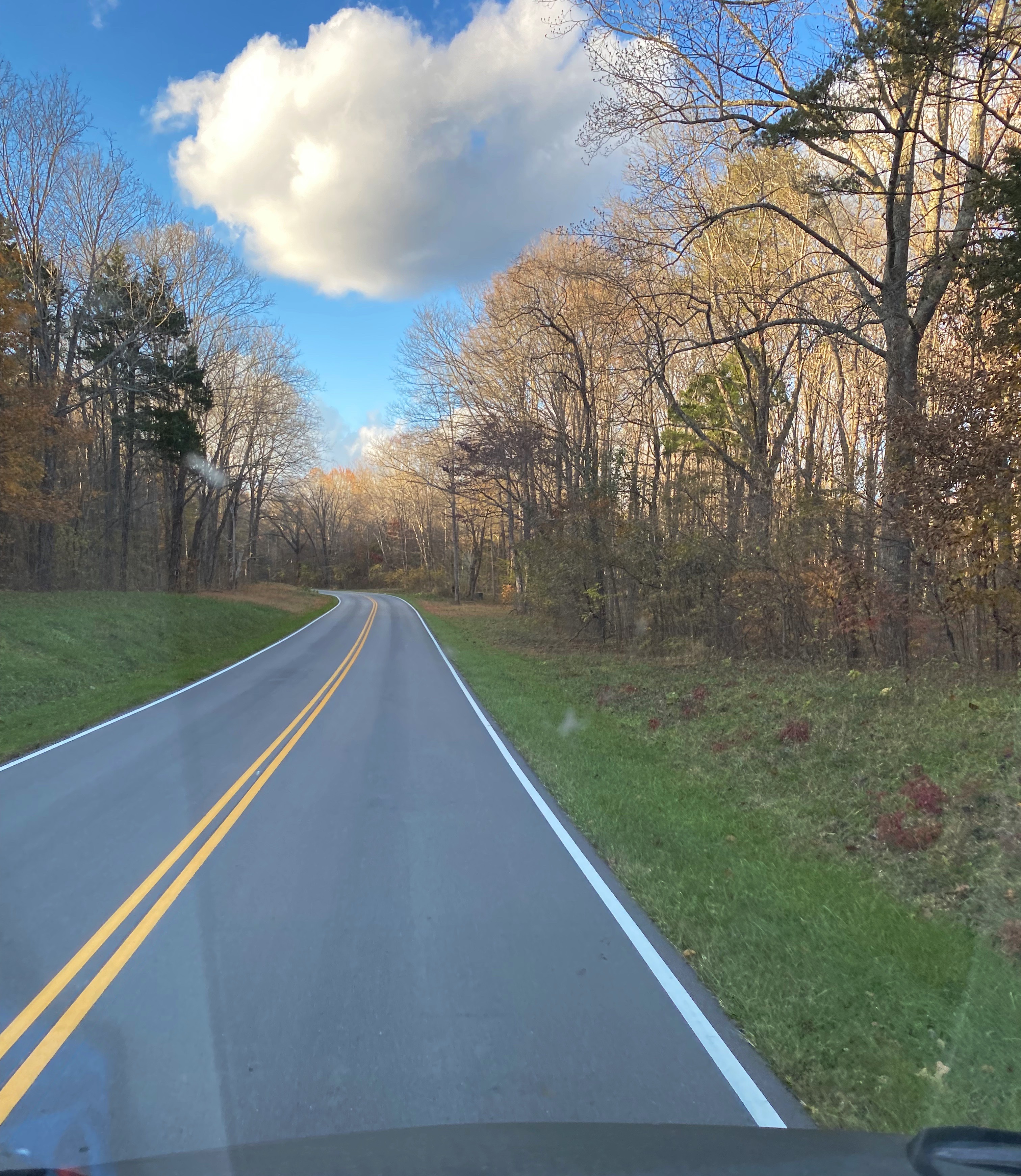
Auto tour
Green River Ferry
A brief History of mam cave
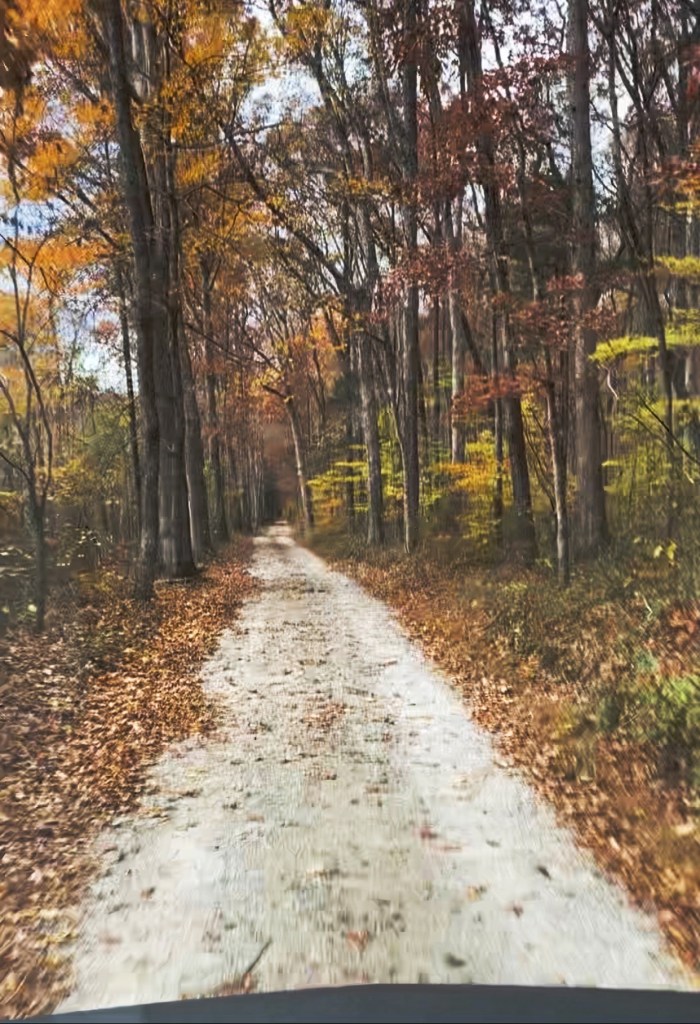
As we mentioned above, Mam Cave became a national park in 1941. What we did not realize until we visited the park and spent time touring the scenic backways of the park was how the park came into being.
Road to Good Spring
The caves were originally mined for saltpeter which was used in the making of ammunition.The caves in the area were privately held and operated by the owners as tourist attractions from the early 1800s until the park became a national park.
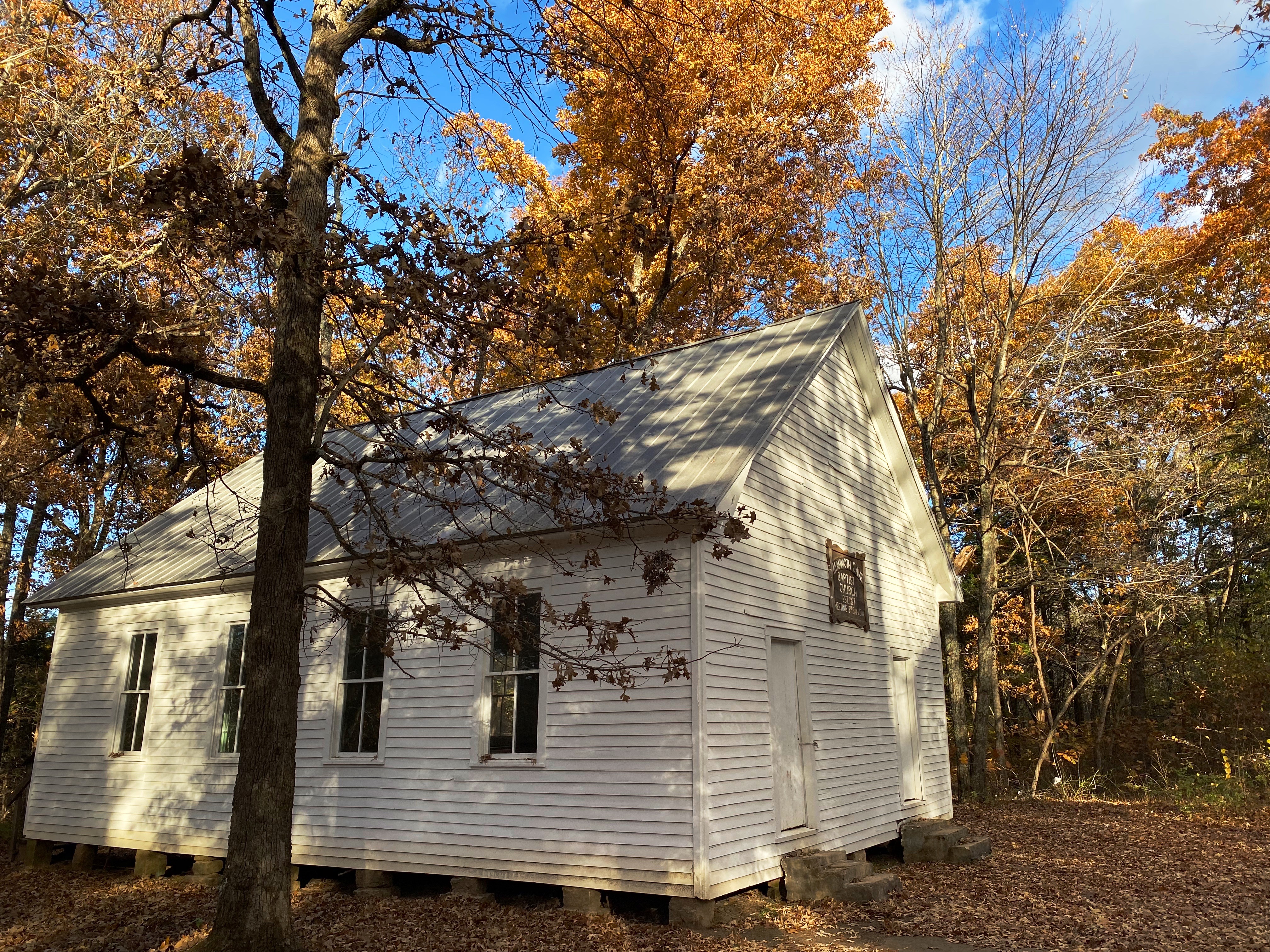
Good Spring Baptist Church
There were many people in government, science and business who, for various reasons, wanted to see Mam Cave designated as a national park and thus be protected. The federal government would not buy land for the creation of a national park but would accept donated land for that purpose. As a result, a private organization was formed for the purpose of buying the privately owned land and donating the land to the federal government.
Over a period of several years the required amount of land was purchased (in some cases through eminent domain). There was also a land donation of 8,000 acres made by a single family.
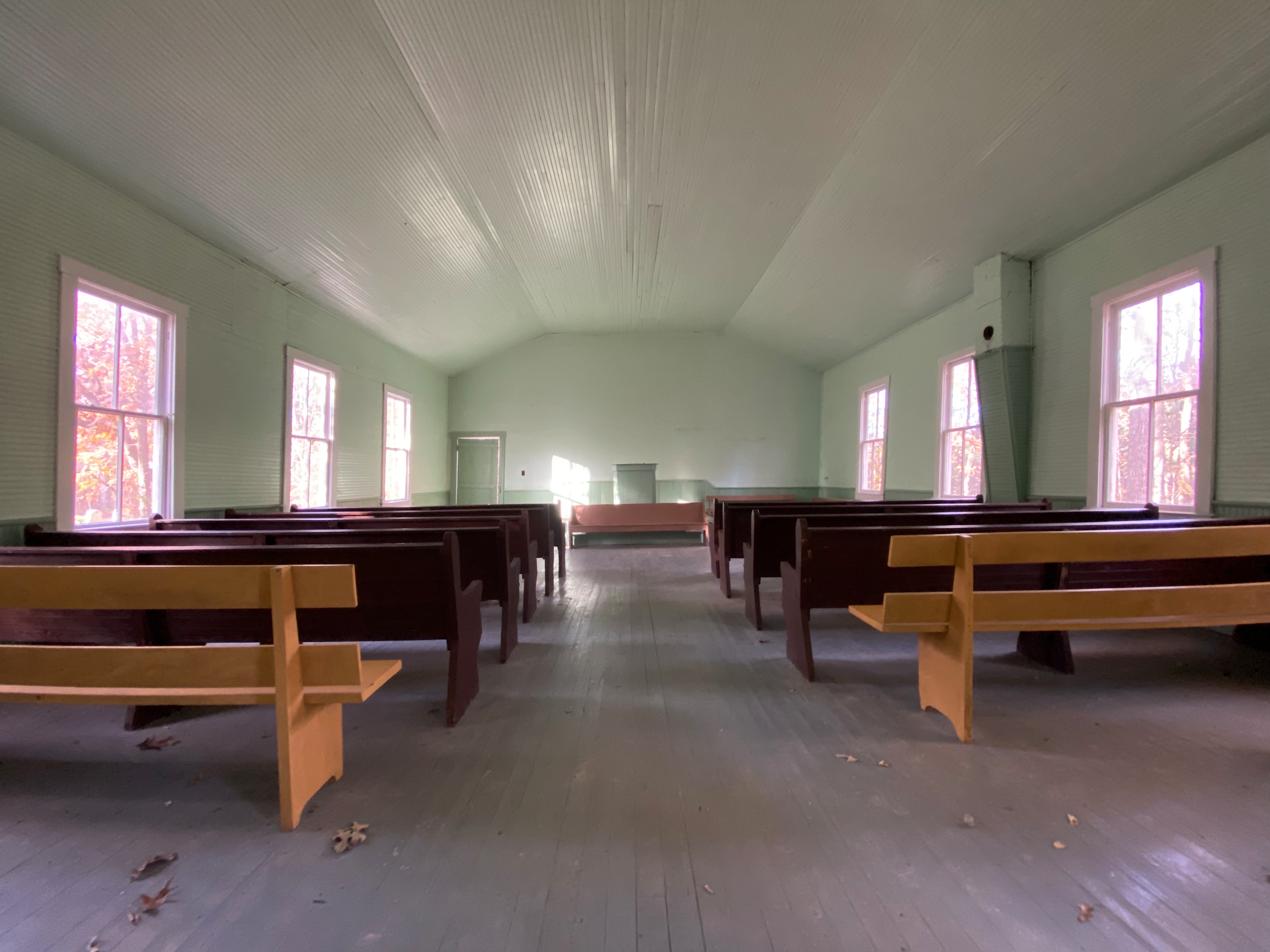
The photographs above and below show the only remaining structures from three of the communities (Good Springs, Flint Ridge, Joppa Ridge) that ceased to exist as the residents moved to other towns outside of the park boundary. Some of the families and their descendants lived in theses communities for 200 years before they were displaced.
The park service has preserved these churches and the adjacent graveyards, providing a peak into life in early rural America. All other structures from these communities were razed when the National Park was established.
The families of the descendants are still able to use the churches for weddings, funerals and other special occasions. The cemetaries bear witness to this use as we observed newer monuments in each of the graveyards.
Conclusion
We enjoyed our two days at Mam Cave. The cave tour was well organized and interesting. We would have to say that from a persective of the cave only that Carlsbad (New Mexico) and Wind Cave (South Dakota) are more dramatic from a visual perspective.
Having said that, Mam Cave offers a number of hiking and mountain biking trails as well as a paved bike path. Additionally, the Green River which flows through the park provides the opportunity for kayaking and canoeing.
If you are a national park fan and have not yet visited, we recommend that you include Mam Cave in an upcoming park itinerary.
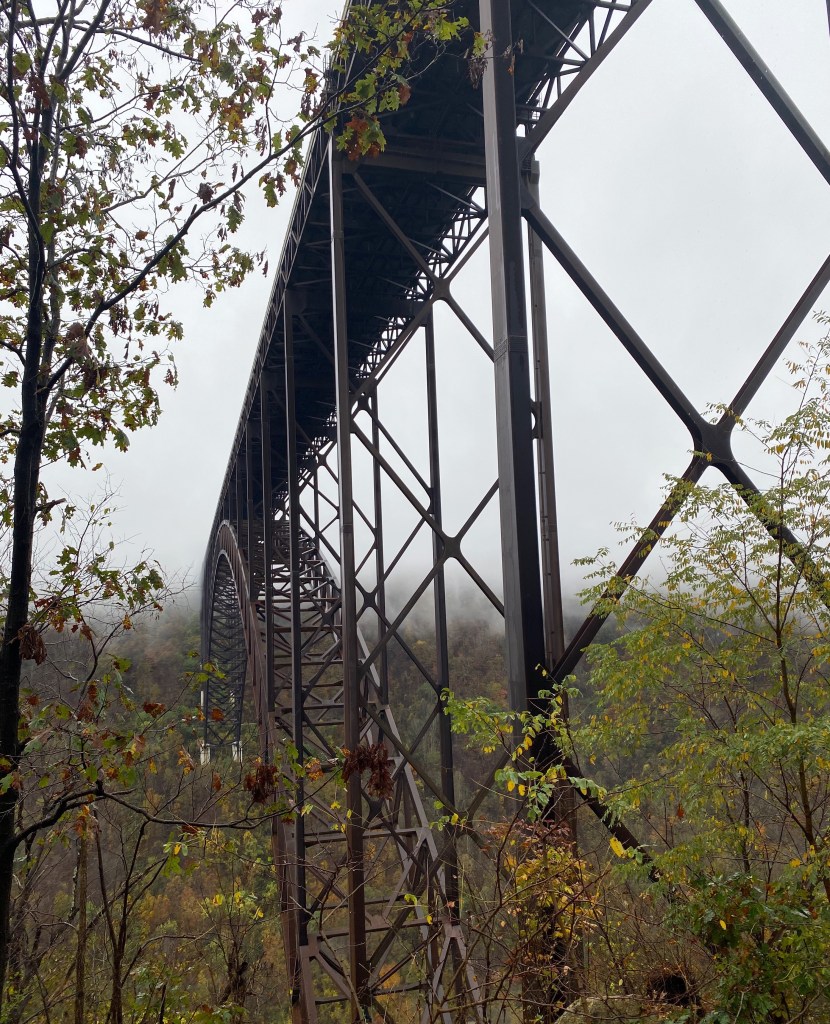
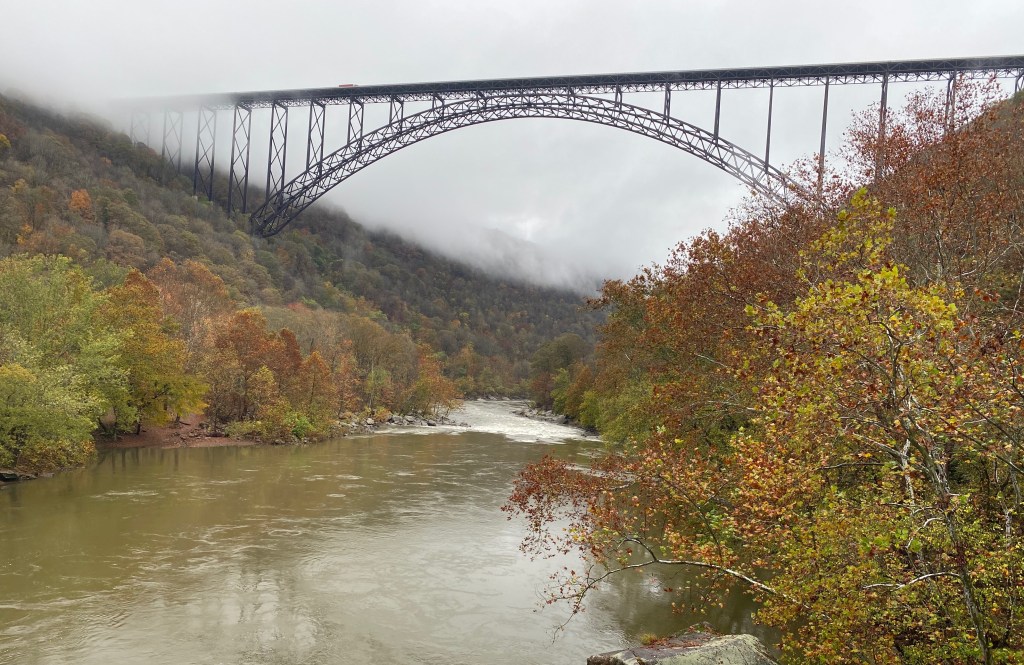
New River Gorge Bridge photographed from Long Point TrailNew River Gorge Bridge photographed from Fayetteville Station RoadNew River Gorge Bridge photographed from Fayetteville Station Bridge
The New River Bridge is quite a sight to see and truely an engineering marvel. It is the fourth longest single arch bridge in the United States and sits at a jaw dropping 876 feet above the floor of the gorge.
But for our money, the real attractions of the NRGNR are the history and artifacts of a way of life that existed down in the gorge for more than eighty years. The gorge was scarcely inhabited until surveyors discovered coal, and not just any coal. The coal in the gorge was high quality “smoke less” coal – highly prized for its high carbon content with minimal waste.
Fayetteville Station Bridge, NRGNR
Within the gorge the remains of the Nuttallburg Mine provide insight into the workings of a coal mine and the life of the miners and their families. It is considered one of the best preserved mining complexes in West Virginia.
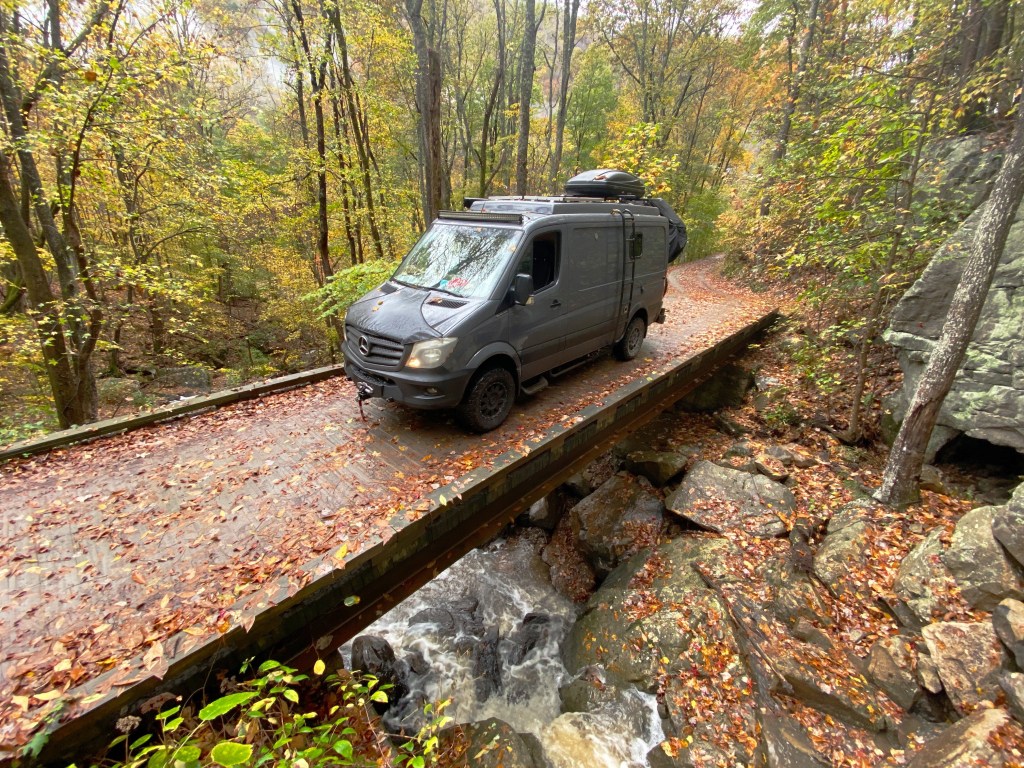
Visiting the site is a commitment in and of itself. The mining complex sits deep in the gorge at river level and requires driving down a windy, narrow and sometimes steep one lane road.
Keeney’s Creek Road (CR 85/2)
Drive to Nuttallburg Mine Site
The Nuttallburg Mine began operations in 1873 after the completion of the Chesapeake & Ohio railine through the gorge was completed. The rail line enabled the shipping of large quantities of coal as the river was not navigable and getting coal up out of the gorge by road was not feasible.
Because mining in the early days was very labor intensive and the local population was small, the mine operators needed to import workers. Workers came from all over Europe and Canada to work at the mine in a variety of capacities. As a result, the mining workforce and their families were a very diverse population.
The mine also employed African American workers who worked side by side with the other employees. However, outside of work the black employees and their families lived in a segregated town on the opposite end of the mining complex with their own church and school.
The mining town here appears to be typical of mining towns in this era as it was self-contained with its own schools, doctors, blacksmiths, social clubs, athletic teams and company store.
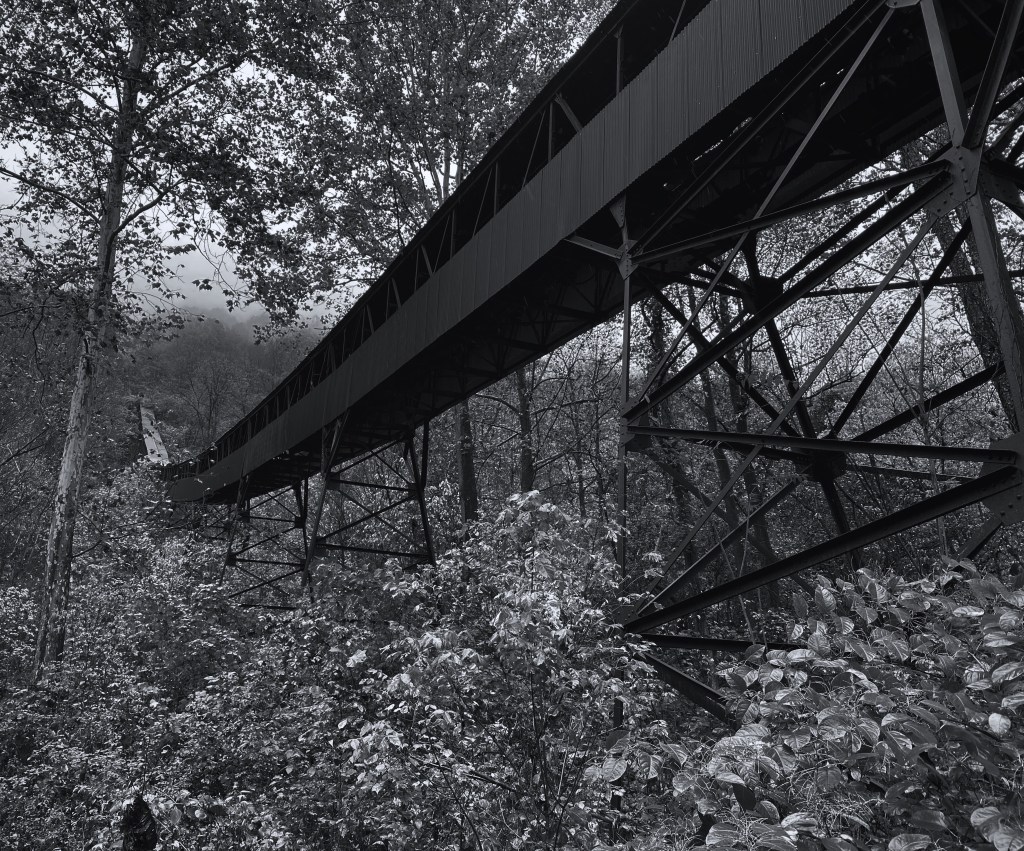
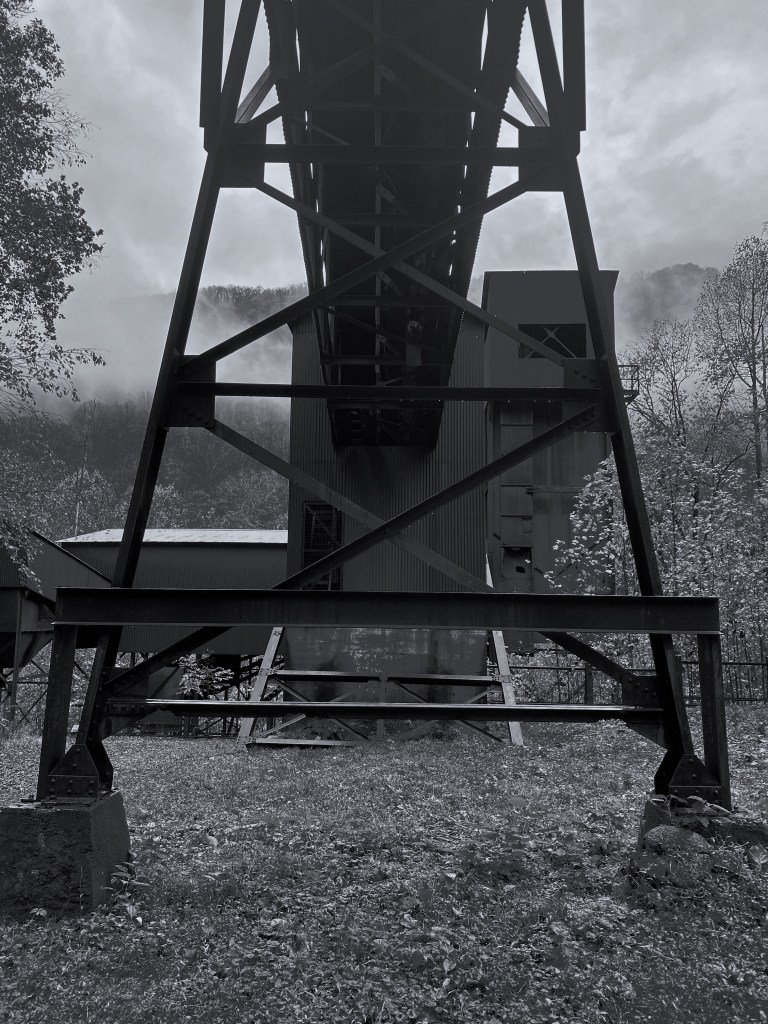
Coal Conveyor, Nuttallburg Mine, NRGNR
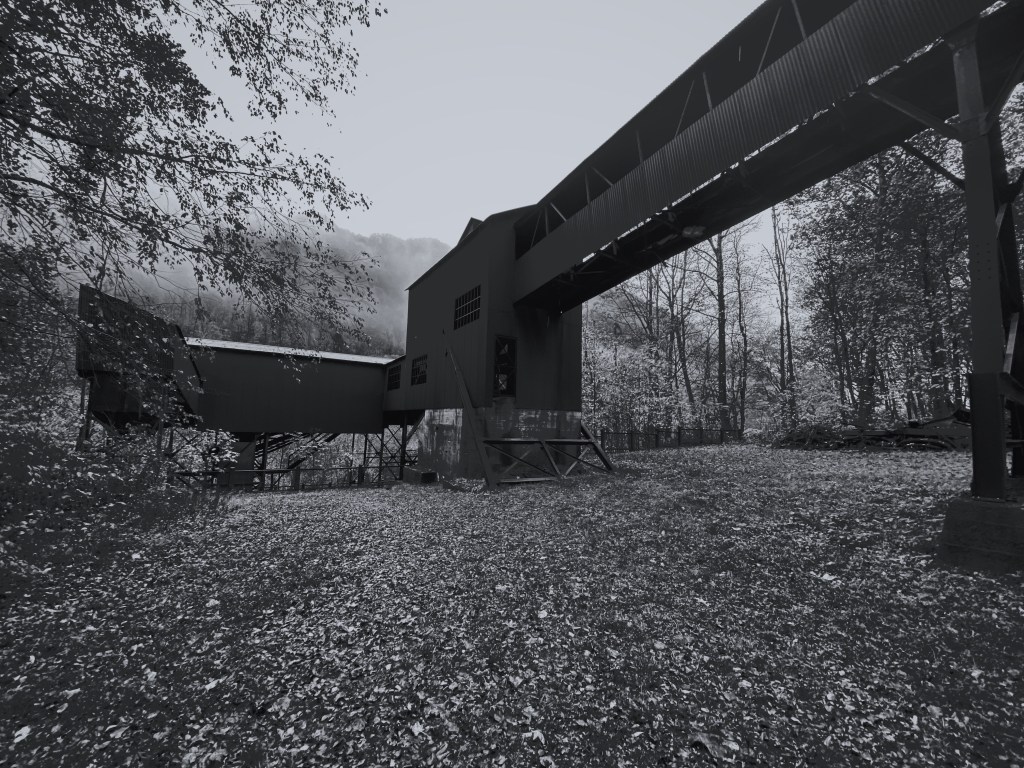
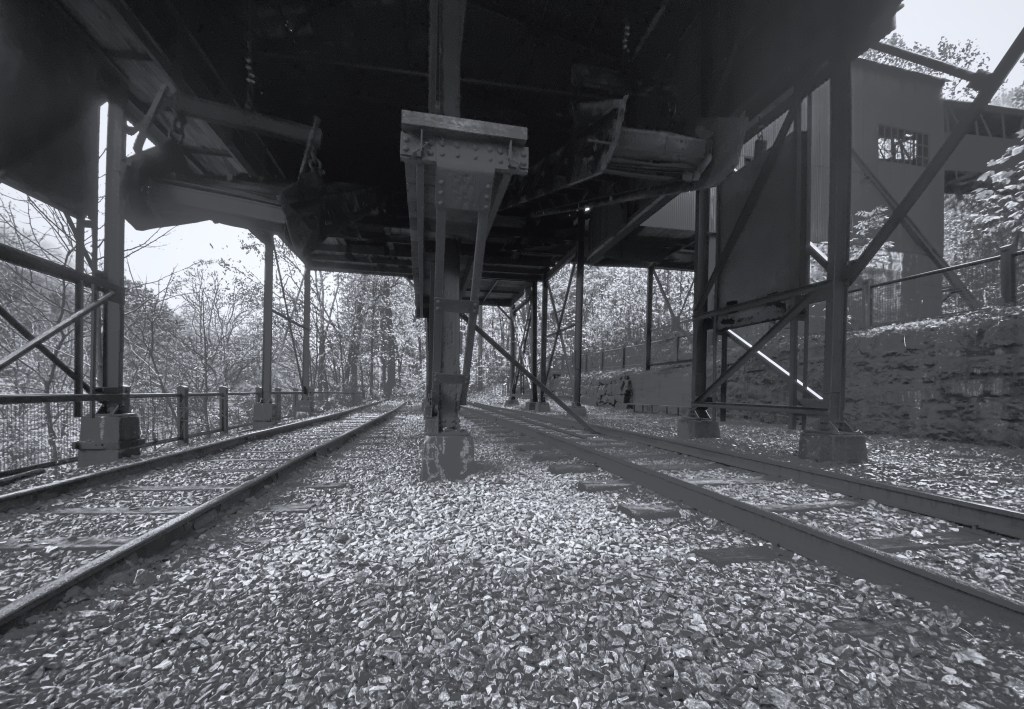
The coal conveyor pictured above is 1385 feet in length and brought coal down from the mine 600 feet above the gorge floor. This conveyor was built in 1926 and could move 125 tons of coal per hour.
Coal Tipple, Nuttallburg Mine, NRGNR
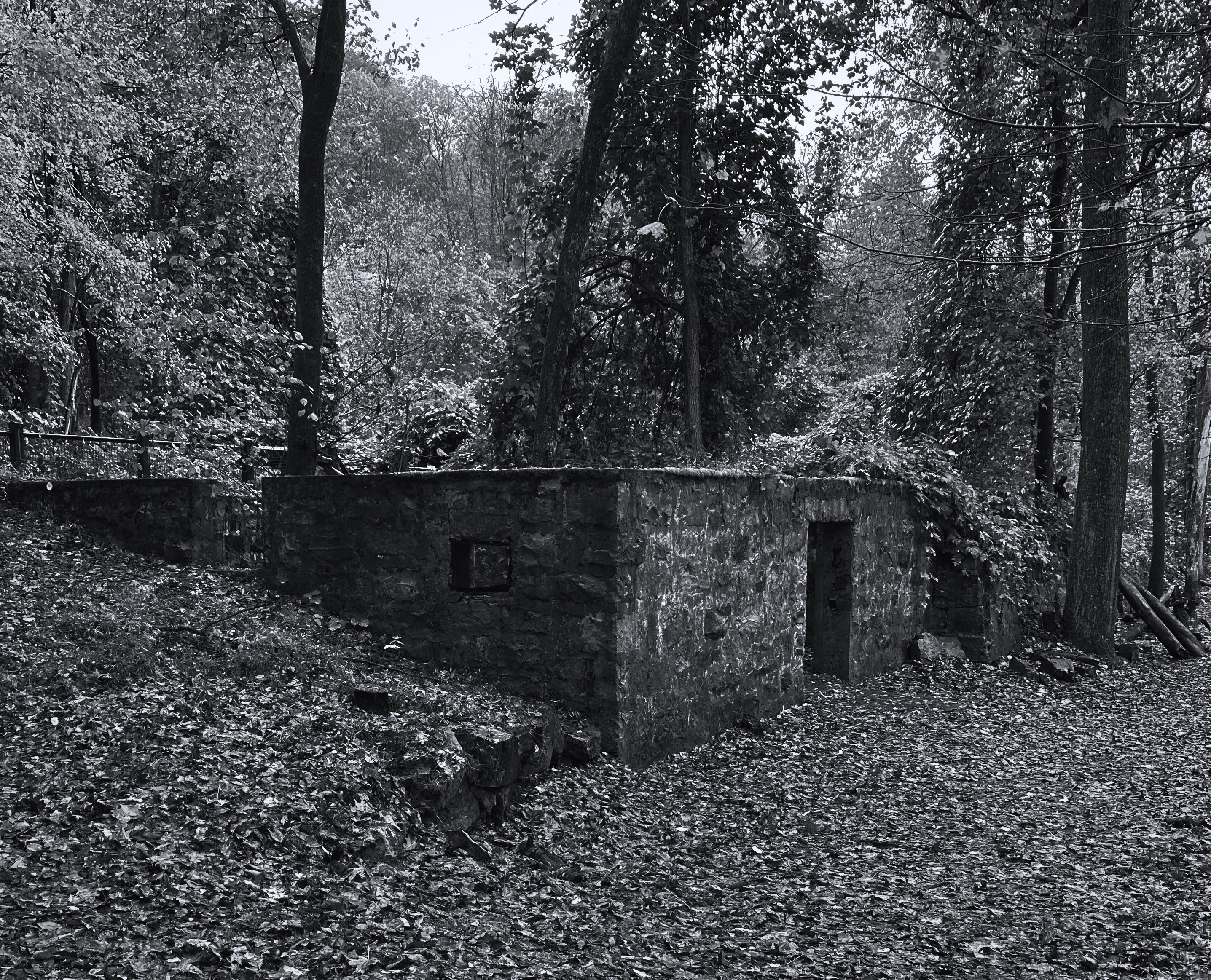
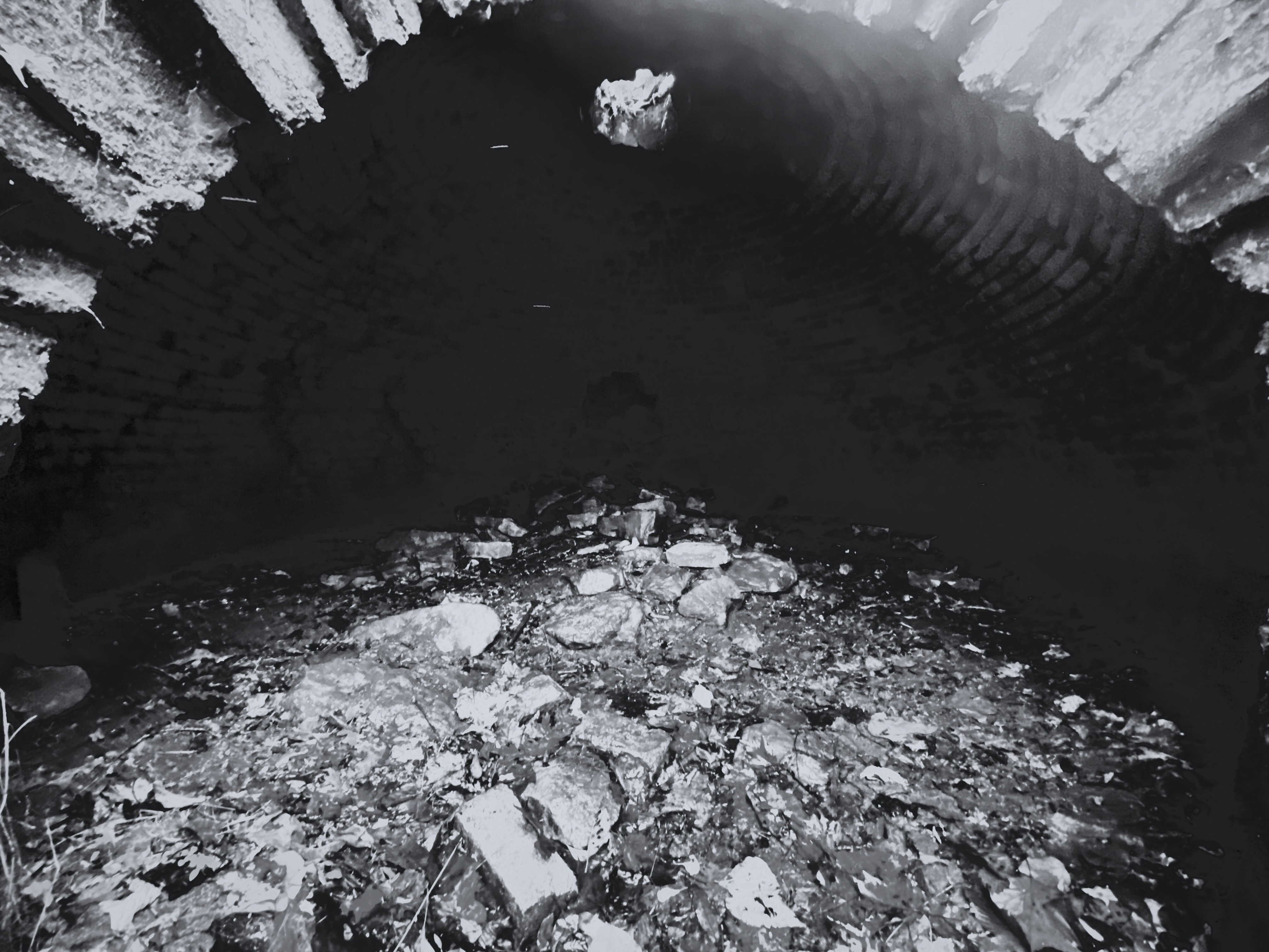
Company Store and Coke Oven
The company store was a necessity because the employees had no means to travel from the mine complex. Therefore, the company paid the employees in a company issued scrip and most likely significantly overcharged their employees.
Henry Ford leased this mine and others during the early 1920s in order to control the coal supply that Ford needed for automobile production in the Dearborn, Michigan plant. Ford made substantial investments in the mine including the state of the art coal conveyor.
Ford ultimately sold his lease back to the Nuttall family when he found that he could not control the the railroad companies and often could not get his coal to Michigan when he needed it.
The mine continued operations under three different owners until the mid 1950s when it became abundantly clear that the mine was “played out”.
Today the National Park Service manages the mine complex and is doing a good job protecting the area and providing research and education relating to the history of the mine and the town of Nuttallburg.
Thurmond, West Virginia
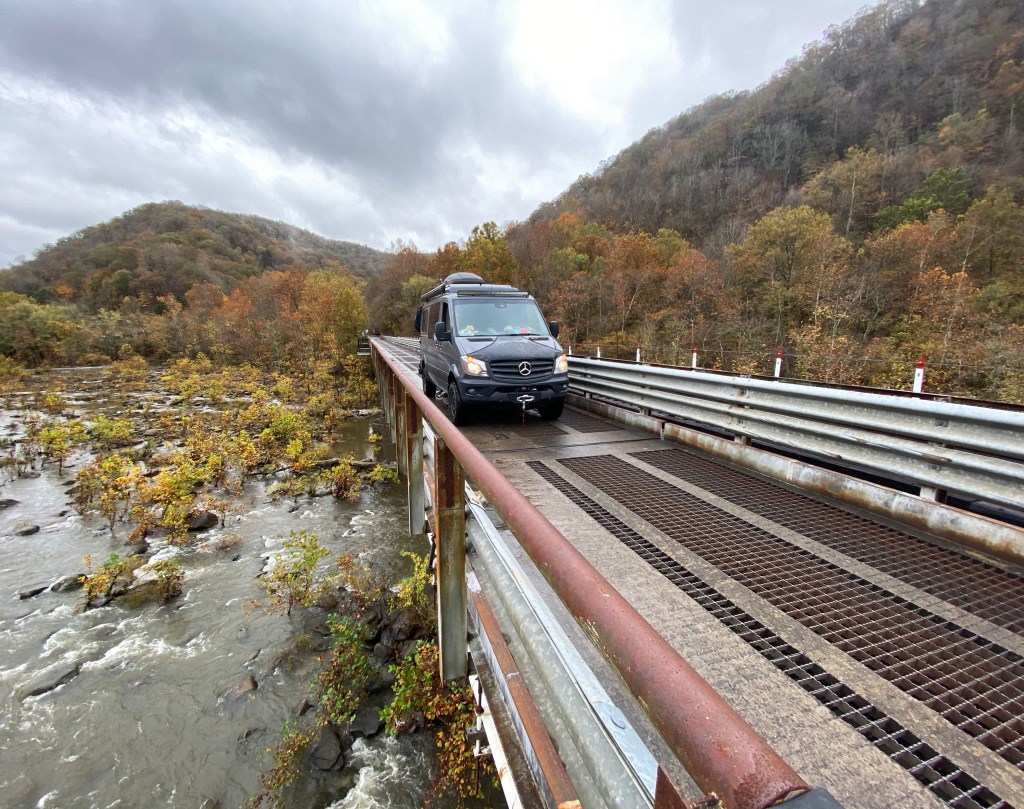
After our exploration of the remains at the Nuttallburg Mine site we ventured south and then east along the Dunloup Creek on County Road 25 to the town of Thurmond. The only way to get to Thurmond was by rail until 1921 when CR 25 was built. Crossing the New River today to Thurmond entails driving across a single lane bridge shared with the railroad.
Car and Train Bridge, Thurmond Road, Thurmond, West Virginia
At one time Thurmond was a rail center where short coal trains were assembled into longer trains that hauled coal out of the gorge. It was also the only place in the gorge where steam engines could load coal and water.
While the town “thrived” (population 462 in 1930) during the early portion of the 20th century the advent of the diesel locomotive rapidly diminished the need for the fueling and servicing of steam powered locomotives. From 1930 on the population diminished steadily although passenger trains continued to bring visitors who stayed at the two hotels that had been built during the prosperous days. Unfortunately, both of the hotels burned to the ground and those events put the finishing touches on the demise of the town.
While the town essentially vanished by the 1950s, the rail lines continue to be operated by the CSX Railway- still hauling coal out of the gorge from the many active mines that remain operational today (more on that topic in a future post about coal country).
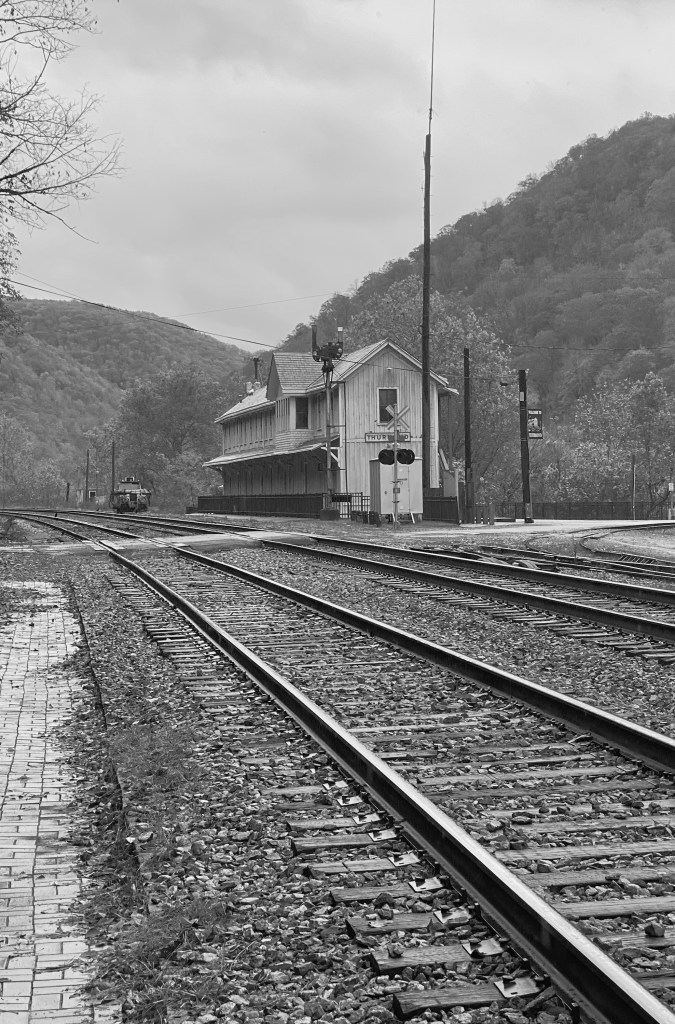
Today the population of Thurmond is four and most of the property in the town is owned and managed by the National Park Service. The former depot pictured below is now a visitor center during the summer months.
Thurmond, West Virginia,
Additionally, the Amtrak Cardinal train which runs three times a week from New York City to Chicago still stops at the Thurmond Depot. Not surprisingly, there is only one other stop in Amtrak’s entire system where fewer passengers board the train.
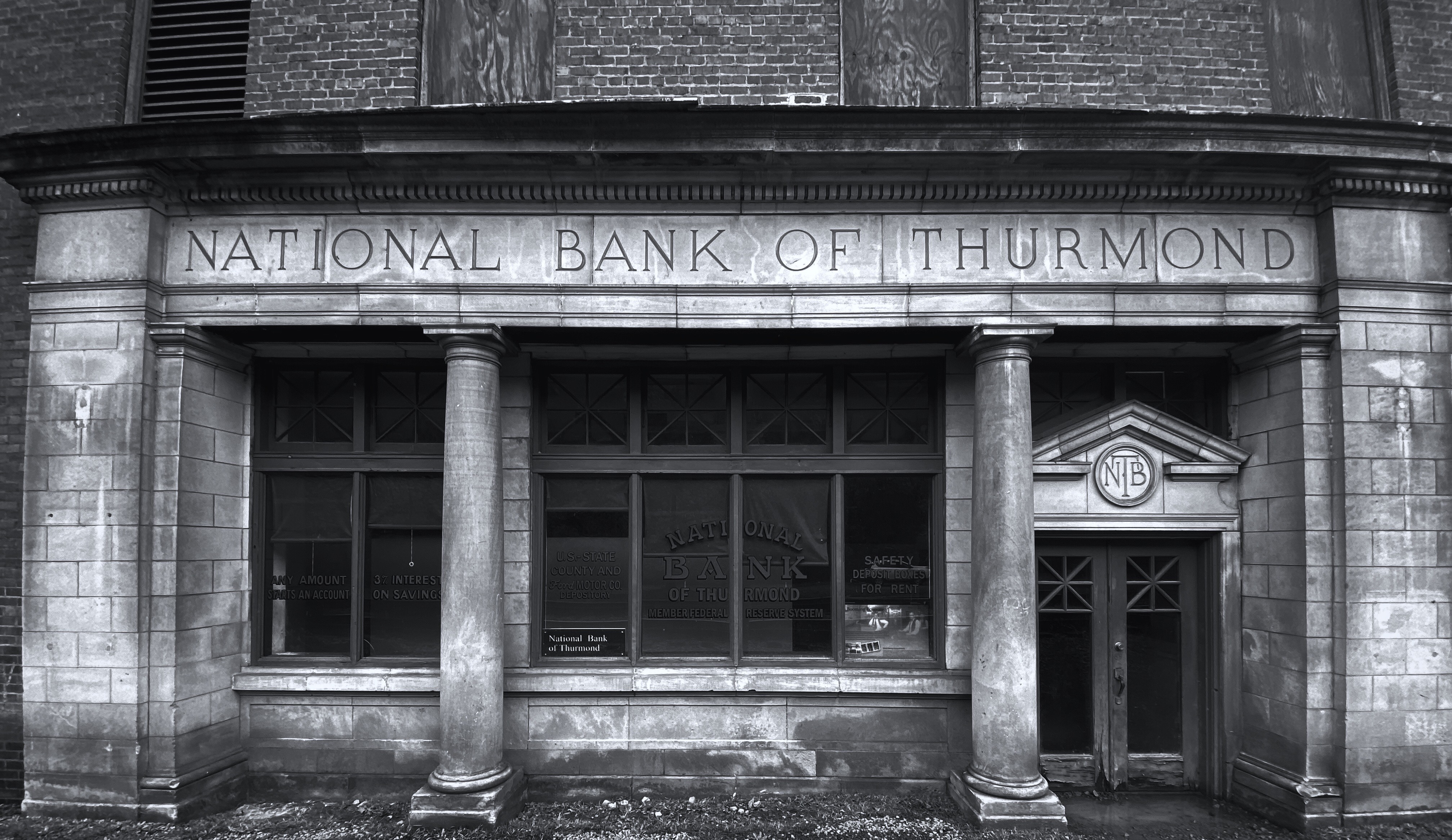
Main Street, Thurmond, West Virginia
An interesting feature of the town is that it never had a main street. All of the commercial buildings in town sat directly along the railroad tracks because there was no room for a street in addition to the rail line in the narrow river gorge.
The Coaling Station pictured below was built in 1922 and could hold more than 500 tons of coal for re-fueling steam locomotives.
Coaling Station, Thurmond, West VirginiaThurmond Depot, Thurmond, West Virginia
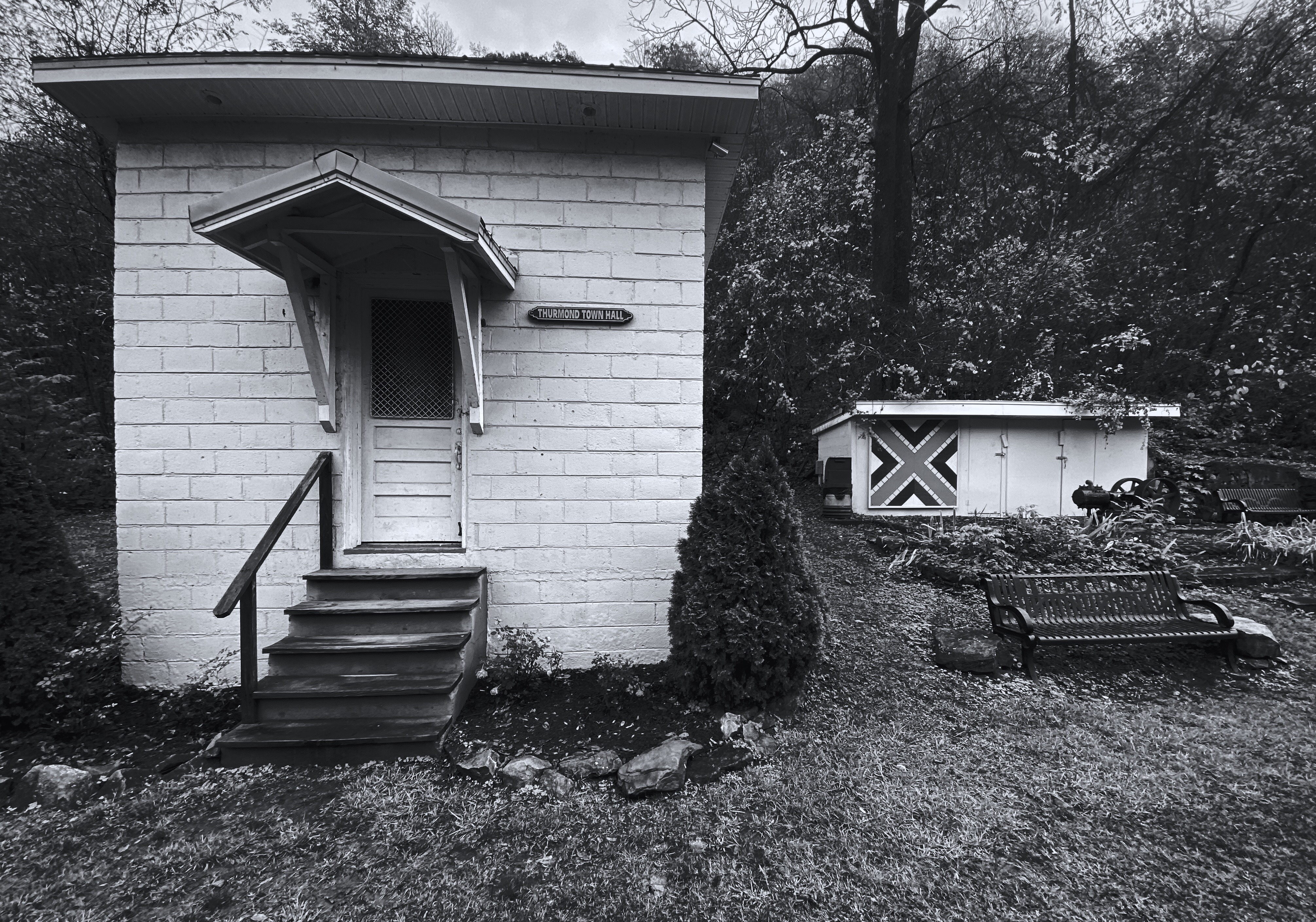
Thurmond, West Virginia, Town Hall Upper Right
We enjoyed exploring the New River Gorge National River and highly recommend this area for its beauty and history.
We will spend the next several days touring “coal country” in the southern part of the state before turning east and heading for Lewisburg, West Virginia for several days of bicycling the Greenbrier River Rail Trail.









































































 ON THE ROAD with Maria + Stephen